

Photochemistry versus Escape in the Trappist-1 planets.
Copernicus Publications (2025)
Abstract:
Survive or not survive, that is the question of the 500-hour JWST Rocky Worlds DDT Program. Whether a terrestrial planets’ atmosphere can suffer under the intense XUV of its host, or if it completely escapes, these are the questions we explore. Zahnle & Catling (2017) defined the Cosmic Shoreline, but recent observations from JWST reveal airless worlds around M-stars, calling for a refinement of this “receding” shoreline (Pass et al. 2025). M-stars spend a longer time in pre-main sequence, subjecting their orbiting worlds to some higher intensity XUV activity. This complicates our present understanding of this shoreline. Investigating chemical effects of planet-star interactions could be the key to a more complete picture of this shoreline. We investigate the interplay between photochemistry, mixing, and escape of carbon dioxide atmospheres under intense and mild XUV fluxes as follow on work to both Johnstone et al. (2018) and Nakayama et al. (2022). We expand on this work by adopting thermal structure models from Nakayama et al. (2022) and apply them to identify key chemical pathways for escape. We create a reduced C-O chemical network including neutral and ionic species to identify these pathways. As photochemistry simulations take into account many reactions, these 1D calculations are too computationally expensive to be done in 3D. Although rudimentary at best, the mixing parameter– eddy diffusion term, K_zz, comprises the dynamical element of 1D photochemical simulations. Here, we consider the mixing of photochemical products in competition with escape to explore the chemical pathways of retention and loss. We compare the photochemical model results for active and inactive cases for the Trappist-1 system planets. Then, using the resulting composition-dependent heating and cooling rates for Trappist-1 planets, we assess their propensity for efficient atomic line cooling versus escape. We follow the work of Chatterjee & Pierrehumbert (2024) in this assessment. Finally, using our pathway analysis, we find an analytical formula for calculating an energy-limited escape boundary for these planets based on composition. It is important here to note the limitations of 1D work. First, there exists an exchange of rigor between modelling chemistry and dynamics. Insights from this work are ripe for implementation into 3D GCMs, especially in response to incorporating UV-driven processes for thermospheric modelling mentioned in Ding and Wordsworth (2019). Second, interaction with the interior is important in the early phase of planetary formation, i.e., the magma ocean phase. Due to exchange between atmosphere and magma early in the planet’s formation, incorporation with an interior-atmosphere model would better constrain higher pressure chemical abundances. Although this work focuses on the upper atmosphere, extrapolation to the surface environment is a key goal for understanding a planet. Considering planet-star interaction is imperative for the selection of targets for observation. However, it is also important when considering anomalous detections of atmospheres around planets predicted to not have an atmosphere. This could be a first step in determining an atmosphere as non-primary and/or distinguishing between an airless planet and one with high altitude haze.Revealing patchy clouds on WASP-43b and WASP-121b through coupled microphysical and hydrodynamical models
Copernicus Publications (2025)
Abstract:
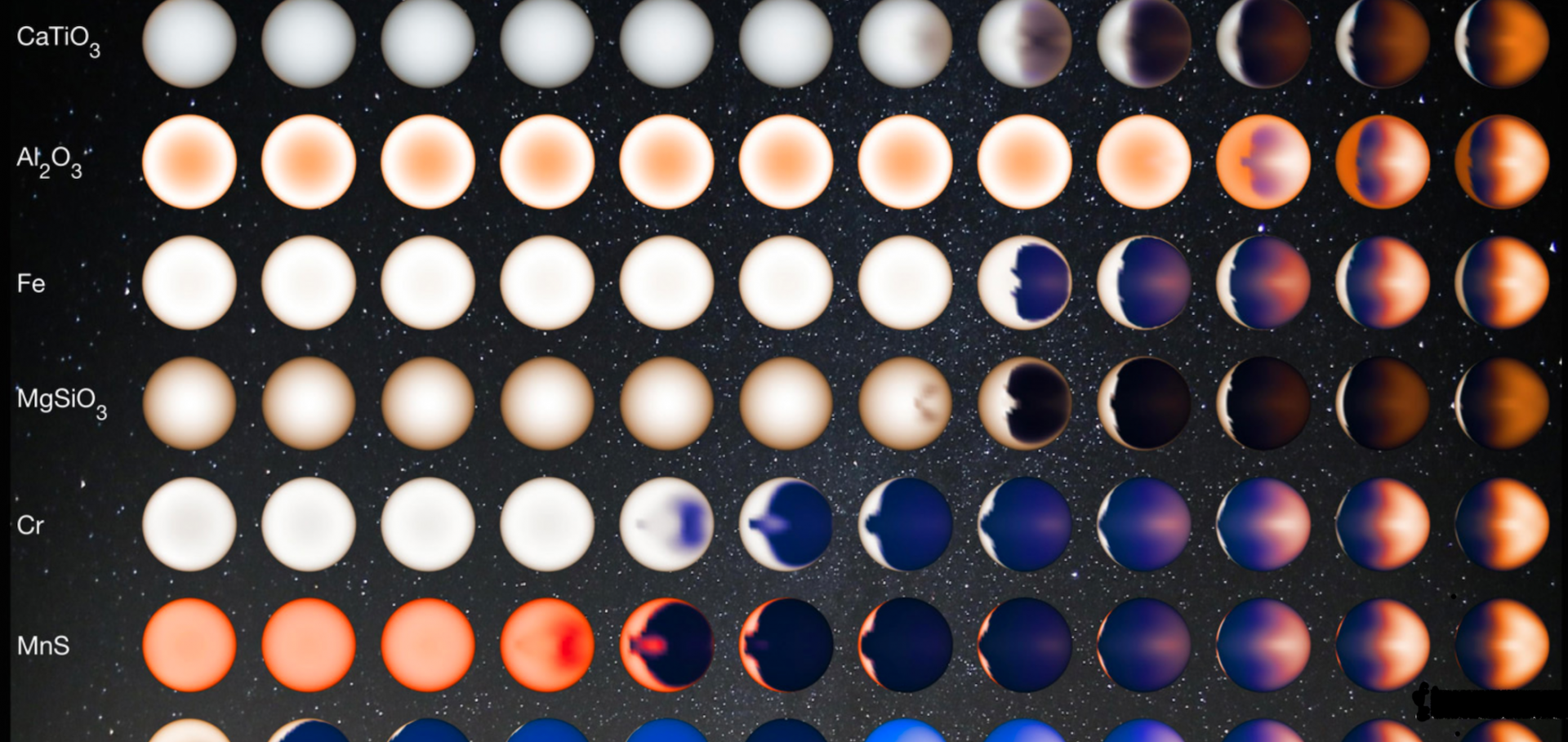
Hot and ultra-hot Jupiters are currently the best observational targets to study the effects of clouds on exoplanet atmospheres. Observations have reported westward optical phase curve offsets, weak spectral features, and nightside temperatures remaining constant with increasing stellar flux, which may together be explained by the presence of exoplanetary clouds. Although there are many models that simulate the 3D structure and circulation of hot/ultra-hot Jupiters and many microphysical models describing the formation of clouds, very few models exist that couple these two approaches. This gap, along with recent JWST observations unmatched by models, suggests a need for more accurate models to track the formation of clouds as well as their radiative feedback on atmospheric circulation and dynamics. In this work, we couple two models to better understand how atmospheric dynamics and cloud microphysics in hot Jupiter atmospheres affect each other and the observable properties of such planets in the context of JWST data. We run cloudless 3D general circulation model (GCM) simulations using the SPARC/MITgcm for WASP-43b and WASP-121b, two hot/ultra-hot Jupiters that already have high-quality data from HST and recent JWST observations. We then feed the temperature-pressure profile outputs from the GCM simulations into 1D CARMA, which models the microphysics of mineral clouds in hot and ultra-hot Jupiter atmospheres. Finally, we use our coupled circulation and cloud formation results to calculate synthetic spectra with a ray-striking radiative transfer code and compare our results to emission and transmission observations of WASP-43b and WASP-121b. We find that various cloud species, including corundum, forsterite, and iron, form everywhere on WASP-43b and on the nightside and west limb of WASP-121b, perhaps explaining the most recent phase curve observations of these planets. We discuss implications for the interpretation of JWST/MIRI and JWST/NIRSpec observations of WASP-43b and WASP-121b respectively, with implications for the broader planetary population.Saturn’s Local and Seasonal Aerosol Variations Inferred from Cassini Combined UV, Visual, and Near-IR Observations
(2025)
Abstract:
Super-Earth lava planet from birth to observation: photochemistry, tidal heating, and volatile-rich formation
Copernicus Publications (2025)
Abstract:
Larger-than-Earth exoplanets are sculpted by strong stellar irradiation, but it is unknown whence they originate. Two propositions are that they formed with rocky interiors and hydrogen-rich envelopes (‘gas-dwarfs’), or with bulk compositions rich in water-ices (‘water-worlds’) . Multiple observations of super-Earth L 98-59 d have revealed its low bulk-density, consistent with substantial volatile content alongside a rocky/metallic interior, and recent JWST spectroscopy evidences a high mean molecular weight atmosphere. Its density and composition make it a waymarker for disentangling the processes which separate super-Earths and sub-Neptunes across geological timescales. We simulate the possible pathways for L 98-59 d from birth up to the present day using a comprehensive evolutionary modelling framework. Emerging from our calculations is a novel self-limiting mechanism between radiative cooling, tidal heating, and mantle rheology, which we term the 'radiation-tide-rheology feedback'. Coupled numerical modelling yields self-limiting tidal heating estimates that are up to two orders of magnitude lower than previous calculations, and yet are still large enough to enable the extension of primordial magma oceans to Gyr timescales. Our analysis indicates that the planet formed with a large amount (>1.8 mass%) of sulfur and hydrogen, and a chemically-reducing mantle; inconsistent with both the canonical gas-dwarf and water-world scenarios. A thick atmosphere and tidal heating sustain a permanent deep magma ocean, allowing the dissolution and retention of volatiles within its mantle. Transmission features can be explained by in-situ photochemical production of SO2 in a high-molecular weight H2-H2S background. These results subvert the emerging gas-dwarf vs. water-world dichotomy of small planet categorisation, inviting a more nuanced classification framework. We show that interactions between planetary interiors and atmospheres shape their observable characteristics over billions of years.Temperature, Composition, and Cloud structure in Atmosphere of Neptune from MIRI-MRS and NIRSpec-IFU Observations
(2025)