

The stabilisation of final focus system
PRAMANA-J PHYS 69:6 (2007) 1137-1140
Abstract:
The StaFF (stabilisation of final focus) system will use interferometers to monitor the relative positions and orientations of several key components in the beam-delivery and interaction region. Monitoring the relative positions of the ILC final focus quadrupole magnets will be the most demanding application, where mutual and beam-relative stability will have a direct impact on machine luminosity. Established, laser-based frequency scanning interferometry (FSI) and fixed-frequency interferometry (FFI) offer positional resolution at length scales of the laser wavelength (1500 nm to 1560 nm) and a thousandth of the wavelength, respectively. As part of the ATF at KEK, StaFF will use interferometers to measure lines of a geodetic network to record relative motion between two beam position monitors. Interferometers are being designed and tested in Oxford prior to deployment at the ATF.BlackMax: A black-hole event generator with rotation, recoil, split branes and brane tension
ArXiv 0711.3012 (2007)
Abstract:
We present a comprehensive black-hole event generator, BlackMax, which simulates the experimental signatures of microscopic and Planckian black-hole production and evolution at the LHC in the context of brane world models with low-scale quantum gravity. The generator is based on phenomenologically realistic models free of serious problems that plague low-scale gravity, thus offering more realistic predictions for hadron-hadron colliders. The generator includes all of the black-hole graybody factors known to date and incorporates the effects of black-hole rotation, splitting between the fermions, non-zero brane tension and black-hole recoil due to Hawking radiation (although not all simultaneously). The generator can be interfaced with Herwig and Pythia.The ATLAS semiconductor tracker end-cap module
Nuclear Instruments and Methods in Physics Research Section A Accelerators Spectrometers Detectors and Associated Equipment 575:3 (2007) 353-389
Abstract:
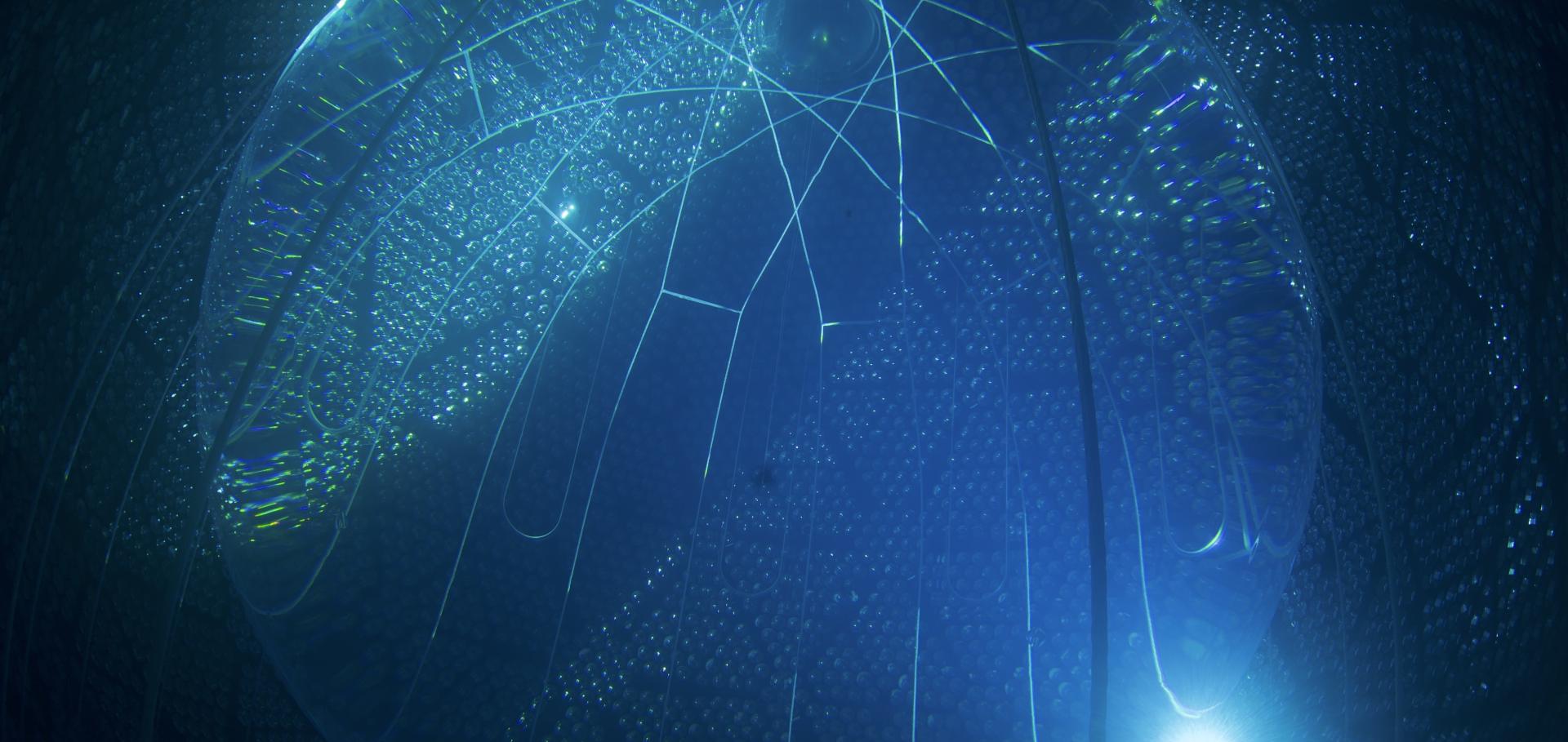
The challenges for the tracking detector systems at the LHC are unprecedented in terms of the number of channels, the required read-out speed and the expected radiation levels. The ATLAS Semiconductor Tracker (SCT) end-caps have a total of about 3 million electronics channels each reading out every 25 ns into its own on-chip 3.3 μ s buffer. The highest anticipated dose after 10 years operation is 1.4 × 1014 cm- 2 in units of 1 MeV neutron equivalent (assuming the damage factors scale with the non-ionising energy loss). The forward tracker has 1976 double-sided modules, mostly of area ∼ 70 cm2, each having 2 × 768 strips read out by six ASICs per side. The requirement to achieve an average perpendicular radiation length of 1.5% XDetermination of the νe and total B8 solar neutrino fluxes using the Sudbury Neutrino Observatory Phase I data set
Physical Review C Nuclear Physics 75:4 (2007)
Abstract:
This article provides the complete description of results from the Phase I data set of the Sudbury Neutrino Observatory (SNO). The Phase I data set is based on a 0.65 kiloton-year exposure of 2H2O (in the following denoted as D2O) to the solar B8 neutrino flux. Included here are details of the SNO physics and detector model, evaluations of systematic uncertainties, and estimates of backgrounds. Also discussed are SNO's approach to statistical extraction of the signals from the three neutrino reactions (charged current, neutral current, and elastic scattering) and the results of a search for a day-night asymmetry in the νe flux. Under the assumption that the B8 spectrum is undistorted, the measurements from this phase yield a solar νe flux of (νe)=1.76-0.05+0. 05(stat.)-0.09+0.09(syst.)×106 cm-2 s-1 and a non-νe component of (νμτ)=3.41-0.45+0.45(stat.)-0.45+0.48(syst.)×106 cm-2 s-1. The sum of these components provides a total flux in excellent agreement with the predictions of standard solar models. The day-night asymmetry in the νe flux is found to be Ae=7.0±4.9(stat.)-1.2+1.3%(syst.), when the asymmetry in the total flux is constrained to be zero. © 2007 The American Physical Society.Measurement of σΛb0/ σB̄0×B(Λb0→Λc+π-)/B(B̄0→D+π- ) in pp̄ Collisions at s=1.96TeV
Physical Review Letters 98:12 (2007)