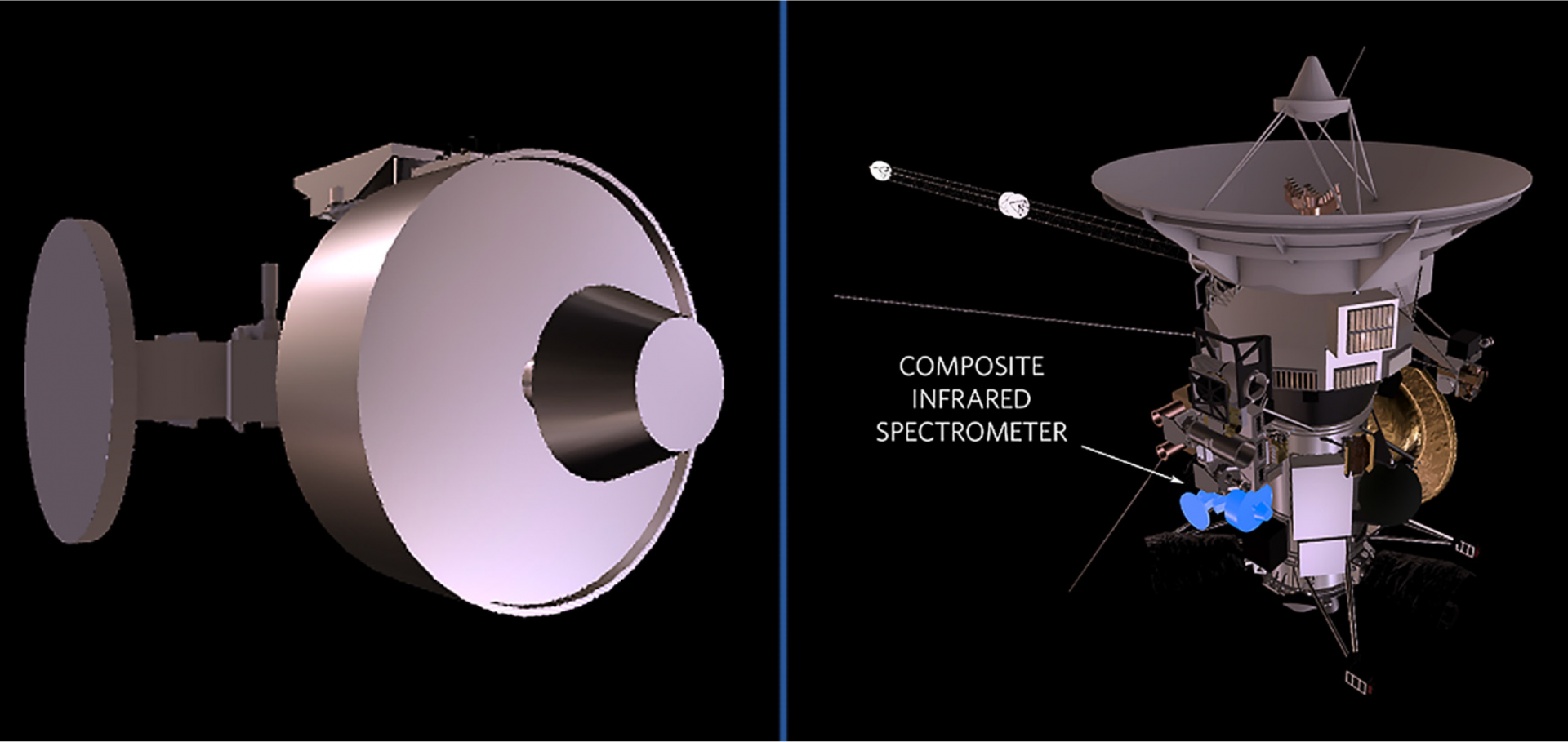
Active upper-atmosphere chemistry and dynamics from polar circulation reversal on Titan.

Nature 491:7426 (2012) 732-735

Authors:

Nicholas A Teanby, Patrick GJ Irwin, Conor A Nixon, Remco de Kok, Sandrine Vinatier, Athena Coustenis, Elliot Sefton-Nash, Simon B Calcutt, F Michael Flasar

Abstract:

Saturn's moon Titan has a nitrogen atmosphere comparable to Earth's, with a surface pressure of 1.4 bar. Numerical models reproduce the tropospheric conditions very well but have trouble explaining the observed middle-atmosphere temperatures, composition and winds. The top of the middle-atmosphere circulation has been thought to lie at an altitude of 450 to 500 kilometres, where there is a layer of haze that appears to be separated from the main haze deck. This 'detached' haze was previously explained as being due to the co-location of peak haze production and the limit of dynamical transport by the circulation's upper branch. Here we report a build-up of trace gases over the south pole approximately two years after observing the 2009 post-equinox circulation reversal, from which we conclude that middle-atmosphere circulation must extend to an altitude of at least 600 kilometres. The primary drivers of this circulation are summer-hemisphere heating of haze by absorption of solar radiation and winter-hemisphere cooling due to infrared emission by haze and trace gases; our results therefore imply that these effects are important well into the thermosphere (altitudes higher than 500 kilometres). This requires both active upper-atmosphere chemistry, consistent with the detection of high-complexity molecules and ions at altitudes greater than 950 kilometres, and an alternative explanation for the detached haze, such as a transition in haze particle growth from monomers to fractal structures.

PacMan returns: An electron-generated thermal anomaly on Tethys

Icarus Elsevier 221:2 (2012) 1084-1088

Authors:

CJA Howett, JR Spencer, T Hurford, A Verbiscer, M Segura

Small‐scale methane dispersion modelling for possible plume sources on the surface of Mars

Geophysical Research Letters American Geophysical Union (AGU) 39:19 (2012)

Authors:

KS Olsen, E Cloutis, K Strong

An oxford swift integral field spectroscopy study of 14 early-type galaxies in the coma cluster

Monthly Notices of the Royal Astronomical Society 425:2 (2012) 1521-1526

Authors:

N Scott, R Houghton, RL Davies, M Cappellari, N Thatte, F Clarke, M Tecza

Abstract:

As a demonstration of the capabilities of the new Oxford SWIFT integral field spectrograph, we present first observations for a set of 14 early-type galaxies in the core of the Coma cluster. Our data consist of I- and z-band spatially resolved spectroscopy obtained with the Oxford SWIFT spectrograph, combined with r-band photometry from the Sloan Digital Sky Survey archive for 14 early-type galaxies. We derive spatially resolved kinematics for all objects from observations of the calcium triplet absorption features at ∼8500Å. Using this kinematic information we classify galaxies as either fast rotators or slow rotators. We compare the fraction of fast and slow rotators in our sample, representing the densest environment in the nearby Universe, to results from the ATLAS3D survey, finding that the slow rotator fraction is ∼50per cent larger in the core of the Coma cluster than in the volume-limited ATLAS3D sample, a 1.2σ increase given our selection criteria. Comparing our sample to the Virgo cluster core only (which is 24 times less dense than the Coma core) we find no evidence of an increase in the slow rotator fraction. Combining measurements of the effective velocity dispersion σe with the photometric data we determine the Fundamental Plane for our sample of galaxies. We find that the use of the average velocity dispersion within 1 effective radius, σe, reduces the residuals by 13per cent with respect to comparable studies using central velocity dispersions, consistent with other recent integral field Fundamental Plane determinations. © 2012 The Authors Monthly Notices of the Royal Astronomical Society © 2012 RAS.

The application of new methane line absorption data to Gemini-N/NIFS and KPNO/FTS observations of Uranus' near-infrared spectrum

Icarus 220:2 (2012) 369-382

Authors:

PGJ Irwin, C de Bergh, R Courtin, B Bézard, NA Teanby, GR Davis, LN Fletcher, GS Orton, SB Calcutt, D Tice, J Hurley

Abstract:

New line data describing the absorption of CH 4 and CH 3D from 1.26 to 1.71μm (Campargue, A., Wang, L., Mondelain, D., Kassi, S., Bézard, B., Lellouch, E., Coustenis, A., de Bergh, C., Hirtzig, M., Drossart, P. [2012]. Icarus 219, 110-128), building upon previous papers by Campargue et al. (Campargue, A., Wang, L., Kassi, S., Masat, M., Votava, O. [2010]. J. Quant. Spectrosc. Radiat. Transfer 111, 1141-1151; Wang, L., Kassi, S., Campargue, A. [2010]. J. Quant. Spectrosc. Radiat. Transfer 111, 1130-1140; Wang, L., Kassi, S., Liu, A.W., Hu, S.M., Campargue, A. [2011]. J. Quant. Spectrosc. Radiat. Transfer 112, 937-951)) have been applied to the analysis of Gemini-N/NIFS observations of Uranus made in 2010 and compared with earlier disc-averaged observations made by KPNO/FTS in 1982. The new line data are found to improve greatly the fit to the observed spectra and present a huge advance over previous methane absorption tables by allowing us to determine the CH 3D/CH 4 ratio and also start to break the degeneracy between methane abundance and cloud top height. The best fits are obtained if the cloud particles in the main cloud deck at the 2-3bar level become less scattering with wavelength across the 1.4-1.6μm region and we have modelled this variation here by varying the extinction cross-section and single-scattering albedo of the particles.Applying the new line data to the NIFS spectra of Uranus, we determine a new estimate of the CH 3D/CH 4 ratio of 2.9-0.5+0.9×10⁻⁴, which is consistent with the estimate of de Bergh et al. (de Bergh, C., Lutz, B.L., Owen, T., Brault, J., Chauville, J. [1986]. Astrophys. J. 311, 501-510) of 3.6-2.8+3.6×10⁻⁴, made by fitting a disc-averaged KPNO/FTS spectrum measured in 1982, but much better constrained. The NIFS observations made in 2010 have been disc-averaged and compared with the 1982 KPNO/FTS spectrum and found to be in excellent agreement.Using k-tables fitted to the new line data, the central meridian observations of Uranus' H-band spectrum (1.49-1.64μm) made by Gemini-N/NIFS in 2010 have been reanalyzed. The use of the new methane absorption coefficients and the modified scattering properties of the cloud particles in the main cloud deck appears to break the degeneracy between cloud height and methane abundance immediately above it in this spectral region and we find that both vary with latitude across Uranus' disc. Overall, we find that the main cloud deck becomes higher, but thinner from equator to poles, with a local maximum in cloud top height in the circumpolar zones at 45°N and 45°S. At the same time, using the 'D' temperature pressure profile of Lindal et al. (Lindal, G.F., Lyons, J.R., Sweetnam, D.N., Eshleman, V.R., Hinson, D.P. [1987]. J. Geophys. Res. 92, 14987-15001) and a deep methane abundance of 1.6% (Baines, K.H., Mickelson, M.E., Larson, L.E., Ferguson, D.W. [1995]. Icarus 144, 328-340) we find that the relative humidity of methane is high near the equator (~60%) and decreases sharply towards the poles, except near the circumpolar zone at 45°N, which has brightened steadily since 2007, and where there is a local maximum in methane relative humidity. In tests conducted with the warmer 'F1' profile of Sromovsky et al. (2011) we find a similar variation of methane abundance above the main cloud, although for this warmer temperature profile this abundance is dependent mostly on the fitted deep methane mole fraction. © 2012 Elsevier Inc.