Home
Department Of Physics text logo
  • Research
    • Our research
    • Our research groups
    • Our research in action
    • Research funding support
    • Summer internships for undergraduates
  • Study
    • Undergraduates
    • Postgraduates
  • Engage
    • For young people
    • For teachers
    • For the public
    • For alumni
    • For business
  • Support
Menu
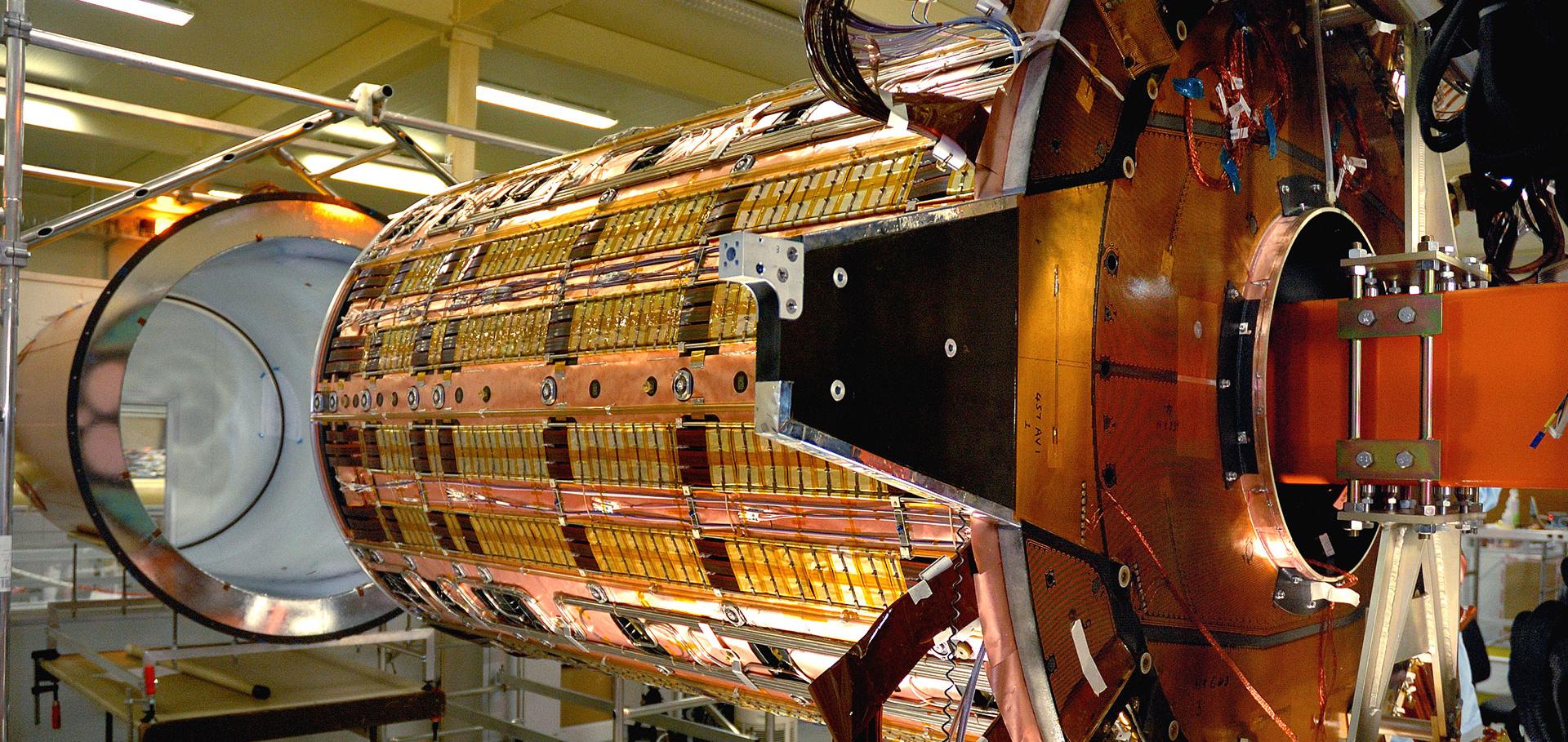
Insertion of STC into TRT at the Department of Physics, Oxford
Credit: CERN

Professor Daniela Bortoletto

Professor and Head of Particle Physics

Research theme

  • Instrumentation
  • Fundamental particles and interactions

Sub department

  • Particle Physics

Research groups

  • AION/Magis
  • ATLAS
  • Future Colliders
  • Mu3e
  • OPMD
daniela.bortoletto@physics.ox.ac.uk
Telephone: 01865 (2)73635
Denys Wilkinson Building, room 608c1
  • About
  • Students
  • Research
  • Teaching
  • Publications

Diffractive dijet production in p̄p collisions at √s=1.96TeV

Physical Review D - Particles, Fields, Gravitation and Cosmology 86:3 (2012)

Authors:

T Aaltonen, M Albrow, B Álvarez González, S Amerio, D Amidei, A Anastassov, A Annovi, J Antos, G Apollinari, JA Appel, T Arisawa, A Artikov, J Asaadi, W Ashmanskas, B Auerbach, A Aurisano, F Azfar, W Badgett, T Bae, A Barbaro-Galtieri, VE Barnes, BA Barnett, P Barria, P Bartos, M Bauce, F Bedeschi, S Behari, G Bellettini, J Bellinger, D Benjamin, A Beretvas, A Bhatti, D Bisello, I Bizjak, KR Bland, B Blumenfeld, A Bocci, A Bodek, D Bortoletto, J Boudreau, A Boveia, L Brigliadori, C Bromberg, E Brucken, J Budagov, HS Budd, K Burkett, G Busetto, P Bussey, A Buzatu, A Calamba, C Calancha, S Camarda, M Campanelli, M Campbell, F Canelli, B Carls, D Carlsmith, R Carosi, S Carrillo, S Carron, B Casal, M Casarsa, A Castro, P Catastini, D Cauz, V Cavaliere, M Cavalli-Sforza, A Cerri, L Cerrito, YC Chen, M Chertok, G Chiarelli, G Chlachidze, F Chlebana, K Cho, D Chokheli, WH Chung, YS Chung, MA Ciocci, A Clark, C Clarke, G Compostella, ME Convery, J Conway, M Corbo, M Cordelli, CA Cox, DJ Cox, F Crescioli, J Cuevas, R Culbertson, D Dagenhart, N D'ascenzo, M Datta, P De Barbaro, M Dell'orso, L Demortier, M Deninno, F Devoto

Abstract:

We report on a study of diffractive dijet production in p̄p collisions at √s=1.96TeV using the CDF II detector at the Fermilab Tevatron p̄p collider. A data sample from 310pb -1 of integrated luminosity collected by triggering on a high transverse energy jet, ETjet, in coincidence with a recoil antiproton detected in a Roman pot spectrometer is used to measure the ratio of single-diffractive to inclusive-dijet event rates as a function of xp ̄ of the interacting parton in the antiproton, the Bjorken-x, xBjp̄, and a Q2(ETjet)2 in the ranges 10 -3-4GeV2. The t p̄ dependence is measured as a function of Q2 and xBjp̄ and compared with that of inclusive single diffraction dissociation. We find weak xBjp̄ and Q2 dependencies in the ratio of single diffractive to inclusive event rates, and no significant Q2 dependence in the diffractive t p̄ distributions. © 2012 American Physical Society.
More details from the publisher
More details
Details from ArXiV

Study of the dijet mass spectrum in pp to W + jets events at sqrt(s) = 7 TeV

ArXiv 1208.3477 (2012)
Details from ArXiV

Measurement of the Λb cross section and the Λ-b to Λb ratio with J/ψΛ decays in pp collisions at s=7 TeV

Physics Letters, Section B: Nuclear, Elementary Particle and High-Energy Physics 714:2-5 (2012) 136-157

Authors:

S Chatrchyan, V Khachatryan, AM Sirunyan, A Tumasyan, W Adam, T Bergauer, M Dragicevic, J Erö, C Fabjan, M Friedl, R Frühwirth, VM Ghete, J Hammer, N Hörmann, J Hrubec, M Jeitler, W Kiesenhofer, V Knünz, M Krammer, D Liko, I Mikulec, M Pernicka, B Rahbaran, C Rohringer, H Rohringer, R Schöfbeck, J Strauss, A Taurok, P Wagner, W Waltenberger, G Walzel, E Widl, CE Wulz, V Mossolov, N Shumeiko, J Suarez Gonzalez, S Bansal, T Cornelis, EA De Wolf, X Janssen, S Luyckx, T Maes, L Mucibello, S Ochesanu, B Roland, R Rougny, M Selvaggi, Z Staykova, H Van Haevermaet, P Van Mechelen, N Van Remortel, A Van Spilbeeck, F Blekman, S Blyweert, J D'Hondt, R Gonzalez Suarez, A Kalogeropoulos, M Maes, A Olbrechts, W Van Doninck, P Van Mulders, GP Van Onsem, I Villella, O Charaf, B Clerbaux, G De Lentdecker, V Dero, APR Gay, T Hreus, A Léonard, PE Marage, T Reis, L Thomas, C Vander Velde, P Vanlaer, J Wang, V Adler, K Beernaert, A Cimmino, S Costantini, G Garcia, M Grunewald, B Klein, J Lellouch, A Marinov, J Mccartin, AA Ocampo Rios, D Ryckbosch, N Strobbe, F Thyssen, M Tytgat, L Vanelderen, P Verwilligen, S Walsh, E Yazgan, N Zaganidis, S Basegmez, G Bruno, R Castello, L Ceard

Abstract:

The Λb differential production cross section and the cross section ratio σ(Λ-b)/σ(Λb) are measured as functions of transverse momentum pTΛb and rapidity |yΛb| in pp collisions at s=7 TeV using data collected by the CMS experiment at the LHC. The measurements are based on Λb decays reconstructed in the exclusive final state J/ψΛ, with the subsequent decays J/ψ→μ+μ- and Λ→pπ, using a data sample corresponding to an integrated luminosity of 1.9 fb-1. The product σ(Λb)×B(Λb→J/ψΛ) versus pTΛb falls faster than that of b mesons. The measured value of σ(Λb)×B(Λb→J/ψΛ) for pTΛb>10 GeV and |yΛb|<2.0 is 1.16±0.06±0.12nb, and the integrated σ(Λ-b)/σ(Λb) ratio is 1.02±0.07±0.09, where the uncertainties are statistical and systematic, respectively. © 2012 CERN.
More details from the publisher

Observation of sequential Upsilon suppression in PbPb collisions

ArXiv 1208.2826 (2012)
Details from ArXiV

Search for narrow resonances in dilepton mass spectra in pp collisions at s=7TeV

Physics Letters, Section B: Nuclear, Elementary Particle and High-Energy Physics 714:2-5 (2012) 158-179

Authors:

S Chatrchyan, V Khachatryan, AM Sirunyan, A Tumasyan, W Adam, T Bergauer, M Dragicevic, J Erö, C Fabjan, M Friedl, R Frühwirth, VM Ghete, J Hammer, N Hörmann, J Hrubec, M Jeitler, W Kiesenhofer, V Knünz, M Krammer, D Liko, I Mikulec, M Pernicka, B Rahbaran, C Rohringer, H Rohringer, R Schöfbeck, J Strauss, A Taurok, P Wagner, W Waltenberger, G Walzel, E Widl, CE Wulz, V Mossolov, N Shumeiko, J Suarez Gonzalez, S Bansal, T Cornelis, EA De Wolf, X Janssen, S Luyckx, T Maes, L Mucibello, S Ochesanu, B Roland, R Rougny, M Selvaggi, Z Staykova, H Van Haevermaet, P Van Mechelen, N Van Remortel, A Van Spilbeeck, F Blekman, S Blyweert, J D'Hondt, R Gonzalez Suarez, A Kalogeropoulos, M Maes, A Olbrechts, W Van Doninck, P Van Mulders, GP Van Onsem, I Villella, O Charaf, B Clerbaux, G De Lentdecker, V Dero, APR Gay, T Hreus, A Léonard, PE Marage, T Reis, L Thomas, C Vander Velde, P Vanlaer, J Wang, V Adler, K Beernaert, A Cimmino, S Costantini, G Garcia, M Grunewald, B Klein, J Lellouch, A Marinov, J Mccartin, AA Ocampo Rios, D Ryckbosch, N Strobbe, F Thyssen, M Tytgat, L Vanelderen, P Verwilligen, S Walsh, E Yazgan, N Zaganidis, S Basegmez, G Bruno, R Castello, A Caudron

Abstract:

A search for narrow, high-mass resonances decaying to electron or muon pairs has been performed using pp collision data collected at s=7TeV by the CMS experiment in 2011. The data sample corresponds to an integrated luminosity of approximately 5 fb -1. The event yields observed in the signal regions are consistent with predictions of the standard model backgrounds, and upper limits on the cross section times branching fraction for a resonance decaying to dileptons are extracted from a shape analysis of the dilepton invariant mass distribution. The resulting mass limits at 95% confidence level are 2330 GeV for the Z ' in the Sequential Standard Model, 2000 GeV for the superstring-inspired Z ψ' resonance, 890 (540) GeV for the Stueckelberg extension Z St' with the mass parameter ε=0.06 (0.04), and 2140 (1810) GeV for Kaluza-Klein gravitons with the coupling parameter k/M- Pl of 0.10 (0.05). These limits are the most stringent to date. © 2012 Elsevier B.V.
More details from the publisher

Pagination

  • First page First
  • Previous page Prev
  • …
  • Page 572
  • Page 573
  • Page 574
  • Page 575
  • Current page 576
  • Page 577
  • Page 578
  • Page 579
  • Page 580
  • …
  • Next page Next
  • Last page Last

Footer Menu

  • Contact us
  • Giving to the Dept of Physics
  • Work with us
  • Media

User account menu

  • Log in

Follow us

FIND US

Clarendon Laboratory,

Parks Road,

Oxford,

OX1 3PU

CONTACT US

Tel: +44(0)1865272200

University of Oxfrod logo Department Of Physics text logo
IOP Juno Champion logo Athena Swan Silver Award logo

© University of Oxford - Department of Physics

Cookies | Privacy policy | Accessibility statement

Built by: Versantus

  • Home
  • Research
  • Study
  • Engage
  • Our people
  • News & Comment
  • Events
  • Our facilities & services
  • About us
  • Giving to Physics
  • Current students
  • Staff intranet