Home
Department Of Physics text logo
  • Research
    • Our research
    • Our research groups
    • Our research in action
    • Research funding support
    • Summer internships for undergraduates
  • Study
    • Undergraduates
    • Postgraduates
  • Engage
    • For young people
    • For teachers
    • For the public
    • For alumni
    • For business
  • Support
Menu
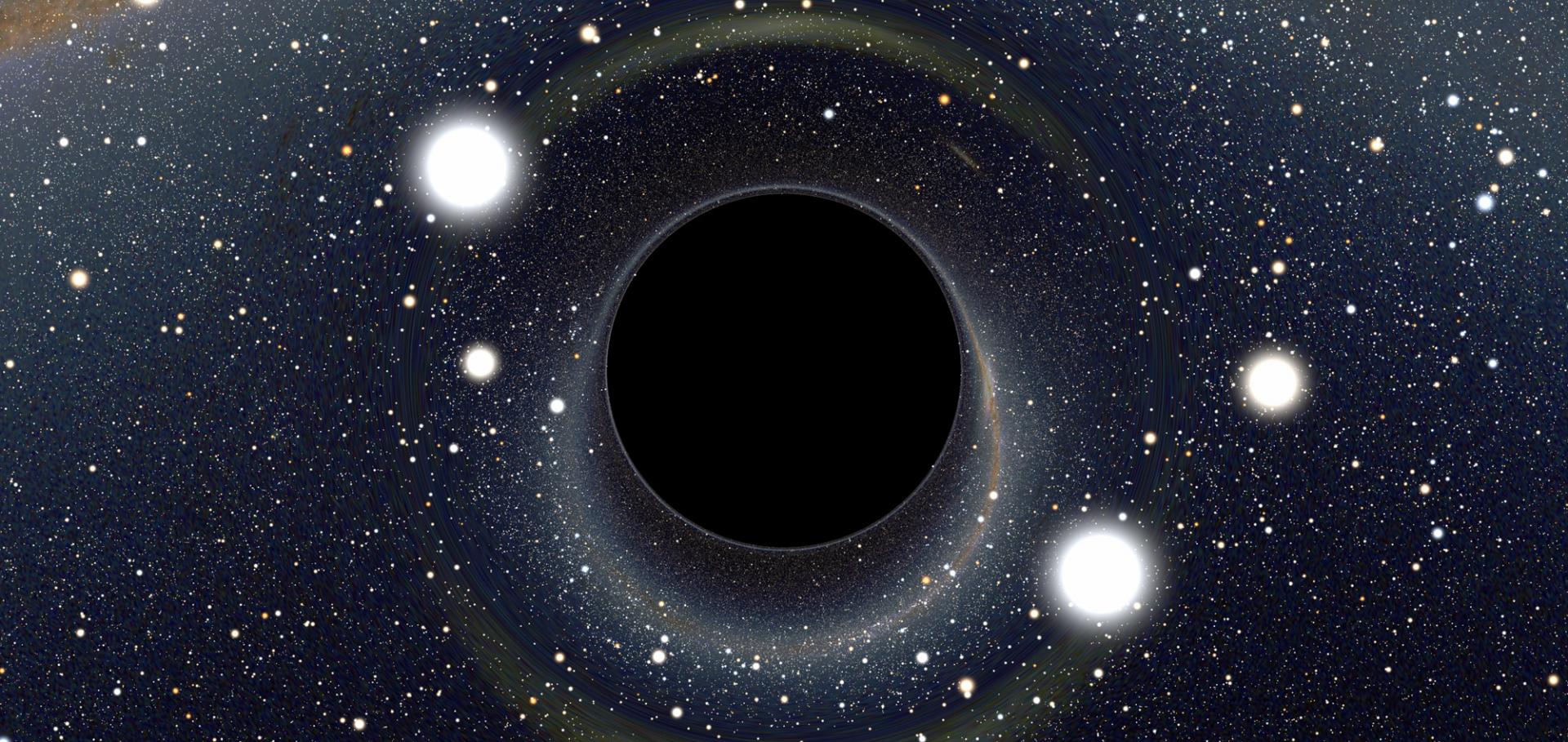
Black Hole

Lensing of space time around a black hole. At Oxford we study black holes observationally and theoretically on all size and time scales - it is some of our core work.

Credit: ALAIN RIAZUELO, IAP/UPMC/CNRS. CLICK HERE TO VIEW MORE IMAGES.

Professor Andrew Bunker

Professor of Astrophysics

Research theme

  • Astronomy and astrophysics

Sub department

  • Astrophysics

Research groups

  • Galaxy formation and evolution
Andy.Bunker@physics.ox.ac.uk
Telephone: 01865 (2)83126
Denys Wilkinson Building, room 702
  • About
  • Publications

New star-forming galaxies at z≈ 7 from Wide Field Camera Three imaging

Monthly Notices of the Royal Astronomical Society 411:1 (2011) 23-36

Authors:

SM Wilkins, AJ Bunker, S Lorenzoni, J Caruana

Abstract:

The addition of Wide Field Camera Three on the Hubble Space Telescope has led to a dramatic increase in our ability to study the z > 6 Universe. The improvement in the near-infrared (NIR) sensitivity of WFC3 over previous instruments has enabled us to reach apparent magnitudes approaching 29 (AB). This allows us to probe the rest-frame UV continuum, redshifted into the NIR at z > 6. Taking advantage of the large optical depths of the intergalactic medium at this redshift, resulting in the Lyman α break, we use a combination of WFC3 imaging and pre-existing Advanced Camera for Surveys imaging to search for z≈ 7 galaxies over four fields in and around Great Observatories Origins Survey-South (GOODS-S). Our analysis reveals 29 new z≈ 7 star-forming galaxy candidates in addition to 15 pre-existing candidates already discovered in these fields. The improved statistics from our doubling of the robust sample of z-drop candidates confirms the previously observed evolution of the bright end of the luminosity function. © 2010 The Authors. Journal compilation © 2010 RAS.
More details from the publisher
More details
Details from ArXiV

Star-forming galaxies at z≈ 8-9 from Hubble Space Telescope/WFC3: Implications for reionization

Monthly Notices of the Royal Astronomical Society 414:2 (2011) 1455-1466

Authors:

S Lorenzoni, AJ Bunker, SM Wilkins, ER Stanway, MJ Jarvis, J Caruana

Abstract:

We present a search for galaxies at 7.6 < z < 9.8 using the latest Hubble Space Telescope/Wide Field Camera 3 (WFC3) near-infrared data, based on the Lyman-break technique. We search for galaxies which have large (Y-J) colours (the 'Y-drops') on account of the Lyman α forest absorption, and with (J-H) colours inconsistent with being low-redshift contaminants. We identify 24 candidates at redshift z≈ 8-9 (15 are robust and a further nine more marginal but consistent with being high redshift) over an area of ≈50arcmin2. Previous searches for Y-drops with WFC3 have focused only on the Hubble Ultra Deep Field, and our larger survey (involving two other nearby deep fields and a wider area survey) has trebled the number of robust Y-drop candidates. For the first time, we have sufficient z≈ 8-9 galaxies to fit both φ* and M* of the UV Schechter luminosity function. There is evidence for evolution in this luminosity function from z= 6-7 to z= 8-9, in the sense that there are fewer UV-bright galaxies at z≈ 8-9, consistent with an evolution mainly in M*. The candidate z≈ 8-9 galaxies we detect have insufficient ionizing flux to reionize the Universe, and it is probable that galaxies below our detection limit provide a significant UV contribution. The faint-end slope, α, is not well constrained. However, adopting a similar faint-end slope to that determined at z= 3-6 (α=-1.7) and a Salpeter initial mass function (IMF), then the ionizing photon budget still falls short if fesc < 0.5, even integrating down to MUV=-8. A steeper faint-end slope or a low-metallicity population (or a top-heavy IMF) might still provide sufficient photons for star-forming galaxies to reionize the Universe, but confirmation of this might have to await the James Webb Space Telescope. © 2011 The Authors Monthly Notices of the Royal Astronomical Society © 2011 RAS.
More details from the publisher
More details
Details from ArXiV

The WFC3 infrared spectroscopic parallel (WISP) survey

Astrophysical Journal 723:1 (2010) 104-115

Authors:

H Atek, M Malkan, P McCarthy, HI Teplitz, C Scarlata, B Siana, A Henry, JW Colbert, NR Ross, C Bridge, AJ Bunker, A Dressler, RAE Fosbury, C Martin, H Shim

Abstract:

We present the WFC3 Infrared Spectroscopic Parallel (WISP) Survey. WISP is obtaining slitless, near-infrared grism spectroscopy of ∼90 independent, high-latitude fields by observing in the pure-parallel mode with the Wide Field Camera Three on the Hubble Space Telescope for a total of ∼250 orbits. Spectra are obtained with the G102 (λ = 0.8-1.17 μm, R ∼ 210) and G141 grisms (λ = 1.11-1.67 μm, R ∼ 130), together with direct imaging in the J and H bands (F110W and F140W, respectively). In the present paper, we present the first results from 19 WISP fields, covering approximately 63 arcmin2. For typical exposure times (∼6400 s in G102 and ∼2700 s in G141), we reach 5σ detection limits for emission lines of f ∼ 5 × 10 -17 erg s-1 cm-2 for compact objects. Typical direct imaging 5σ limits are 26.3 and 26.1 mag. (AB) in F110W and F140W, respectively. Restricting ourselves to the lines measured with the highest confidence, we present a list of 328 emission lines, in 229 objects, in a redshift range 0.3 < z < 3. The single-line emitters are likely to be a mix of Hα and [O III]5007,4959 Å, with Hα predominating. The overall surface density of high-confidence emission-line objects in our sample is approximately 4 per arcmin2. These first fields show high equivalent width sources, active galactic nucleus, and post-starburst galaxies. The median observed star formation rate (SFR) of our Hα-selected sample is 4 M⊙ yr-1. At intermediate redshifts, we detect emission lines in galaxies as faint as H140 ∼ 25, or M R < - 19, and are sensitive to SFRs down to less than 1M ⊙ yr-1. The slitless grisms on WFC3 provide a unique opportunity to study the spectral properties of galaxies much fainter than L* at the peak of the galaxy assembly epoch. © 2010. The American Astronomical Society.
More details from the publisher
More details

Candidate z~8-9 Galaxies from WFC3 Imaging

(2010)

Authors:

Silvio Lorenzoni, Andrew Bunker, Stephen Wilkins, Elizabeth Stanway, Matt Jarvis, Joseph Caruana
More details from the publisher

The WFC3 Infrared Spectroscopic Parallel (WISP) Survey

(2010)

Authors:

H Atek, M Malkan, P McCarthy, H Teplitz, C Scarlata, B Siana, A Henry, J Colbert, NR Ross, C Bridge, AJ Bunker, A Dressler, RAE Fosbury, C martin, H Shim
More details from the publisher

Pagination

  • First page First
  • Previous page Prev
  • …
  • Page 95
  • Page 96
  • Page 97
  • Page 98
  • Current page 99
  • Page 100
  • Page 101
  • Page 102
  • Page 103
  • …
  • Next page Next
  • Last page Last

Footer Menu

  • Contact us
  • Giving to the Dept of Physics
  • Work with us
  • Media

User account menu

  • Log in

Follow us

FIND US

Clarendon Laboratory,

Parks Road,

Oxford,

OX1 3PU

CONTACT US

Tel: +44(0)1865272200

University of Oxfrod logo Department Of Physics text logo
IOP Juno Champion logo Athena Swan Silver Award logo

© University of Oxford - Department of Physics

Cookies | Privacy policy | Accessibility statement

Built by: Versantus

  • Home
  • Research
  • Study
  • Engage
  • Our people
  • News & Comment
  • Events
  • Our facilities & services
  • About us
  • Giving to Physics
  • Current students
  • Staff intranet