


A novel design of a fibre-fed high resolution spectrograph for WFMOS
Proceedings of SPIE the International Society for Optical Engineering 7014 (2008)
Abstract:
We present a novel design of a fibre-fed high-resolution spectrograph (HRS hereafter) for WFMOS. WFMOS HRS is a multi-object spectrograph for studying the formation and evolution history of our Galaxy by measuring spectra of Galactic stars. In a 8m-class telescope, it aims to measure 1,500 stellar spectra simultaneously with spectral resolution between 25,000 and 40,000 in optical wavebands de.ned within 4000Å and 9000Å. For the HRS optical design, we have explored three disperser options : Volume Phase Holographic Grating (VPHGs), prism-immersed VPHG, and Echelle grating. Two camera designs have also been studied for the spectrograph camera optics, one tranmissive design and the other a Schmidt design. We also investigated a conjugate collimator design that allows two spectrographs to share a single grating so as to work as a single spectrograph.Development of non-hybridised HgCdTe detectors for the next generation of astronomical instrumentation
Proceedings of SPIE the International Society for Optical Engineering 7021 (2008)
Abstract:
The superb image quality that is predicted, and even demanded, for the next generation of Extremely Large Telescopes (ELT) presents a potential crisis in terms of the sheer number of detectors that may be required. Developments in infrared technology have progressed dramatically in recent years, but a substantial reduction in the cost per pixel of these IR arrays will be necessary to permit full exploitation of the capabilities of these telescopes. Here we present an outline and progress report of an initiative to develop a new generation of astronomical grade Cadmium Mercury Telluride (HgCdTe) array detectors using a novel technique which enables direct growth of the sensor diodes onto the Read Out Integrated Circuit large monolithic arrays. We present preliminary growth and design simulation results for devices based on this technique, and discuss the prospects for deployment of this technology in the era of extremely large telescopes.FMOS: The fiber multiple-object spectrograph VI: On board performances and results of the engineering observations
Proceedings of SPIE the International Society for Optical Engineering 7014 (2008)
Abstract:
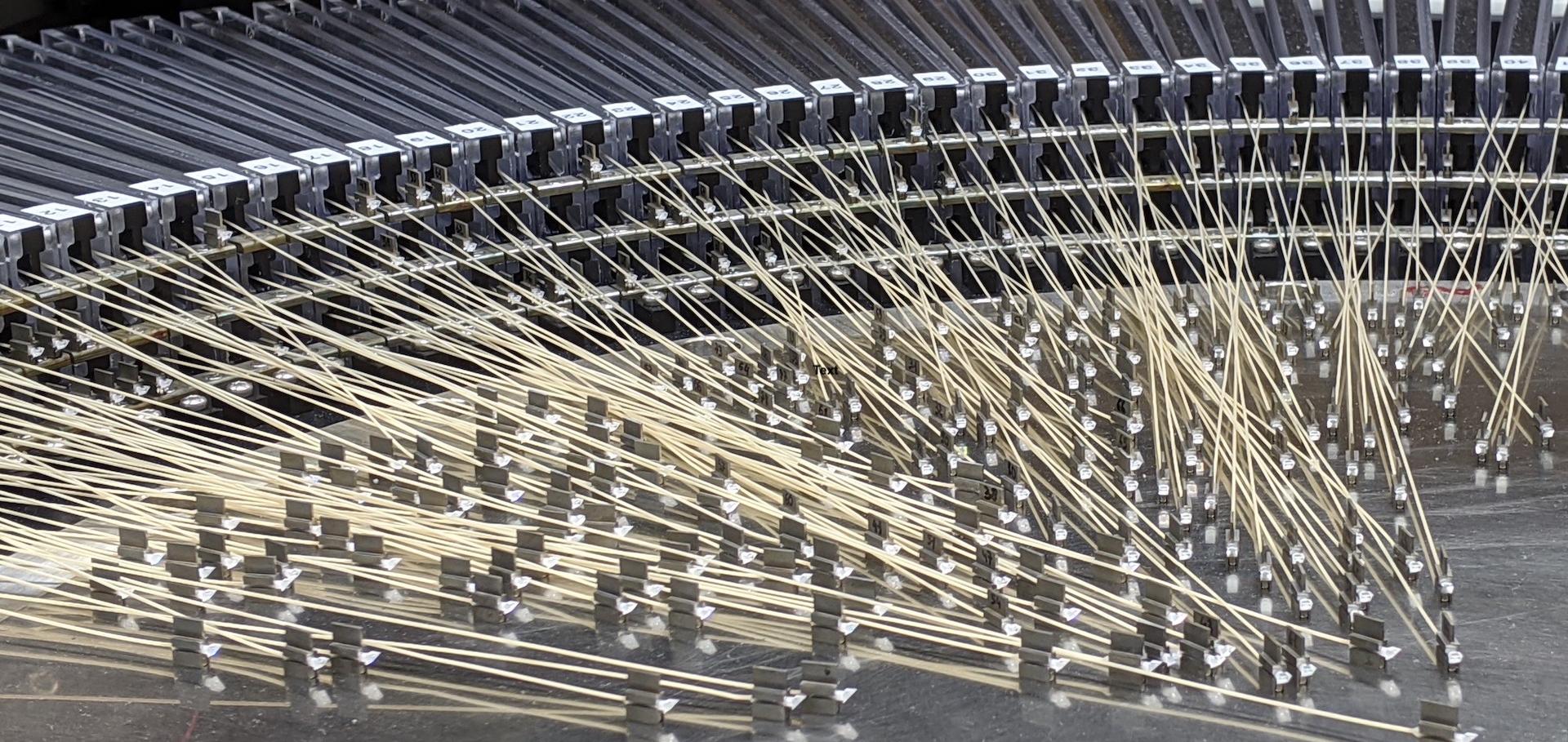
FMOS: the Fiber Multiple-Object Spectrograph is the next common-use instrument of the Subaru Telescope, having a capability of 400 targets multiplicity in the near-infrared 0.9-1.8μm wavelength range with a field coverage of 30- diameter. FMOS consists of three units: 1) the prime focus unit including the corrector lenses, the Echidna fiber positioner, and the instrument-bay to adjust the instrument focus and shift the axis of the corrector lens system, 2) the fiber bundle unit equipping two fiber slits on one end and a fiber connector box with the back-illumination mechanism on the other end on the bundle, 3) the two infrared spectrographs (IRS1 and IRS2) to obtain 2×200 spectra simultaneously. After all the components were installed in the telescope at the end of 2007, the total performance was checked through various tests and engineering observations. We report the results of these tests and demonstrate the performance of FMOS.Implementation of differential wavefront sampling in optical alignment of pupil-segmented telescope systems
Proceedings of SPIE the International Society for Optical Engineering 7017 (2008)
Abstract:
We describe the implementation of differential wavefront sampling(DWS) in optical alignment of a pupilsegmented telescope system. As a wavefront-based optical alignment method, DWS can efficiently provide estimations of misalignments present in an optical system by deliberately perturbing optical elements in a systematic manner. This has been demonstrated in our previous numerical studies with realistic uncertainties in wavefront measurements, motion control, and optical surface deformations, suggesting that the method has potential in optical alignment and phasing of pupil-segmented systems such as the future Extremely Large Telescopes (ELTs). The basic idea and procedures of DWS are first described. We then present and discuss preliminary simulations using the currently proposed European Extremely Large Telescope (E-ELT) as an example system.Integration, commissioning and performance of the UK FMOS spectrograph
Proceedings of SPIE the International Society for Optical Engineering 7014 (2008)