Home
Department Of Physics text logo
  • Research
    • Our research
    • Our research groups
    • Our research in action
    • Research funding support
    • Summer internships for undergraduates
  • Study
    • Undergraduates
    • Postgraduates
  • Engage
    • For young people
    • For teachers
    • For the public
    • For alumni
    • For business
  • Support
Menu
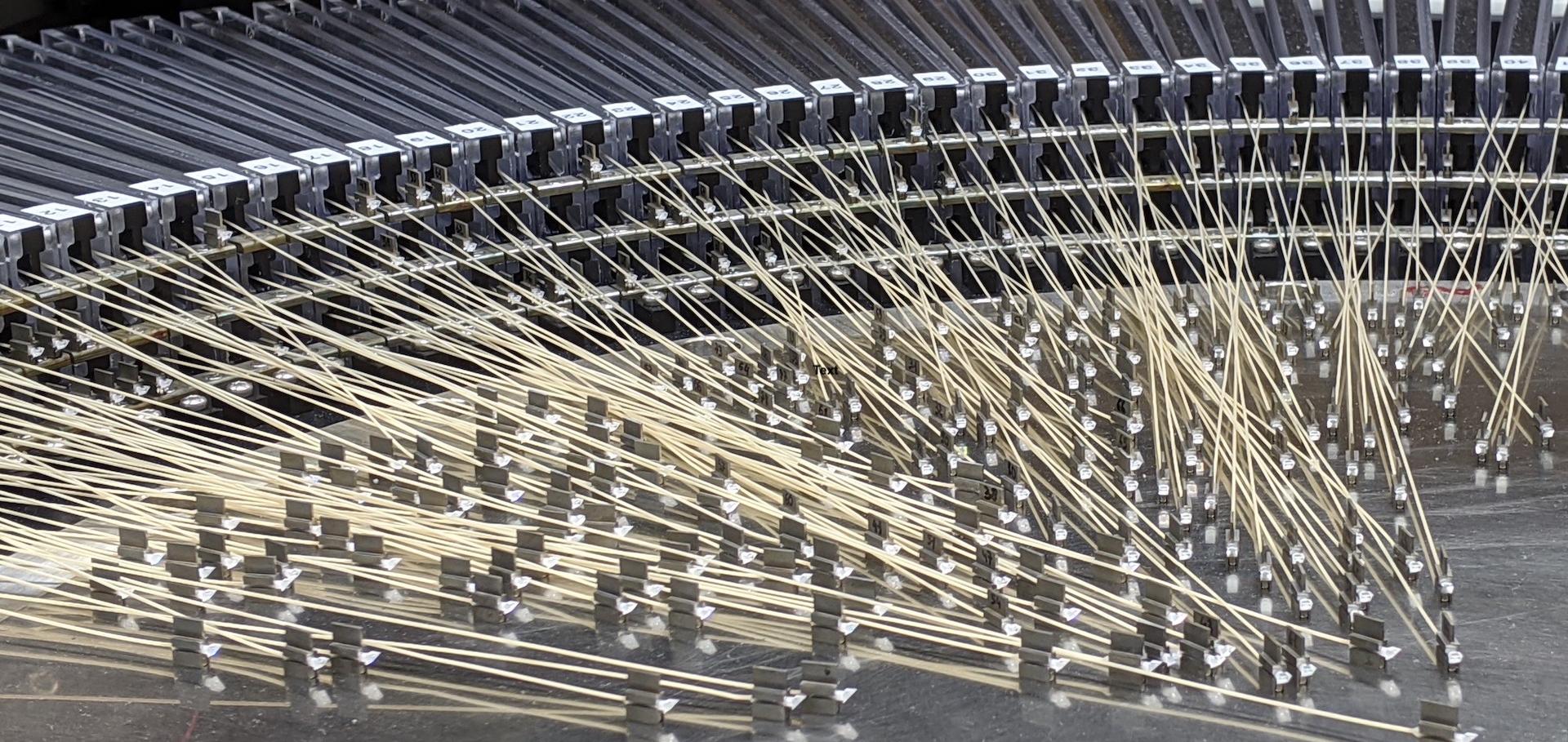
Part of a WEAVE fibre configuration

Part of the WEAVE focal plane showing optical fibres positioned on a set of targets in the telescope focal plane.

Prof Gavin Dalton

Professor of Astrophysics

Research theme

  • Astronomy and astrophysics

Sub department

  • Astrophysics

Research groups

  • Astronomical instrumentation
  • Extremely Large Telescope
Gavin.Dalton@physics.ox.ac.uk
  • About
  • Research
  • Publications

The clustering and evolution of Hα emitters at z ∼ 1 from HiZELS

Monthly Notices of the Royal Astronomical Society 404:3 (2010) 1551-1563

Authors:

D Sobral, PN Best, JE Geach, I Smail, M Cirasuolo, T Garn, GB Dalton, J Kurk

Abstract:

The clustering properties of a well-defined sample of 734 Hα emitters at z= 0.845 ± 0.015, obtained as part of the Hi-z Emission Line Survey, are investigated. The spatial correlation function of these Hα emitters is very well described by the power-law ξ = (r/r0)-1.8, with a real-space correlation, r0, of 2.7 ± 0.3 h-1 Mpc. The correlation length r0 increases strongly with Hα luminosity (LHα), from r0 ∼ 2 h-1 Mpc for the most quiescent galaxies [star formation rates (SFRs) of ∼4 M⊙ yr-1] up to r0 > 5 h-1 Mpc for the brightest galaxies in Hα. The correlation length also increases with increasing rest-frame K-band (MK) luminosity, but the r0-LHα correlation maintains its full statistical significance at fixed MK. At z = 0.84, star-forming galaxies classified as irregulars or mergers are much more clustered than discs and non-mergers, respectively; however, once the samples are matched in LHα and MK, the differences vanish, implying that the clustering is independent of morphological type at z ∼ 1 just as in the local Universe. The typical Hα emitters found at z = 0.84 reside in dark matter haloes of ≈1012 M⊙, but those with the highest SFRs reside in more massive haloes of ≈1013 M⊙. The results are compared with those of Hα surveys at different redshifts: although the break of the Hα luminosity function L*Hα evolves by a factor of ∼30 from z= 0.24 to 2.23, if the Hα luminosities at each redshift are scaled by L*Hα(z) then the correlation lengths indicate that, independently of cosmic time, galaxies with the same (LHα)/L*Hα(z) are found in dark matter haloes of similar masses. This not only confirms that the star formation efficiency in high redshift haloes is higher than locally but also suggests a fundamental connection between the strong negative evolution of L*Hα since z = 2.23 and the quenching of star formation in galaxies residing within dark matter haloes significantly more massive than 1012 M⊙ at any given epoch. © 2010 The Authors. Journal compilation © 2010 RAS.
More details from the publisher

The herschel ATLAS

Publications of the Astronomical Society of the Pacific 122:891 (2010) 499-515

Authors:

S Eales, L Dunne, D Clements, A Cooray, G De Zotti, S Dye, R Ivison, M Jarvis, G Lagache, S Maddox, M Negrello, S Serjeant, MA Thompson, E Van Kampen, A Amblard, P Andreani, M Baes, A Beelen, GJ Bendo, D Benford, F Bertoldi, J Bock, D Boneield, A Boselli, C Bridge, V Buat, D Burgarella, R Carlberg, A Cava, P Chanial, S Charlot, N Christopher, P Coles, L Cortese, A Dariush, E Da Cunha, G Dalton, L Danese, H Dannerbauer, S Driver, J Dunlop, L Fan, D Farrah, D Frayer, C Frenk, J Geach, J Gardner, H Gomez, J González-Nuevo, E González-Solares, M Griffin, M Hardcastle, E Hatziminaoglou, D Herranz, D Hughes, E Ibar, WS Jeong, C Lacey, A Lapi, A Lawrence, M Lee, L Leeuw, J Liske, M López-Caniego, T Müller, K Nandra, P Panuzzo, A Papageorgiou, G Patanchon, J Peacock, C Pearson, S Phillipps, M Pohlen, C Popescu, S Rawlings, E Rigby, M Rigopoulou, A Robotham, G Rodighiero, A Sansom, B Schulz, D Scott, DJB Smith, B Sibthorpe, I Smail, J Stevens, W Sutherland, T Takeuchi, J Tedds, P Temi, R Tuffs, M Trichas, M Vaccari, I Valtchanov, P Van Der Werf, A Verma, J Vieria, C Vlahakis, GJ White

Abstract:

The Herschel ATLAS is the largest open-time key project that will be carried out on the Herschel Space Observatory. It will survey 570 deg 2 of the extragalactic sky, 4 times larger than all the other Herschel extragalactic surveys combined, in five far-infrared and submillimeter bands. We describe the survey, the complementary multiwavelength data sets that will be combined with the Herschel data, and the six major science programs we are undertaking. Using new models based on a previous submillimeter survey of galaxies, we present predictions of the properties of the ATLAS sources in other wave bands. © 2010. The Astronomical Society of the Pacific. All rights reserved.
More details from the publisher

The Herschel ATLAS

PUBLICATIONS OF THE ASTRONOMICAL SOCIETY OF THE PACIFIC 122:891 (2010) 499-515

Authors:

S Eales, L Dunne, D Clements, A Cooray, G De Zotti, S Dye, R Ivison, M Jarvis, G Lagache, S Maddox, M Negrello, S Serjeant, MA Thompson, E Van Kampen, A Amblard, P Andreani, M Baes, A Beelen, GJ Bendo, D Benford, F Bertoldi, J Bock, D Bonfield, A Boselli, C Bridge, V Buat, D Burgarella, R Carlberg, A Cava, P Chanial, S Charlot, N Christopher, P Coles, L Cortese, A Dariush, E da Cunha, G Dalton, L Danese, H Dannerbauer, S Driver, J Dunlop, L Fan, D Farrah, D Frayer, C Frenk, J Geach, J Gardner, H Gomez, J Gonzalez-Nuevo, E Gonzalez-Solares, M Griffin, M Hardcastle, E Hatziminaoglou, D Herranz, D Hughes, E Ibar, Woong-Seob Jeong, C Lacey, A Lapi, A Lawrence, M Lee, L Leeuw, J Liske, M Lopez-Caniego, T Mueller, K Nandra, P Panuzzo, A Papageorgiou, G Patanchon, J Peacock, C Pearson, S Phillipps, M Pohlen, C Popescu, S Rawlings, E Rigby, M Rigopoulou, A Robotham, G Rodighiero, A Sansom, B Schulz, D Scott, DJB Smith, B Sibthorpe, I Smail, J Stevens, W Sutherland, T Takeuchi, J Tedds, P Temi, R Tuffs, M Trichas, M Vaccari, I Valtchanov, P van der Werf, A Verma, J Vieria, C Vlahakis, Glenn J White
More details from the publisher
Details from ArXiV

The clustering and evolution of Hα emitters at z ∼ 1 from HiZELS☆

MONTHLY NOTICES OF THE ROYAL ASTRONOMICAL SOCIETY 404:3 (2010) 1551-1563

Authors:

David Sobral, Philip N Best, James E Geach, Ian Smail, Michele Cirasuolo, Timothy Garn, Gavin B Dalton, Jaron Kurk
More details from the publisher
Details from ArXiV

The clustering and evolution of H-alpha emitters at z~1 from HiZELS

(2009)

Authors:

David Sobral, Philip N Best, James E Geach, Ian Smail, Michele Cirasuolo, Timothy Garn, Gavin B Dalton, Jaron Kurk
More details from the publisher

Pagination

  • First page First
  • Previous page Prev
  • …
  • Page 40
  • Page 41
  • Page 42
  • Page 43
  • Current page 44
  • Page 45
  • Page 46
  • Page 47
  • Page 48
  • …
  • Next page Next
  • Last page Last

Footer Menu

  • Contact us
  • Giving to the Dept of Physics
  • Work with us
  • Media

User account menu

  • Log in

Follow us

FIND US

Clarendon Laboratory,

Parks Road,

Oxford,

OX1 3PU

CONTACT US

Tel: +44(0)1865272200

University of Oxfrod logo Department Of Physics text logo
IOP Juno Champion logo Athena Swan Silver Award logo

© University of Oxford - Department of Physics

Cookies | Privacy policy | Accessibility statement

Built by: Versantus

  • Home
  • Research
  • Study
  • Engage
  • Our people
  • News & Comment
  • Events
  • Our facilities & services
  • About us
  • Giving to Physics
  • Current students
  • Staff intranet