Home
Department Of Physics text logo
  • Research
    • Our research
    • Our research groups
    • Our research in action
    • Research funding support
    • Summer internships for undergraduates
  • Study
    • Undergraduates
    • Postgraduates
  • Engage
    • For young people
    • For teachers
    • For the public
    • For alumni
    • For business
  • Support
Menu
CMP
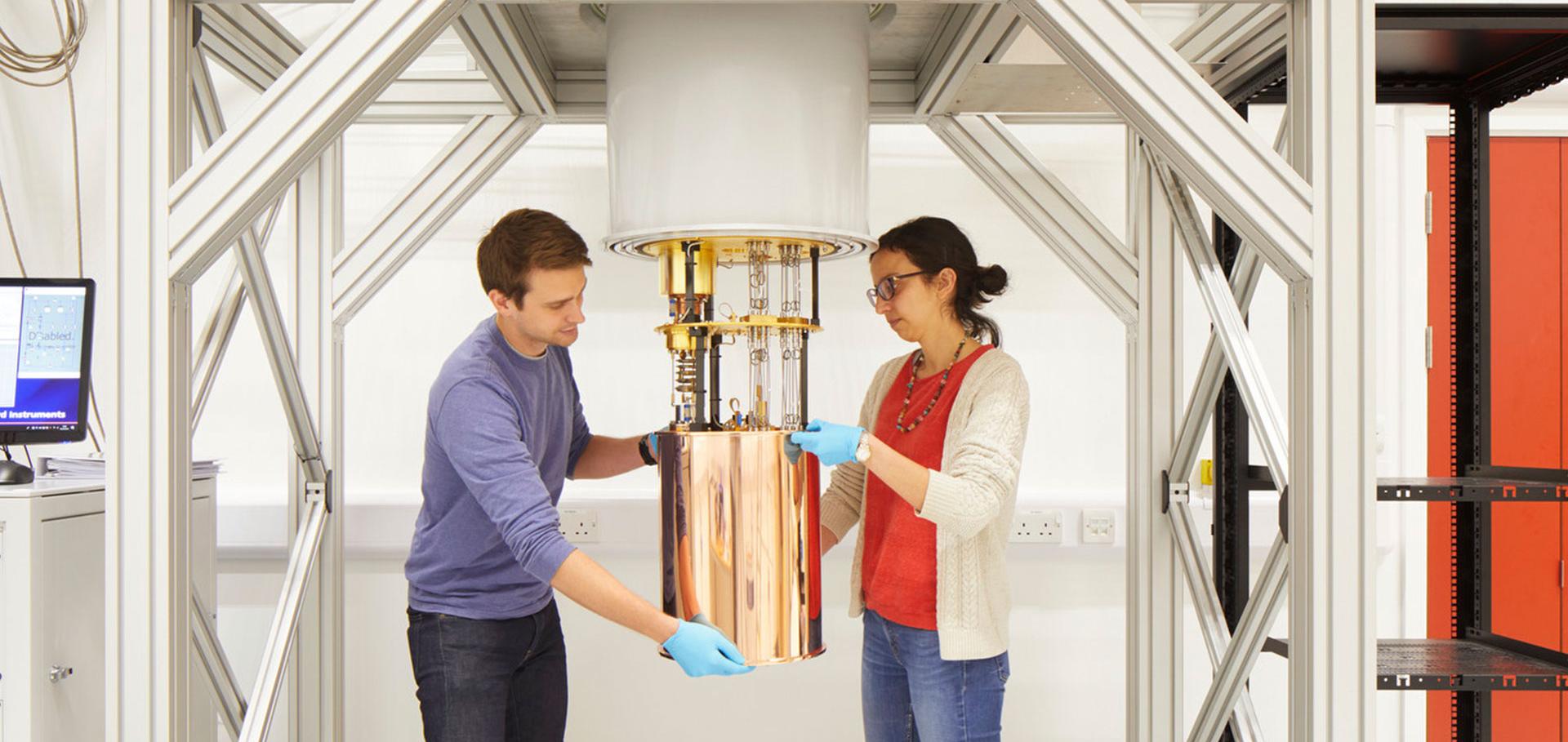
Credit: Jack Hobhouse

Dr Dharmalingam Prabhakaran

Researcher

Research theme

  • Quantum materials

Sub department

  • Condensed Matter Physics

Research groups

  • Synthesis and crystal growth
dharmalingam.prabhakaran@physics.ox.ac.uk
Telephone: 01865 (2)72270,01865 (2)72351,01865 (2)72341
Clarendon Laboratory, room 175,375,374B,374A,371A,371,177,115,373 (office)
  • About
  • Publications

Brownian motion and quantum dynamics of magnetic monopoles in spin ice.

Nat Commun 4 (2013) 1535

Authors:

L Bovo, JA Bloxsom, D Prabhakaran, G Aeppli, ST Bramwell

Abstract:

Spin ice illustrates many unusual magnetic properties, including zero point entropy, emergent monopoles and a quasi liquid-gas transition. To reveal the quantum spin dynamics that underpin these phenomena is an experimental challenge. Here we show how crucial information is contained in the frequency dependence of the magnetic susceptibility and in its high frequency or adiabatic limit. The typical response of Dy(2)Ti(2)O(7) spin ice indicates that monopole diffusion is Brownian but is underpinned by spin tunnelling and is influenced by collective monopole interactions. The adiabatic response reveals evidence of driven monopole plasma oscillations in weak applied field, and unconventional critical behaviour in strong applied field. Our results clarify the origin of the relatively high frequency response in spin ice. They disclose unexpected physics and establish adiabatic susceptibility as a revealing characteristic of exotic spin systems.
More details from the publisher
Details from ORA
More details

Development of the magnetic excitations of charge-stripe ordered La2-xSrxNiO4 on doping towards checkerboard charge order

JOURNAL OF THE KOREAN PHYSICAL SOCIETY 62:10 (2013) 1453-1457

Authors:

PG Freeman, SR Giblin, K Hradil, RA Mole, D Prabhakaran
More details from the publisher

Neutron scattering investigation of the d - d excitations below the Mott gap of CoO

PHYSICAL REVIEW B 88:20 (2013) ARTN 205117

Authors:

RA Cowley, WJL Buyers, C Stock, Z Yamani, C Frost, JW Taylor, D Prabhakaran
More details from the publisher

Photoinduced melting of the orbital order in La0.5Sr1.5MnO4 measured with 4-fs laser pulses

PHYSICAL REVIEW B 88:7 (2013) ARTN 075107

Authors:

R Singla, A Simoncig, M Foerst, D Prabhakaran, AL Cavalieri, A Cavalleri
More details from the publisher

Study of the structural, electric and magnetic properties of Mn-doped Bi 2 Te 3 single crystals

New Journal of Physics 15 (2013) 10

Authors:

MD Watson, LJ Collins-McIntyre, LR Shelford, AI Coldea, D Prabhakaran, SC Speller, T Mousavi, CRM Grovenor, Z Salman, SR Giblin, G van der Laan, T Hesjedal

Abstract:

Breaking the time reversal symmetry of a topological insulator, for example by the presence of magnetic ions, is a prerequisite for spin-based electronic applications in the future. In this regard Mn-doped Bi 2 Te 3 is a prototypical example that merits a systematic investigation of its magnetic properties. Unfortunately, Mn doping is challenging in many host materials—resulting in structural or chemical inhomogeneities affecting the magnetic properties. Here, we present a systematic study of the structural, magnetic and magnetotransport properties of Mn-doped Bi 2 Te 3 single crystals using complimentary experimental techniques. These materials exhibit a ferromagnetic phase that is very sensitive to the structural details, with T C varying between 9 and 13 K (bulk values) and a saturation moment that reaches4.4(5) μ B per Mn in the ordered phase. Muon spin rotation suggests that the magnetism is homogeneous throughout the sample. Furthermore, torque measurements in fields up to 33 T reveal an easy axis magnetic anisotropy perpendicular to the ab -plane. The electrical transport data show an anomaly around T C that is easily suppressed by an applied magnetic field, and also anisotropic behavior due to the spin-dependent scattering in relation to the alignment of the Mn magnetic moment. Hall measurements on different crystals established that these systems are n -doped with carrier concentrations of ∼ 0.5–3.0 × 10 20 cm −3 . X-ray magnetic circular dichroism (XMCD) at the Mn L 2,3 edge at 1.8 K reveals a large spin magnetic moment of4.3(3) μ B /Mn, and a small orbital magnetic moment of0.18(2) μ B /Mn. The results also indicate a ground state of mixed d 4 –d 5 –d 6 character of a localized electronic nature, similar to the diluted ferromagnetic semiconductor Ga 1− x Mn x As. XMCD measurements in a field of 6 T give a transition point at T ≈ 16 K, which is ascribed to short range magnetic order induced by the magnetic field. In the ferromagnetic state the easy direction of magnetization is along the c -axis, in agreement with bulk magnetization measurements. This could lead to gap opening at the Dirac point, providing a means to control the surface electric transport, which is of great importance for applications.
More details from the publisher

Pagination

  • First page First
  • Previous page Prev
  • …
  • Page 32
  • Page 33
  • Page 34
  • Page 35
  • Current page 36
  • Page 37
  • Page 38
  • Page 39
  • Page 40
  • …
  • Next page Next
  • Last page Last

Footer Menu

  • Contact us
  • Giving to the Dept of Physics
  • Work with us
  • Media

User account menu

  • Log in

Follow us

FIND US

Clarendon Laboratory,

Parks Road,

Oxford,

OX1 3PU

CONTACT US

Tel: +44(0)1865272200

University of Oxfrod logo Department Of Physics text logo
IOP Juno Champion logo Athena Swan Silver Award logo

© University of Oxford - Department of Physics

Cookies | Privacy policy | Accessibility statement

Built by: Versantus

  • Home
  • Research
  • Study
  • Engage
  • Our people
  • News & Comment
  • Events
  • Our facilities & services
  • About us
  • Giving to Physics
  • Current students
  • Staff intranet