

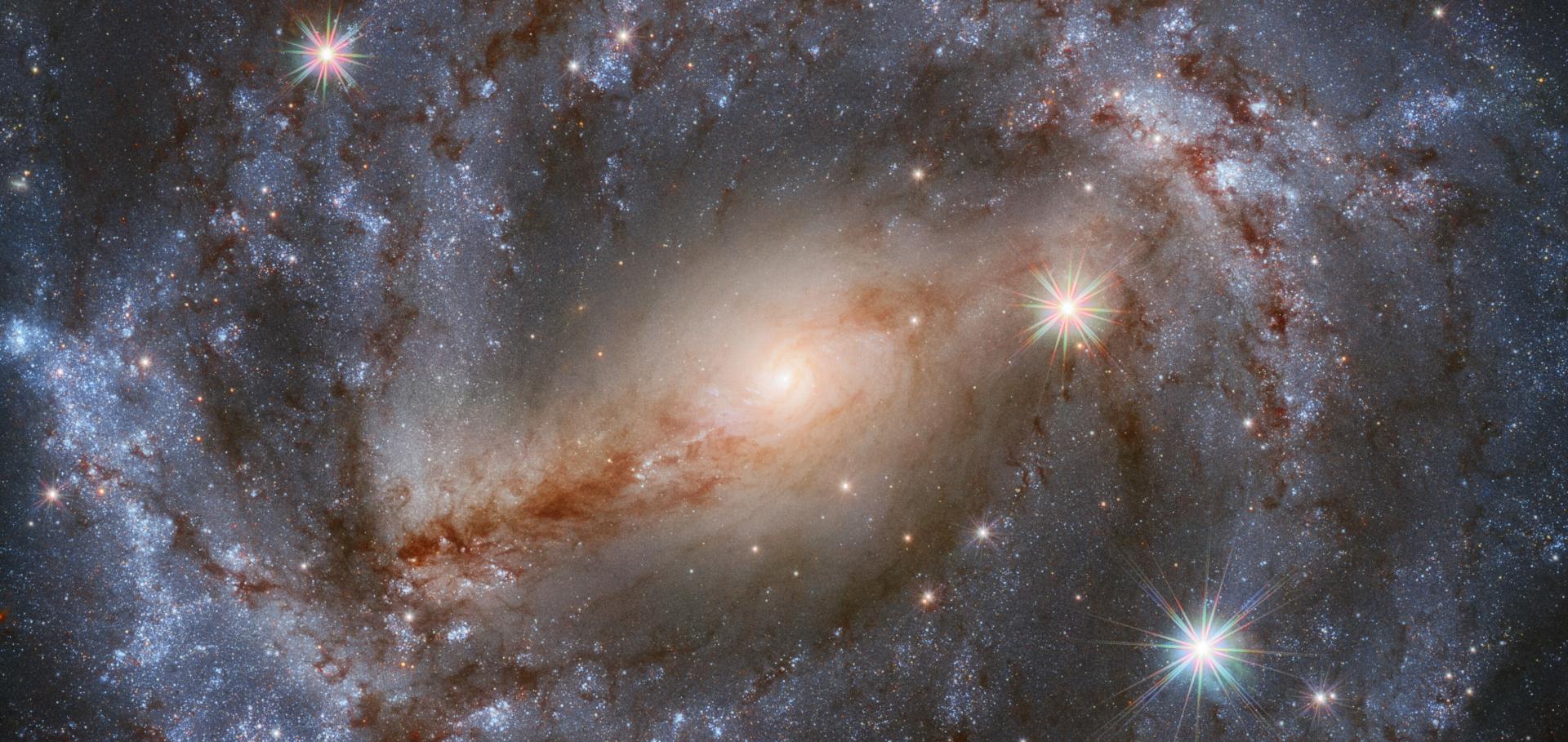

Absence of nuclear polycyclic aromatic hydrocarbon emission from a compact starburst: The case of the type-2 quasar Mrk 477
Astronomy & Astrophysics EDP Sciences 669 (2022) L5-L5
Abstract:
Mrk 477 is the closest type-2 quasar, at a distance of 163 Mpc. This makes it an ideal laboratory for studying the interplay between nuclear activity and star formation with a great level of detail and signal-to-noise. In this Letter we present new mid-infrared (mid-IR) imaging and spectroscopic data with an angular resolution of 0.4″ (∼300 pc) obtained with the Gran Telescopio Canarias instrument CanariCam. The N-band (8–13 μm) spectrum of the central ∼400 pc of the galaxy reveals [S IV]λ10.51 μm emission, but no 8.6 or 11.3 μm polycyclic aromatic hydrocarbon (PAH) features, which are commonly used as tracers of recent star formation. This is in stark contrast with the presence of a nuclear starburst of ∼300 pc in size, an age of 6 Myr, and a mass of 1.1×10⁸ M⊙, as constrained from ultraviolet Hubble Space Telescope observations. Considering this, we argue that even the more resilient, neutral molecules that mainly produce the 11.3 μm PAH band are most likely being destroyed in the vicinity of the active nucleus despite the relatively large X-ray column density, log NH = 23.5 cm−2, and modest X-ray luminosity, 1.5×1043 erg s−1. This highlights the importance of being cautious when using PAH features as star formation tracers in the central region of galaxies to evaluate the impact of feedback from active galactic nucleiA detailed look at the most obscured galactic nuclei in the mid-infrared
Astronomy & Astrophysics EDP Sciences 669 (2022) A87-A87
Abstract:
Context. Compact obscured nuclei (CONs) represent an extreme phase of galaxy evolution where rapid supermassive black hole growth and/or compact star-forming activity is completely obscured by gas and dust. Aims. We investigate the properties of CONs in the mid-infrared and explore techniques aimed at identifying these objects, such as through the equivalent width (EW) ratios of their polycyclic aromatic hydrocarbon (PAH) features. Methods. We modelled Spitzer spectra by decomposing the continua into nuclear and star-forming components, from which we then measured the nuclear optical depth, τN, of the 9.8 μm silicate absorption feature. We also used Spitzer spectral maps to investigate how PAH EW ratios vary with aperture size for objects that host CONs. Results. We find that the nuclear optical depth, τN, strongly correlates with the HCN-vib emission line in the millimetre for CONs, with a Pearson correlation coefficient of 0.91. We find the PAH EW ratio technique to be effective at selecting CONs and robust against highly inclined galaxies, where strong dust lanes may mimic a CON-like spectrum by producing a high τN. Our analysis of the Spitzer spectral maps shows that the efficacy of the PAH EW ratios in isolating CONs is reduced when there is a strong starforming component from the host galaxy. In addition, we find that the use of the inferred nuclear optical depth is a reliable method for identifying CONs in 36+8-7% of ultra-luminous infrared galaxies and 17+3-3% of luminous infrared galaxies, consistent with previous work. Conclusions. We confirm mid-infrared spectra to be a powerful diagnostic of CONs. The increased sensitivity of JWST will allow the identification of CONs at cosmic noon, revealing this extreme but hidden phase of galaxy evolutionTorus and polar dust dependence on active galactic nucleus properties
Astronomy & Astrophysics EDP Sciences 667 (2022) A140-A140
Abstract:
We present a statistical analysis of the properties of the obscuring material around active galactic nuclei (AGN). This study represents the first of its kind for an ultra-hard X-ray (14–195 keV; Swift /BAT), volume-limited ( D L < 40 Mpc) sample of 24 Seyfert (Sy) galaxies (BCS 40 sample) using high angular resolution infrared data and various torus models: smooth, clumpy, and two-phase torus models and clumpy disc+wind models. We find that torus models (i.e. without including the polar dusty wind component) and disc+wind models provide the best fits for a comparable number of galaxies, 8 out of 24 (33.3%) and 9 out of 24 (37.5%), respectively. We find that the best-fit models depend on the hydrogen column density ( N H X−ray ), which is related to the X-ray (unobscured or obscured) and optical (Sy1/Sy2) classification. In particular, smooth, clumpy, and two-phase torus models are best at reproducing the infrared (IR) emission of AGN with relatively high hydrogen column density (median value of log ( N H X−ray cm −2 ) = 23.5 ± 0.8; i.e. Sy2). However, clumpy disc+wind models provide the best fits to the nuclear IR spectral energy distributions (SEDs) of Sy1/1.8/1.9 (median value of log ( N H X−ray cm −2 ) = 21.0 ± 1.0) – specifically, in the near-infrared (NIR) range. The success of the disc+wind models in fitting the NIR emission of Sy1 galaxies is due to the combination of adding large graphite grains to the dust composition and self-obscuration effects caused by the wind at intermediate inclinations. In general, we find that the Seyfert galaxies having unfavourable (favourable) conditions, namely, nuclear hydrogen column density and Eddington ratio, for launching IR dusty polar outflows are best-fitted with smooth, clumpy, and two-phase torus (disc+wind) models, confirming the predictions from simulations. Therefore, our results indicate that the nature of the inner dusty structure in AGN depends on the intrinsic AGN properties.A high angular resolution view of the PAH emission in Seyfert galaxies using JWST/MRS data
Astronomy & Astrophysics EDP Sciences 666 (2022) L5-L5
Abstract:
Low-power jet–interstellar medium interaction in NGC 7319 revealed by JWST/MIRI MRS
Astronomy & Astrophysics EDP Sciences 665 (2022) L11-L11