Home
Department Of Physics text logo
  • Research
    • Our research
    • Our research groups
    • Our research in action
    • Research funding support
    • Summer internships for undergraduates
  • Study
    • Undergraduates
    • Postgraduates
  • Engage
    • For young people
    • For teachers
    • For the public
    • For alumni
    • For business
  • Support
Menu
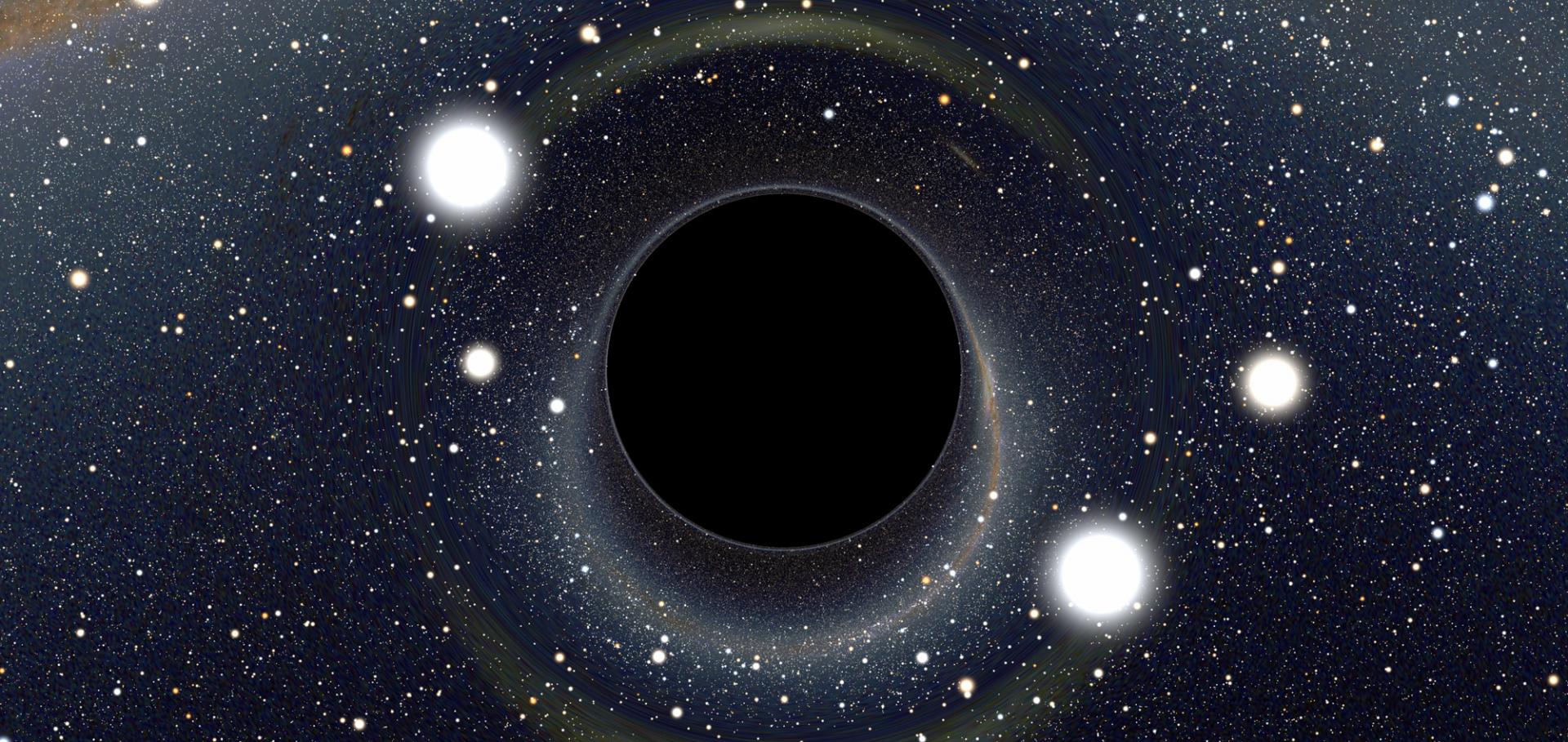
Black Hole

Lensing of space time around a black hole. At Oxford we study black holes observationally and theoretically on all size and time scales - it is some of our core work.

Credit: ALAIN RIAZUELO, IAP/UPMC/CNRS. CLICK HERE TO VIEW MORE IMAGES.

Dr James Matthews

Royal Society University Research Fellow

Research theme

  • Astronomy and astrophysics
  • Particle astrophysics & cosmology

Sub department

  • Astrophysics

Research groups

  • Galaxy formation and evolution
  • MeerKAT
  • Pulsars, transients and relativistic astrophysics
  • Gamma-ray astronomy
james.matthews@physics.ox.ac.uk
Telephone: 01865(2)73299
Denys Wilkinson Building, room 763
Website
  • About
  • Into the Cosmos
  • Publications

Cosmic ray transport and acceleration with magnetic mirroring

Monthly Notices of the Royal Astronomical Society Oxford University Press (OUP) (2025) staf562

Authors:

AR Bell, JH Matthews, AM Taylor, G Giacinti
More details from the publisher
More details

MeerKAT discovers a jet-driven bow shock near GRS 1915+105

Astronomy & Astrophysics EDP Sciences 696 (2025) a222

Authors:

SE Motta, P Atri, James H Matthews, Jakob van den Eijnden, Rob P Fender, James CA Miller-Jones, Ian Heywood, Patrick Woudt
More details from the publisher
More details

Quantifying jet–interstellar medium interactions in Cyg X-1: Insights from dual-frequency bow shock detection with MeerKAT

Astronomy & Astrophysics EDP Sciences 696 (2025) a223

Authors:

P Atri, SE Motta, J van den Eijnden, JH Matthews, JCA Miller-Jones, R Fender, D Williams-Baldwin, I Heywood, P Woudt
More details from the publisher
More details

Blast waves and reverse shocks: from ultra-relativistic GRBs to moderately relativistic X-ray binaries

(2025)

Authors:

James H Matthews, Alex J Cooper, Lauren Rhodes, Katherine Savard, Rob Fender, Francesco Carotenuto, Fraser J Cowie, Emma L Elley, Joe Bright, Andrew K Hughes, Sara E Motta
More details from the publisher
Details from ArXiV

Type I X-ray burst emission reflected into the eclipses of EXO 0748−676

Monthly Notices of the Royal Astronomical Society Oxford University Press 538:3 (2025) 2058-2074

Authors:

Amy H Knight, Jakob van den Eijnden, Adam Ingram, James H Matthews, Sara E Motta, Matthew Middleton, Giulio C Mancuso, Douglas JK Buisson, Diego Altamirano, Rob Fender, Timothy P Roberts

Abstract:

The neutron star X-ray binary, EXO 0748−676, was observed regularly by the Rossi X-ray Timing Explorer (RXTE) and XMM–Newton during its first detected outburst (1985–2008). These observations captured hundreds of asymmetric, energy-dependent X-ray eclipses, influenced by the ongoing ablation of the companion star and numerous Type I thermonuclear X-ray bursts. Here, we present the light curves of 22 Type I X-ray bursts observed by RXTE that coincide, fully or partially, with an X-ray eclipse. We identify nine instances where the burst occurs entirely within totality, seven bursts split across an egress, and six cases interrupted by an ingress. All in-eclipse and split bursts occurred while the source was in the hard spectral state. We establish that we are not observing direct burst emission during eclipses since the companion star and the ablated outflow entirely obscure our view of the X-ray emitting region. We determine that the reflected flux from the outer accretion disc, even if maximally flared, is insufficient to explain all observations of in-eclipse X-ray bursts and instead explore scenarios whereby the emission arising from the X-ray bursts is scattered, either by a burst-induced rise in that provides extra material, an accretion disc wind or the ablated outflow, into our line of sight. However, the rarity of a burst and eclipse overlap makes it challenging to determine their origin.
More details from the publisher
Details from ORA
More details

Pagination

  • First page First
  • Previous page Prev
  • …
  • Page 5
  • Page 6
  • Page 7
  • Page 8
  • Current page 9
  • Page 10
  • Page 11
  • Page 12
  • Page 13
  • …
  • Next page Next
  • Last page Last

Footer Menu

  • Contact us
  • Giving to the Dept of Physics
  • Work with us
  • Media

User account menu

  • Log in

Follow us

FIND US

Clarendon Laboratory,

Parks Road,

Oxford,

OX1 3PU

CONTACT US

Tel: +44(0)1865272200

University of Oxfrod logo Department Of Physics text logo
IOP Juno Champion logo Athena Swan Silver Award logo

© University of Oxford - Department of Physics

Cookies | Privacy policy | Accessibility statement

Built by: Versantus

  • Home
  • Research
  • Study
  • Engage
  • Our people
  • News & Comment
  • Events
  • Our facilities & services
  • About us
  • Giving to Physics
  • Current students
  • Staff intranet