Home
Department Of Physics text logo
  • Research
    • Our research
    • Our research groups
    • Our research in action
    • Research funding support
    • Summer internships for undergraduates
  • Study
    • Undergraduates
    • Postgraduates
  • Engage
    • For alumni
    • For business
    • For schools
    • For the public
  • Support
Menu
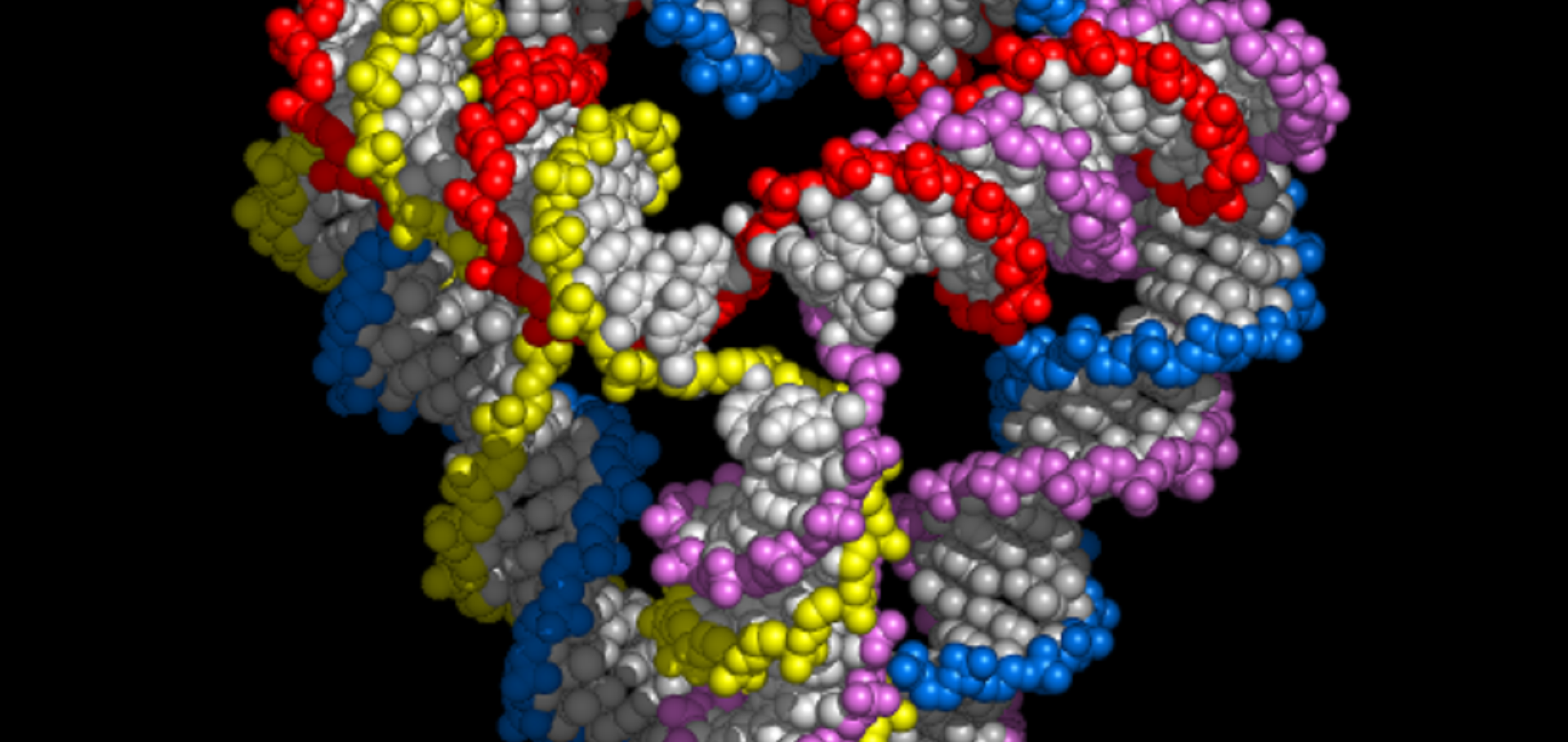
DNA tetrahedron

Professor Andrew Turberfield

Professor of Biological Physics

Research theme

  • Biological physics

Sub department

  • Condensed Matter Physics

Research groups

  • Nucleic acid nanotechnology
Andrew.Turberfield@physics.ox.ac.uk
  • About
  • Publications

Precision control of DNA-based molecular reactions

Institution of Engineering and Technology (IET) (2016) 1 .-1 .

Authors:

TE Ouldridge, JS Schreck, F Romano, P Sulc, RF Machinek, NEC Haley, AA Louis, JPK Doye, J Bath, AJ Turberfield
More details from the publisher

Modelling DNA origami self-assembly at the domain level.

Journal of Chemical Physics AIP Publishing 143:16 (2015) 165102

Authors:

Frits Dannenberg, Katherine E Dunn, Jonathan Bath, Marta Kwiatkowska, Andrew J Turberfield, Thomas E Ouldridge

Abstract:

We present a modelling framework, and basic model parameterization, for the study of DNA origami folding at the level of DNA domains. Our approach is explicitly kinetic and does not assume a specific folding pathway. The binding of each staple is associated with a free-energy change that depends on staple sequence, the possibility of coaxial stacking with neighbouring domains, and the entropic cost of constraining the scaffold by inserting staple crossovers. A rigorous thermodynamic model is difficult to implement as a result of the complex, multiply connected geometry of the scaffold: we present a solution to this problem for planar origami. Coaxial stacking of helices and entropic terms, particularly when loop closure exponents are taken to be larger than those for ideal chains, introduce interactions between staples. These cooperative interactions lead to the prediction of sharp assembly transitions with notable hysteresis that are consistent with experimental observations. We show that the model reproduces the experimentally observed consequences of reducing staple concentration, accelerated cooling, and absent staples. We also present a simpler methodology that gives consistent results and can be used to study a wider range of systems including non-planar origami.
More details from the publisher
Details from ORA
More details
More details
Details from ArXiV

Modelling DNA origami self-assembly at the domain level

Journal of Chemical Physics American Institute of Physics 143:16 (2015) 165102

Authors:

Frits Dannenberg, Katherine E Dunn, Jonathan Bath, Marta Kwiatkowska, Andrew Turberfield, Thomas E Ouldridge

Abstract:

We present a modelling framework, and basic model parameterization, for the study of DNA origami folding at the level of DNA domains. Our approach is explicitly kinetic and does not assume a specific folding pathway. The binding of each staple is associated with a free-energy change that depends on staple sequence, the possibility of coaxial stacking with neighbouring domains, and the entropic cost of constraining the scaffold by inserting staple crossovers. A rigorous thermodynamic model is difficult to implement as a result of the complex, multiply connected geometry of the scaffold: we present a solution to this problem for planar origami. Coaxial stacking of helices and entropic terms, particularly when loop closure exponents are taken to be larger than those for ideal chains, introduce interactions between staples. These cooperative interactions lead to the prediction of sharp assembly transitions with notable hysteresis that are consistent with experimental observations. We show that the model reproduces the experimentally observed consequences of reducing staple concentration, accelerated cooling, and absent staples. We also present a simpler methodology that gives consistent results and can be used to study a wider range of systems including non-planar origami.
More details from the publisher
Details from ORA

Guiding the folding pathway of DNA origami

Nature Springer Nature 525:7567 (2015) 82-86

Authors:

Katherine E Dunn, Frits Dannenberg, Thomas E Ouldridge, Marta Kwiatkowska, Andrew J Turberfield, Jonathan Bath
More details from the publisher
More details
More details

DNA walker circuits: computational potential, design, and verification

Natural Computing 14:2 (2015) 195-211

Authors:

F Dannenberg, M Kwiatkowska, C Thachuk, AJ Turberfield

Abstract:

Unlike their traditional, silicon counterparts, DNA computers have natural interfaces with both chemical and biological systems. These can be used for a number of applications, including the precise arrangement of matter at the nanoscale and the creation of smart biosensors. Like silicon circuits, DNA strand displacement systems (DSD) can evaluate non-trivial functions. However, these systems can be slow and are susceptible to errors. It has been suggested that localised hybridization reactions could overcome some of these challenges. Localised reactions occur in DNA ‘walker’ systems which were recently shown to be capable of navigating a programmable track tethered to an origami tile. We investigate the computational potential of these systems for evaluating Boolean functions and forming composable circuits. We find that systems of multiple walkers have severely limited potential for parallel circuit evaluation. DNA walkers, like DSDs, are also susceptible to errors. We develop a discrete stochastic model of DNA walker ‘circuits’ based on experimental data, and demonstrate the merit of using probabilistic model checking techniques to analyse their reliability, performance and correctness. This analysis aids in the design of reliable and efficient DNA walker circuits.
More details from the publisher

Pagination

  • First page First
  • Previous page Prev
  • …
  • Page 6
  • Page 7
  • Page 8
  • Page 9
  • Current page 10
  • Page 11
  • Page 12
  • Page 13
  • Page 14
  • …
  • Next page Next
  • Last page Last

Footer Menu

  • Contact us
  • Giving to the Dept of Physics
  • Work with us
  • Media

User account menu

  • Log in

Follow us

FIND US

Clarendon Laboratory,

Parks Road,

Oxford,

OX1 3PU

CONTACT US

Tel: +44(0)1865272200

University of Oxfrod logo Department Of Physics text logo
IOP Juno Champion logo Athena Swan Silver Award logo

© University of Oxford - Department of Physics

Cookies | Privacy policy | Accessibility statement

Built by: Versantus

  • Home
  • Research
  • Study
  • Engage
  • Our people
  • News & Comment
  • Events
  • Our facilities & services
  • About us
  • Giving to Physics
  • Current students
  • Staff intranet