

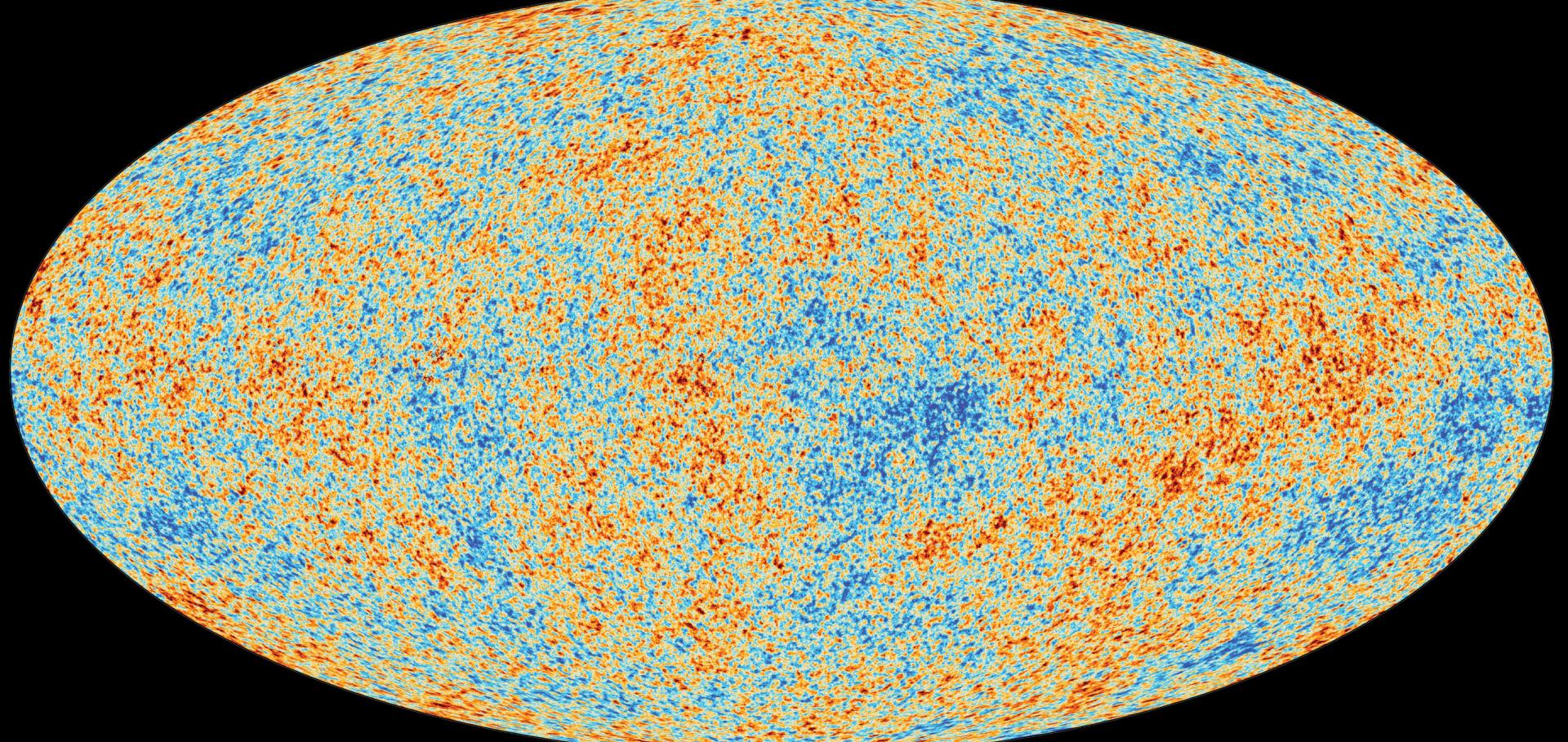
The Cosmic Background Radiation circa nu2K
ArXiv astro-ph/0011381 (2000)
Abstract:
We describe the implications of cosmic microwave background (CMB) observations and galaxy and cluster surveys of large scale structure (LSS) for theories of cosmic structure formation, especially emphasizing the recent Boomerang and Maxima CMB balloon experiments. The inflation-based cosmic structure formation paradigm we have been operating with for two decades has never been in better shape. Here we primarily focus on a simplified inflation parameter set, {omega_b,omega_{cdm},Omega_{tot}, Omega_Λ,n_s,τ_C, σ_8}. Combining all of the current CMB+LSS data points to the remarkable conclusion that the local Hubble patch we can access has little mean curvature (Omega_{tot}=1.08\pm 0.06) and the initial fluctuations were nearly scale invariant (n_s=1.03\pm 0.08), both predictions of (non-baroque) inflation theory. The baryon density is found to be slightly larger than that preferred by independent Big Bang Nucleosynthesis estimates (omega_b=0.030\pm 0.005 cf. 0.019\pm 0.002). The CDM density is in the expected range (omega_{cdm}=0.17 \pm 0.02). Even stranger is the CMB+LSS evidence that the density of the universe is dominated by unclustered energy akin to the cosmological constant (Omega_Λ=0.66\pm 0.06), at the same level as that inferred from high redshift supernova observations. We also sketch the CMB+LSS implications for massive neutrinos.Measuring Stellar and Dark Mass Fractions in Spiral Galaxies
ArXiv astro-ph/0011250 (2000)
Abstract:
We explore the relative importance of the stellar mass density as compared to the inner dark halo, for the observed gas kinematics thoughout the disks of spiral galaxies. We perform hydrodynamical simulations of the gas flow in a sequence of potentials with varying the stellar contribution to the total potential. The stellar portion of the potential was derived empirically from K-band photometry. The output of the simulations - namely the gas density and the gas velocity field - are then compared to the observed spiral arm morphology and the H-alpha gas kinematics. We solve for the best matching spiral pattern speed and draw conclusions on how massive the stellar disk can be at most. For the case of the galaxy NGC 4254 (Messier 99) we demonstrate that the prominent spiral arms of the stellar component would overpredict the non-circular gas motions unless an axisymmetric dark halo component adds significantly in the radial range R_exp R 3*R_exp.The Impact of Galaxy Formation on the Diffuse Background Radiation
ArXiv astro-ph/0010460 (2000)
Abstract:
The far infrared background is a sink for the hidden aspects of galaxy formation. At optical wavelengths, ellipticals and spheroids are old, even at $z \sim 1.$ Neither the luminous formation phase nor their early evolution is seen in the visible. We infer that ellipticals and, more generally, most spheroids must have formed in dust-shrouded starbursts. In this article, we show how separate tracking of disk and spheroid star formation enables us to infer that disks dominate near the peak in the cosmic star formation rate at $z \lapproxeq 2$ and in the diffuse ultraviolet/optical/infrared background, whereas spheroid formation dominates the submillimetre background.The Impact of Galaxy Formation on the Diffuse Background Radiation
(2000)