

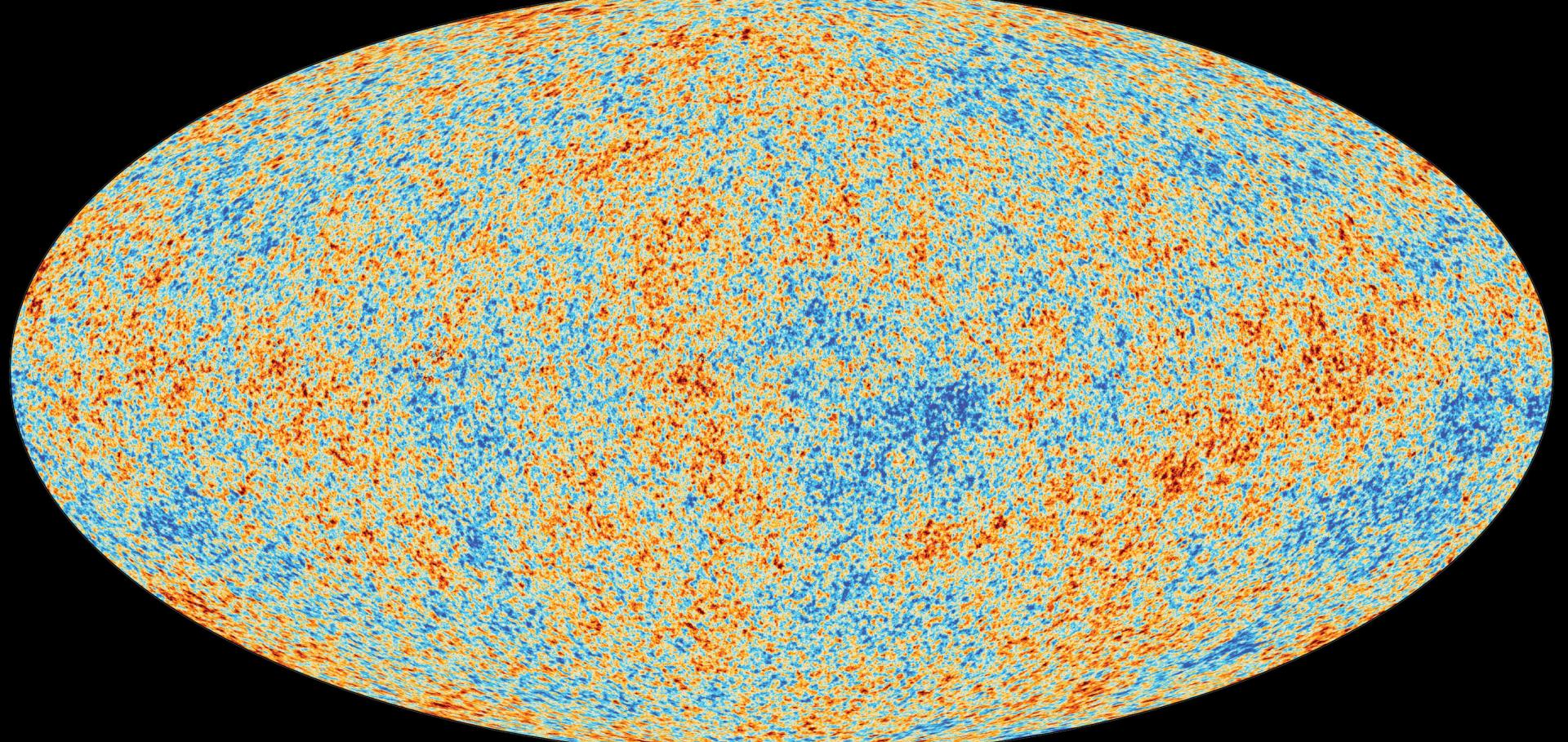
Evidence for non-Gaussianity in the COBE DMR Four Year Sky Maps
Astrophys.J. 503 (1998) L1-L4
Abstract:
We introduce and study the distribution of an estimator for the normalized bispectrum of the Cosmic Microwave Background (CMB) anisotropy. We use it to construct a goodness of fit statistic to test the coadded 53 and 90 GHz COBE-DMR 4 year maps for non-Gaussianity. Our results indicate that Gaussianity is ruled out at the confidence level in excess of 98%. This value is a lower bound, given all the investigated systematics. The dominant non-Gaussian contribution is found near the multipole of order $\ell=16$. Our attempts to explain this effect as caused by the diffuse foreground emission from the Galaxy have failed. We conclude that unless there exists a microwave foreground emission which spatially correlates neither with the DIRBE nor Haslam maps, the cosmological CMB anisotropy is genuinely non-Gaussian.Cosmology with a Primordial Scaling Field
Phys.Rev.D 58 (1998) 023503-023503
Abstract:
A weakly coupled scalar field $\Phi$ with a simple exponential potential $V=M_P^4\exp(-\lambda\Phi/M_P)$ where $M_P$ is the reduced Planck mass, and $\lambda > 2$, has an attractor solution in a radiation or matter dominated universe in which it mimics the scaling of the dominant component, contributing a fixed fraction $\Omega_\phi$ (determined by $\lambda$) to the energy density. Such fields arise generically in particle physics theories involving compactified dimensions, with values of $\lambda$ which give a cosmologically relevant $\Omega_\phi$. For natural initial conditions on the scalar field in the early universe the attractor solution is established long before the epoch of structure formation, and in contrast to the solutions used in other scalar field cosmologies, it is one which does not involve an energy scale for the scalar field characteristic of late times . We study in some detail the evolution of matter and radiation perturbations in a standard inflation-motivated $\Omega=1$ dark-matter dominated cosmology with this extra field. Using a full Einstein-Boltzmann calculation we compare observable quantities with current data. We find that, for $\Omega_\phi\simeq 0.08-0.12$, these models are consistent with large angle cosmic microwave background anisotropies as detected by COBE, the linear mass variance as compiled from galaxy surveys, big bang nucleosynthesis, the abundance of rich clusters and constraints from the Lyman-$\alpha$ systems at high redshift. Given the simplicity of the model, its theoretical motivation and its success in matching observations, we argue that it should be taken on a par with other currently viable models of structure formation.Contribution of Galaxies to the Background Hydrogen-Ionizing Flux
(1998)
Evidence for non-Gaussianity in the COBE DMR Four Year Sky Maps
(1998)