

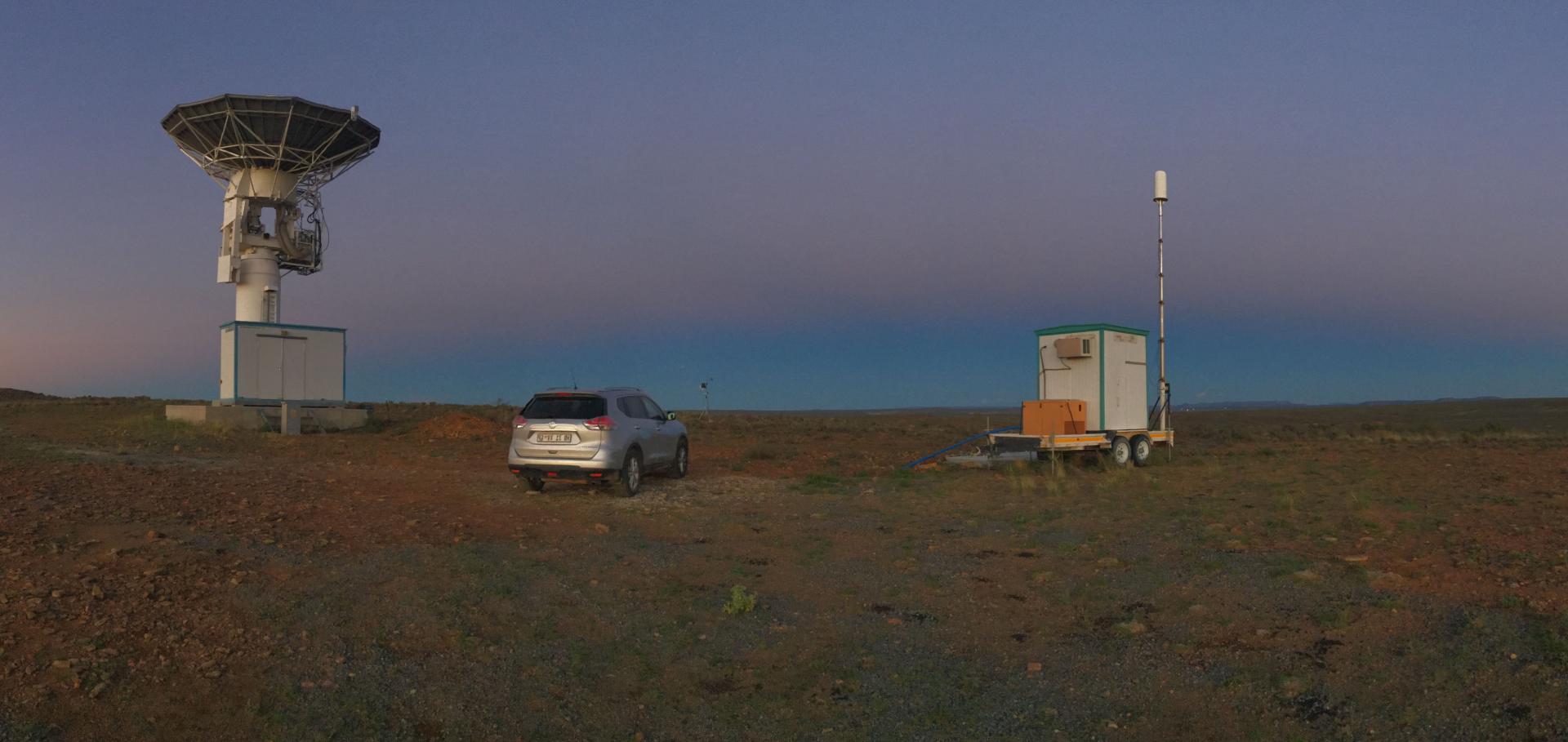
The QUIET Instrument
ArXiv 1207.5562 (2012)
Abstract:
The Q/U Imaging ExperimenT (QUIET) is designed to measure polarization in the Cosmic Microwave Background, targeting the imprint of inflationary gravitational waves at large angular scales (~ 1 degree). Between 2008 October and 2010 December, two independent receiver arrays were deployed sequentially on a 1.4 m side-fed Dragonian telescope. The polarimeters which form the focal planes use a highly compact design based on High Electron Mobility Transistors (HEMTs) that provides simultaneous measurements of the Stokes parameters Q, U, and I in a single module. The 17-element Q-band polarimeter array, with a central frequency of 43.1 GHz, has the best sensitivity (69 uK sqrt(s)) and the lowest instrumental systematic errors ever achieved in this band, contributing to the tensor-to-scalar ratio at r < 0.1. The 84-element W-band polarimeter array has a sensitivity of 87 uK sqrt(s) at a central frequency of 94.5 GHz. It has the lowest systematic errors to date, contributing at r < 0.01. The two arrays together cover multipoles in the range l= 25-975. These are the largest HEMT-based arrays deployed to date. This article describes the design, calibration, performance of, and sources of systematic error for the instrument.The first billion years: report of a study program
(2012)
A 650 GHz unilateral finline SIS mixer fed by a multiple flare-angle smooth-walled horn
IEEE Transactions on Terahertz Science and Technology 2:1 (2012) 40-49
Abstract:
We report the design and successful operation of an superconductor- insulator-superconductor (SIS) mixer operating near the superconducting gap of niobium. A key feature of this design is the employment of a unilateral finline taper to transform the waveguide modes to microstrip signals. This transition is easy to design since it can be rigorously modeled, and also easy to fabricate being a single-layer structure. We will show that unilateral finline mixers have important advantages at THz frequencies since they exhibit wideband operation at both radio frequency (RF) and intermediate frequency (IF), allow elegant on-chip integration of the mixer circuits and result in an extremely simple mixer block that does not require a backshort or any mechanical tuners. The mixer we describe below is fed by a multiple flare-angle smooth-walled horn which exhibits beam pattern characteristic comparable to the conventional corrugated horn and yet is much easier to fabricate. In this paper, we shall present a brief discussion of the testing of the multiple flare-angle horn and detailed description of the design and testing of the mixer, covering ∼100 GHz bandwidth centered at 650 GHz. In particular, we will present full electromagnetic design description of the mixer chip including the superconducting effects, and the heterodyne properties of the mixer using quantum mixing theory. Mixer performance tests that we carried out from 595 to 702 GHz gave a best receiver noise temperature of 145 K at 600 GHz, corrected for a 75 μm beam splitter. Finally, we performed a thorough analysis of the mixer performance, comparing the experimental results with theoretical models. Our investigation demonstrated that unilateral finline mixers fed by a multiple flare-angle horn can yield performance comparable to conventional designs, hence are suitable for large format mixer array at THz frequencies. © 2011 IEEE.Experimental investigation of a low-cost, high performance focal-plane horn array
IEEE Transactions on Terahertz Science and Technology 2:1 (2012) 61-70
Abstract:
In previous work, we have described novel smooth-walled multiple flare-angle horns designed using a genetic algorithm. A key feature of these horns is that they can be manufactured very rapidly and cheaply in large numbers, by repeated direct drilling into a single plate of aluminum using a shaped machine tool. The rapid manufacturing technique will enable the construction of very low cost focal-plane arrays, offering an alternative to conventional electroformed corrugated horn arrays. © 2011 IEEE.SECOND SEASON QUIET OBSERVATIONS: MEASUREMENTS OF THE COSMIC MICROWAVE BACKGROUND POLARIZATION POWER SPECTRUM AT 95 GHz
ASTROPHYSICAL JOURNAL 760:2 (2012) ARTN 145