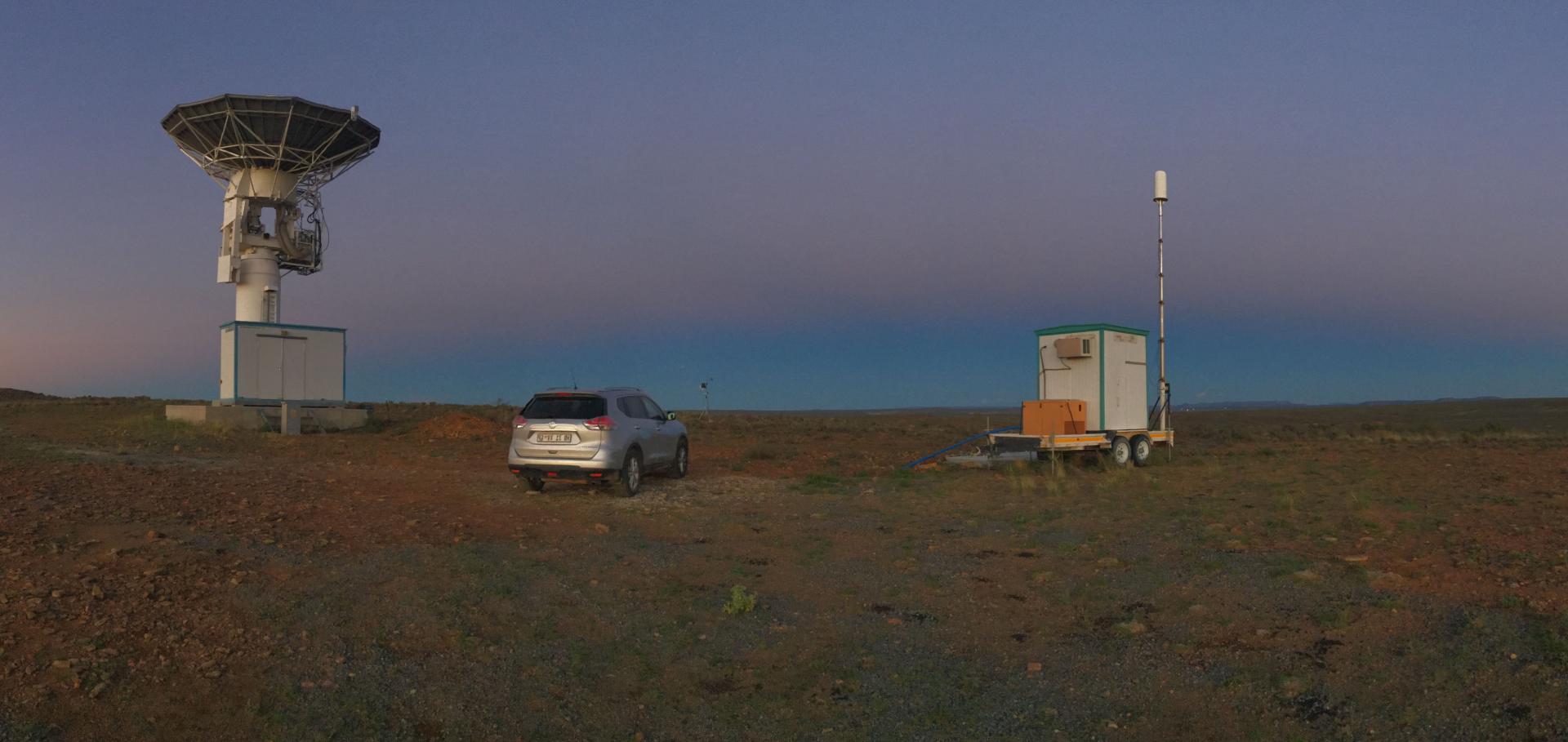
Radio source calibration for the Very Small Array and other cosmic microwave background instruments at around 30 GHz

Monthly Notices of the Royal Astronomical Society 388:4 (2008) 1775-1786

Authors:

YA Hafez, RD Davies, RJ Davis, C Dickinson, ES Battistelli, F Blanco, K Cleary, T Franzen, R Genova-Santos, K Grainge, MP Hobson, ME Jones, K Lancaster, AN Lasenby, CP Padilla-Torres, JA Rubiño-Martin, R Rebolo, RDE Saunders, PF Scott, AC Taylor, D Titterington, M Tucci, RA Watson

Abstract:

Accurate calibration of data is essential for the current generation of cosmic microwave background (CMB) experiments. Using data from the Very Small Array (VSA), we describe procedures which will lead to an accuracy of 1 per cent or better for experiments such as the VSA and CBI. Particular attention is paid to the stability of the receiver systems, the quality of the site and frequent observations of reference sources. At 30 GHz the careful correction for atmospheric emission and absorption is shown to be essential for achieving 1 per cent precision. The sources for which a 1 per cent relative flux density calibration was achieved included Cas A, Cyg A, Tau A and NGC 7027 and the planets Venus, Jupiter and Saturn. A flux density, or brightness temperature in the case of the planets, was derived at 33 GHz relative to Jupiter which was adopted as the fundamental calibrator. A spectral index at ∼30 GHz is given for each. Cas A, Tau A, NGC 7027 and Venus were examined for variability. Cas A was found to be decreasing at 0.394 ± 0.019 per cent yr-1 over the period 2001 March to 2004 August. In the same period Tau A was decreasing at 0.22 ± 0.07 per cent yr-1. A survey of the published data showed that the planetary nebula NGC 7027 decreased at 0.16 ± 0.04 per cent yr-1 over the period 1967-2003. Venus showed an insignificant (1.5 ± 1.3 per cent) variation with Venusian illumination. The integrated polarization of Tau A at 33 GHz was found to be 7.8 ± 0.6 per cent at position angle =148° ± 3°. © 2008 The Authors.

Implementation of an optimized Cassegrain system for radio telescopes

MONTHLY NOTICES OF THE ROYAL ASTRONOMICAL SOCIETY 384:3 (2008) 1207-1210

Authors:

CM Holler, RE Hills, ME Jones, K Grainge, T Kaneko

The Arcminute Microkelvin Imager★

Monthly Notices of the Royal Astronomical Society Blackwell Publishing Ltd 391 (2008) 4

Authors:

JTL Zwart, RW Barker, P Biddulph, D Bly, RC Boysen, AR Brown, C Clementson, M Crofts, TL Culverhouse, J Czeres, RJ Dace, ML Davies, R D Alessandro, P Doherty, K Duggan, JA Ely, M Felvus, F Feroz, W Flynn, TMO Franzen, J Geisbüsch, R Génova-Santos, KJB Grainge, WF Grainger, D Hammett, RE Hills, MP Hobson, CM Holler, N Hurley-Walker, R Jilley, ME Jones, T Kaneko, R Kneissl, K Lancaster, AN Lasenby, PJ Marshall, F Newton, O Norris, I Northrop, DM Odell, G Petencin, JC Pober, GG Pooley, MW Pospieszalski, V Quy, C Rodríguez-Gonzálvez, RDE Saunders, AMM Scaife, J Schofield, PF Scott, C Shaw, TW Shimwell, H Smith, AC Taylor, DJ Titterington, M Velić, EM Waldram, S West, BA Wood, G Yassin

The ClOVER Experiment

MILLIMETER AND SUBMILLIMETER DETECTORS AND INSTRUMENTATION FOR ASTONOMY IV 7020 (2008) ARTN 70201E

Authors:

L Piccirillo, P Ade, MD Audley, C Baines, R Battye, M Brown, P Calisse, A Challinor, WD Duncan, P Ferreira, W Gear, DM Glowacka, D Goldie, PK Grimes, M Halpern, V Haynes, GC Hilton, KD Irwin, B Johnson, M Jones, A Lasenby, P Leahy, J Leech, S Lewis, B Maffei, L Martinis, PD Mauskopf, SJ Melhuish, CE North, D O'Dea, S Parsley, G Pisano, CD Reintsema, G Savini, RV Sudiwala, D Sutton, A Taylor, G Teleberg, D Titterington, VN Tsaneva, C Tucker, R Watson, S Withington, G Yassin, J Zhang

A high performance horn for large format focal plane arrays

Proceedings of the Eighteenth International Symposium on Space Terahertz Technology 2007, ISSTT 2007 (2007) 199-210

Authors:

G Yassin, P Kittara, A Jiralucksanawong, S Wangsuya, J Leech, M Jones

Abstract:

We describe the design and performance of an easy to machine horn which exhibits excellent beam circularity and low cross polarisation over a relatively large bandwidth. No grooves are machined into the horn walls but, alternatively, flare angle discontinuities are generated along the horn profile. In other words, the horns will have several flare angles or sections instead of one. For example, if the horn consists of two flare angles, it could then be considered as a conventional Potter horn. As can be seen below, even with this simple design, excellent radiation patterns can be obtained over 15% bandwidth. The bandwidth could be further increased by adding more subsections with 30% bandwidth obtained when the profile is based on 4 sections. The operation of the horn is based on generating higher order modes at the correct amplitude ratio and phase with respect to the incident TE11 mode in the circular waveguide, which is achieved by accurate determination of the magnitude and location of the flare steps. This in turn yields a field distribution at the horn aperture that has low sidelobes and cross polarization in the radiation pattern. A key component in the design package is the optimization software that searches for the correct magnitude and location of the flare discontinuities. We have generated a software package based on the combination of modal matching, genetic algorithm (GA) and simplex optimization. The genetic code is first used to locate the proximity of the global minimum. The set of parameters obtained are then used as a starting point for the simplex method, which refines the parameters to the required accuracy. We shall illustrate our method by showing radiation patterns using two and three step discontinuities and also patterns for a spline profiled horn based on work by other investigators who used different optimization techniques.