

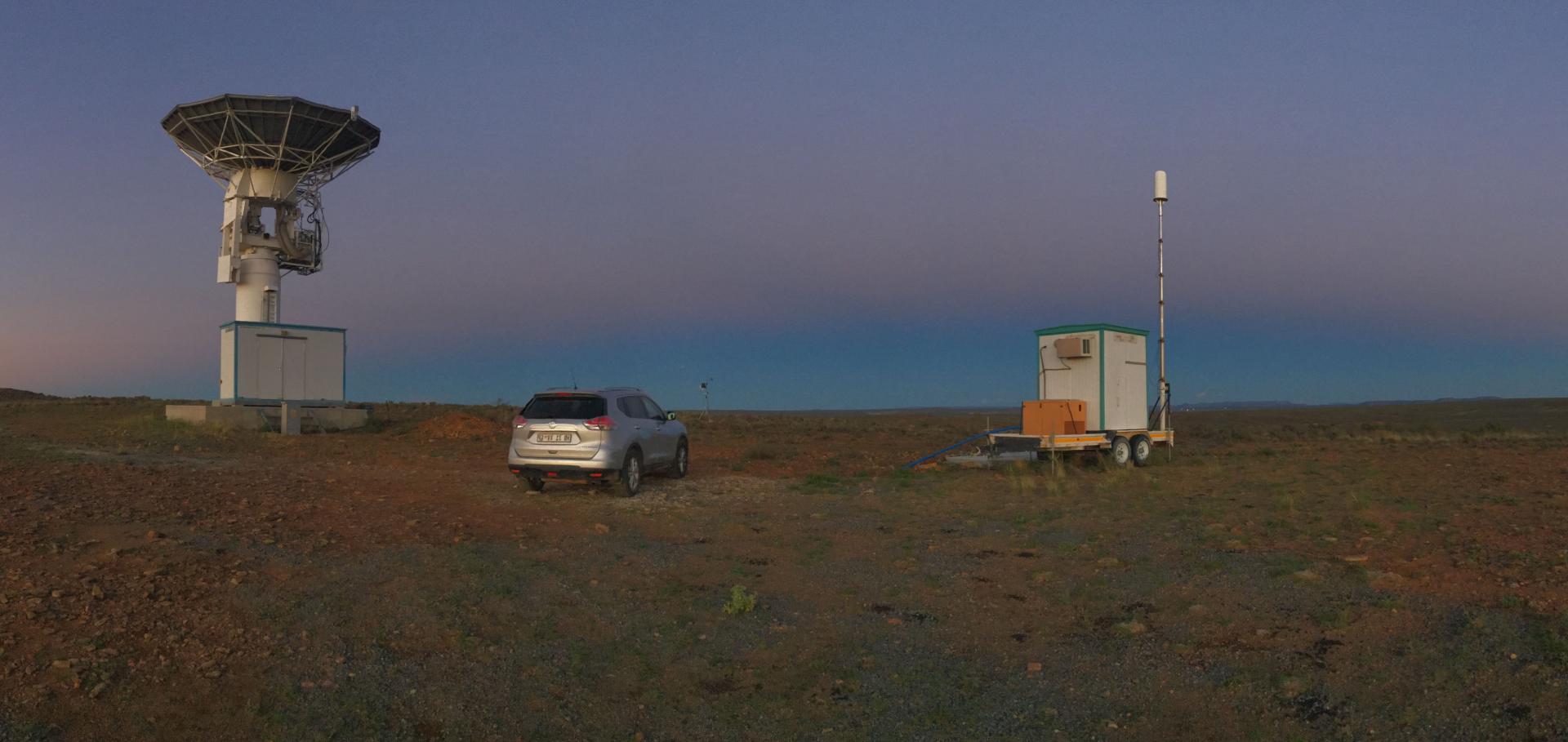
The CMB power spectrum out to l=1400 measured by the VSA
ArXiv astro-ph/0212495 (2002)
Abstract:
We have observed the cosmic microwave background (CMB) in three regions of sky using the Very Small Array (VSA) in an extended configuration with antennas of beamwidth 2 degrees at 34 GHz. Combined with data from previous VSA observations using a more compact array with larger beamwidth, we measure the power spectrum of the primordial CMB anisotropies between angular multipoles l = 160 - 1400. Such measurements at high l are vital for breaking degeneracies in parameter estimation from the CMB power spectrum and other cosmological data. The power spectrum clearly resolves the first three acoustic peaks, shows the expected fall off in power at high l and starts to constrain the position and height of a fourth peak.First results from the Very Small Array -- I. Observational methods
ArXiv astro-ph/0205378 (2002)
Abstract:
The Very Small Array (VSA) is a synthesis telescope designed to image faint structures in the cosmic microwave background on degree and sub-degree angular scales. The VSA has key differences from other CMB interferometers with the result that different systematic errors are expected. We have tested the operation of the VSA with a variety of blank-field and calibrator observations and cross-checked its calibration scale against independent measurements. We find that systematic effects can be suppressed below the thermal noise level in long observations; the overall calibration accuracy of the flux density scale is 3.5 percent and is limited by the external absolute calibration scale.First results from the Very Small Array -- II. Observations of the CMB
ArXiv astro-ph/0205381 (2002)
Abstract:
We have observed the cosmic microwave background temperature fluctuations in eight fields covering three separated areas of sky with the Very Small Array at 34 GHz. A total area of 101 square degrees has been imaged, with sensitivity on angular scales 3.6 - 0.4 degrees (equivalent to angular multipoles l=150-900). We describe the field selection and observing strategy for these observations. In the full-resolution images (with synthesised beam of FWHM ~ 17 arcmin) the thermal noise is typically 45 microK and the CMB signal typically 55 microK. The noise levels in each field agree well with the expected thermal noise level of the telescope, and there is no evidence of any residual systematic features. The same CMB features are detected in separate, overlapping observations. Discrete radio sources have been detected using a separate 15 GHz survey and their effects removed using pointed follow-up observations at 34 GHz. We estimate that the residual confusion noise due to unsubtracted radio sources is less than 14 mJy/beam (15 microK in the full-resolution images), which added in quadrature to the thermal noise increases the noise level by 6 %. We estimate that the rms contribution to the images from diffuse Galactic emission is less than 6 microK. We also present images which are convolved to maximise the signal-to-noise of the CMB features and are co-added in overlapping areas, in which the signal-to-noise of some individual CMB features exceeds 8.First results from the Very Small Array -- IV. Cosmological parameter estimation
ArXiv astro-ph/0205367 (2002)
Abstract:
We investigate the constraints on basic cosmological parameters set by the first compact-configuration observations of the Very Small Array (VSA), and other cosmological data sets, in the standard inflationary LambdaCDM model. Using a weak prior 40 < H_0 < 90 km/s/Mpc and 0 < tau < 0.5 we find that the VSA and COBE_DMR data alone produce the constraints Omega_tot = 1.03^{+0.12}_{-0.12}, Omega_bh^2 = 0.029^{+0.009}_{-0.009}, Omega_cdm h^2 = 0.13^{+0.08}_{-0.05} and n_s = 1.04^{+0.11}_{-0.08} at the 68 per cent confidence level. Adding in the type Ia supernovae constraints, we additionally find Omega_m = 0.32^{+0.09}_{-0.06} and Omega_Lambda = 0.71^{+0.07}_{-0.07}. These constraints are consistent with those found by the BOOMERanG, DASI and MAXIMA experiments. We also find that, by combining all the recent CMB experiments and assuming the HST key project limits for H_0 (for which the X-ray plus Sunyaev--Zel'dovich route gives a similar result), we obtain the tight constraints Omega_m=0.28^{+0.14}_{-0.07} and Omega_Lambda= 0.72^{+0.07}_{-0.13}, which are consistent with, but independent of, those obtained using the supernovae data.The Very Small Array
AIP Conference Proceedings AIP Publishing 616:1 (2002) 72-78