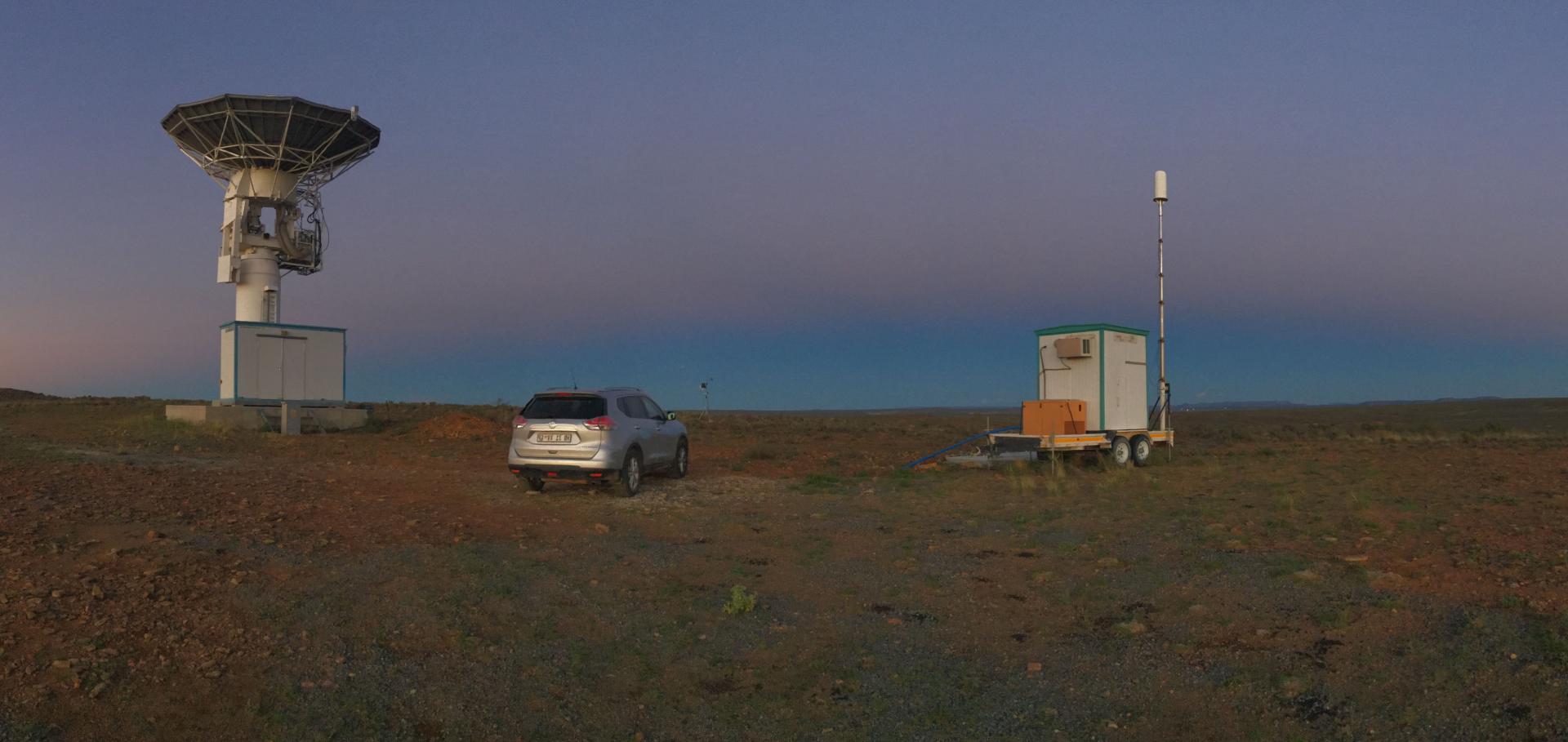
The C-Band All-Sky Survey (C-BASS): Digital backend for the northern survey

Monthly Notices of the Royal Astronomical Society Oxford University Press (OUP) (2019)

Authors:

MA Stevenson, TJ Pearson, Michael E Jones, CJ Copley, C Dickinson, JJ John, OG King, SJC Muchovej, Angela C Taylor

The C-Band All-Sky survey (C-BASS)

Proceedings of the 53rd Rencontres de Moriond, Cosmology 2018 ARISF (2018) 137-140

Abstract:

The C-Band All-Sky survey (C-BASS) is an experiment to image the whole sky in intensity and polarization at 5 GHz. The primary aim of C-BASS is to provide low-frequency all-sky maps of the Galactic emission which will enable accurate component separation analysis of both existing and future CMB intensity and polarization imaging surveys. Here we present an overview of the experiment and an update on the current status of observations. We present simulation results showing the expected improvement in the recovery of CMB and foreground signals when including C-BASS data as an additional low-frequency channel, both for intensity and polarization. We also present preliminary results from the northern part of the sky survey.

The C-Band All-Sky Survey (C-BASS): design and capabilities

MONTHLY NOTICES OF THE ROYAL ASTRONOMICAL SOCIETY 480:3 (2018) 3224-3242

Authors:

Michael E Jones, Angela C Taylor, Moumita Aich, CJ Copley, H Cynthia Chiang, RJ Davis, C Dickinson, RDP Grumitt, Yaser Hafez, Heiko M Heilgendorff, CM Holler, MO Irfan, Luke RP Jew, JJ John, J Jonas, OG King, JP Leahy, J Leech, EM Leitch, SJC Muchovej, TJ Pearson, MW Peel, ACS Readhead, Jonathan Sievers, MA Stevenson, J Zuntz

The STRIP instrument of the Large Scale Polarization Explorer: microwave eyes to map the Galactic polarized foregrounds

SPIE, the international society for optics and photonics 10708 (2018) 107081g

Authors:

Cristian Franceschet, Sabrina Realini, Aniello Mennella, Giuseppe Addamo, Alessandro Baù, Paola M Battaglia, Marco Bersanelli, Barbara Caccianiga, Silvia Caprioli, Francesco Cavaliere, Kieran A Cleary, Francesco Cuttaia, Francesco Del Torto, Viviana Fafone, Zunnoorain Farooqui, Ricardo T Génova Santos, Todd C Gaier, Massimo Gervasi, Tommaso Ghigna, Federico Incardona, Simone Iovenitti, Mike Jones, Pekka Kangaslahti, Roberto Mainini, Davide Maino, Michele Maris, Patricio Mena, Rocío Molina, Gianluca Morgante, Andrea Passerini, Maria del Rosario Perez-de-Taoro, Oscar A Peverini, Federico Pezzotta, Claudio Pincella, Nicolás Reyes, Alessio Rocchi, José A Rubiño-Martín, Maura Sandri, Stefano Sartor, Mary Soria, Valeria Tapia, Luca Terenzi, Maurizio Tomasi, Elisabetta Tommasi, Daniele M Viganó, Fabrizio Villa, Giuseppe Virone, Angela Volpe, Bob Watkins, Andrea Zacchei, Mario Zannoni

The state-of-play of Anomalous Microwave Emission (AME) research

New Astronomy Reviews Elsevier (2018)

Authors:

C Dickinson, Y Ali-Haïmoud, A Barr, ES Battistelli, A Bell, L Bernstein, S Cassassus, K Cleary, BT Draine, R Génova-Santos, Harper, B Hensley, Jaz R Hill-Valler, T Hoang, FP Israel, Luke Jew, A Lazarian, JP Leahy, Jamie Leech, CH López-Carabello, I McDonald, EJ Murphy, T Onaka, R Paladini, MW Peel, Y Perrott, F Poidevin, ACS Readhead, J-A Rubiño-Martín, Angela C Taylor, CT Tibbs, M Todorovic, M Vidal

Abstract:

Anomalous Microwave Emission (AME) is a component of diffuse Galactic radiation observed at frequencies in the range ≈10–60 GHz. AME was first detected in 1996 and recognised as an additional component of emission in 1997. Since then, AME has been observed by a range of experiments and in a variety of environments. AME is spatially correlated with far-IR thermal dust emission but cannot be explained by synchrotron or free–free emission mechanisms, and is far in excess of the emission contributed by thermal dust emission with the powerlaw opacity consistent with the observed emission at sub-mm wavelengths. Polarization observations have shown that AME is very weakly polarized ( ≲ 1 %). The most natural explanation for AME is rotational emission from ultra-small dust grains (“spinning dust”), first postulated in 1957. Magnetic dipole radiation from thermal fluctuations in the magnetization of magnetic grain materials may also be contributing to the AME, particularly at higher frequencies ( ≳ 50 GHz). AME is also an important foreground for Cosmic Microwave Background analyses. This paper presents a review and the current state-of-play in AME research, which was discussed in an AME workshop held at ESTEC, The Netherlands, June 2016.