The Feasibility of Magnetic Reconnection Powered Blazar Flares from Synchrotron Self-Compton Emission

(2018)

Authors:

Paul J Morris, William J Potter, Garret Cotter

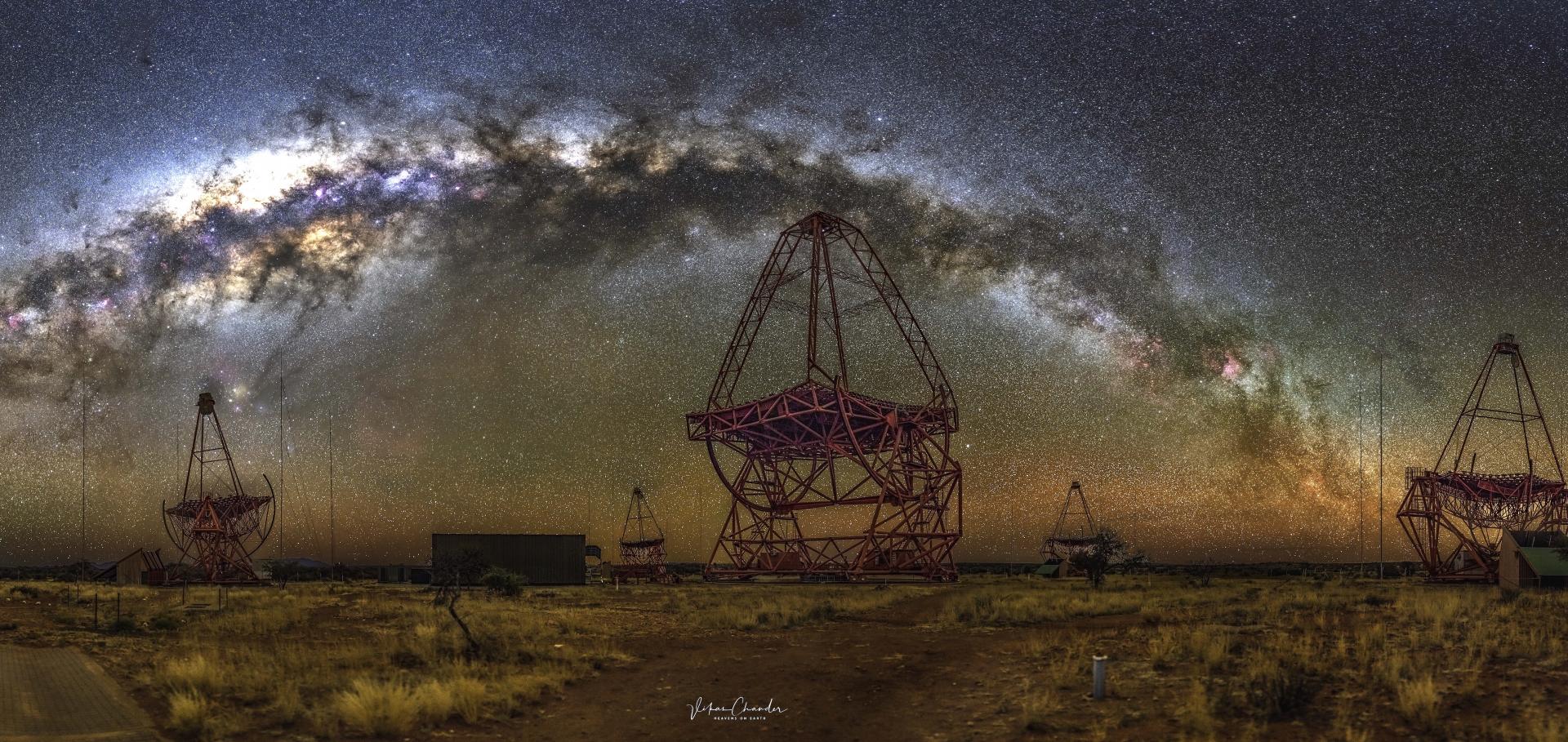
Characterisation and testing of CHEC-M—A camera prototype for the small-sized telescopes of the Cherenkov telescope array

Nuclear Instruments and Methods in Physics Research, Section A: Accelerators, Spectrometers, Detectors and Associated Equipment 904 (2018) 44-63

Authors:

J Zorn, R White, JJ Watson, TP Armstrong, A Balzer, M Barcelo, D Berge, R Bose, AM Brown, M Bryan, PM Chadwick, P Clark, H Costantini, G Cotter, L Dangeon, M Daniel, A De Franco, P Deiml, G Fasola, S Funk, M Gebyehu, J Gironnet, JA Graham, T Greenshaw, JA Hinton, M Kraus, JS Lapington, P Laporte, SA Leach, O Le Blanc, A Malouf, P Molyneux, P Moore, H Prokoph, A Okumura, D Ross, G Rowell, L Sapozhnikov, H Schoorlemmer, H Sol, M Stephan, H Tajima, L Tibaldo, G Varner, A Zink

Abstract:

© 2018 Elsevier B.V. The Compact High Energy Camera (CHEC) is a camera design for the Small-Sized Telescopes (SSTs; 4 m diameter mirror) of the Cherenkov Telescope Array (CTA). The SSTs are focused on very-high-energy γ-ray detection via atmospheric Cherenkov light detection over a very large area. This implies many individual units and hence cost-effective implementation, as well as shower detection at large impact distance, and hence large field of view (FoV), and efficient image capture in the presence of large time gradients in the shower image detected by the camera. CHEC relies on dual-mirror optics to reduce the plate-scale and make use of 6 × 6 mm2pixels, leading to a low-cost (∼150 k€), compact (0.5 m × 0.5 m), and light (∼45 kg) camera with 2048 pixels providing a camera FoV of ∼9 degrees. The CHEC electronics are based on custom TARGET (TeV array readout with GSa/s sampling and event trigger) application-specific integrated circuits (ASICs) and field programmable gate arrays (FPGAs) sampling incoming signals at a gigasample per second, with flexible camera-level triggering within a single backplane FPGA. CHEC is designed to observe in the γ-ray energy range of 1–300 TeV, and at impact distances up to ∼500 m. To accommodate this and provide full flexibility for later data analysis, full waveforms with 96 samples for all 2048 pixels can be read out at rates up to ∼900 Hz. The first prototype, CHEC-M, based on multi-anode photomultipliers (MAPMs) as photosensors, was commissioned and characterised in the laboratory and during two measurement campaigns on a telescope structure at the Paris Observatory in Meudon. In this paper, the results and conclusions from the laboratory and on-site testing of CHEC-M are presented. They have provided essential input on the system design and on operational and data analysis procedures for a camera of this type. A second full-camera prototype based on Silicon photomultipliers (SiPMs), addressing the drawbacks of CHEC-M identified during the first prototype phase, has already been built and is currently being commissioned and tested in the laboratory.

The first tidal disruption flare in ZTF: from photometric selection to multi-wavelength characterization

(2018)

Authors:

Sjoert van Velzen, Suvi Gezari, S Bradley Cenko, Erin Kara, James C Miller-Jones, Tiara Hung, Joe Bright, Nathaniel Roth, Nadejda Blagorodnova, Daniela Huppenkothen, Lin Yan, Eran Ofek, Jesper Sollerman, Sara Frederick, Charlotte Ward, Matthew J Graham, Rob Fender, Mansi M Kasliwal, Chris Canella, Robert Stein, Matteo Giomi, Valery Brinnel, Jakob Santen, Jakob Nordin, Eric C Bellm, Richard Dekany, Christoffer Fremling, V Zach Golkhou, Thomas Kupfer, Shrinivas R Kulkarni, Russ R Laher, Ashish Mahabal, Frank J Masci, Adam A Miller, James D Neill, Reed Riddle, Mickael Rigault, Ben Rusholme, Maayane T Soumagnac, Yutaro Tachibana

The origin of radio emission in broad absorption line quasars: Results from the LOFAR Two-metre Sky Survey

Astronomy and Astrophysics EDP Sciences 622 (2018) A15

Authors:

Leah Morabito, James Matthews, P Best, G Gurkan, Matthew Jarvis, I Prandoni, K Duncan, M Hardcastle, M Kunert-Bajraszewska, A Mechev, S Mooney, J Sabeter, H Rottgering, T Shimwell, D Smith, C Tasse, W Williams

Abstract:

We present a study of the low-frequency radio properties of broad absorption line quasars (BALQSOs) from the LOFAR Two-metre Sky-Survey Data Release 1 (LDR1). The value-added LDR1 catalogue contains Pan-STARRS counterparts, which we match with the Sloan Digital Sky Survey (SDSS) DR7 and DR12 quasar catalogues. We find that BALQSOs are twice as likely to be detected at 144 MHz than their non-BAL counterparts, and BALQSOs with low-ionisation species present in their spectra are three times more likely to be detected than those with only high-ionisation species. The BALQSO fraction at 144 MHz is constant with increasing radio luminosity, which is inconsistent with previous results at 1.4 GHz, indicating that observations at the different frequencies may be tracing different sources of radio emission. We cross-match radio sources between the Faint Images of the Radio Sky at Twenty Centimeters (FIRST) survey and LDR1, which provides a bridge via the LDR1 Pan-STARRS counterparts to identify BALQSOs in SDSS. Consequently we expand the sample of BALQSOs detected in FIRST by a factor of three. The LDR1-detected BALQSOs in our sample are almost exclusively radio-quiet (log(R144 MHz) <2), with radio sizes at 144 MHz typically less than 200 kpc; these radio sizes tend to be larger than those at 1.4 GHz, suggesting more extended radio emission at low frequencies. We find that although the radio detection fraction increases with increasing balnicity index (BI), there is no correlation between BI and either low-frequency radio power or radio-loudness. This suggests that both radio emission and BI may be linked to the same underlying process, but are spatially distinct phenomena.

Identifying transient and variable sources in radio images

(2018)

Authors:

Antonia Rowlinson, Adam J Stewart, Jess W Broderick, John D Swinbank, Ralph AMJ Wijers, Dario Carbone, Yvette Cendes, Rob Fender, Alexander van der Horst, Gijs Molenaar, Bart Scheers, Tim Staley, Sean Farrell, Jean-Mathias Grießmeier, Martin Bell, Jochen Eislöffel, Casey J Law, Joeri van Leeuwen, Philippe Zarka