

Very-high-energy $\gamma$-ray emission from young massive star clusters in the Large Magellanic Cloud
(2024)
Dark matter line searches with the Cherenkov Telescope Array
Journal of Cosmology and Astroparticle Physics IOP Publishing 2024:07 (2024) 047
Abstract:
Monochromatic gamma-ray signals constitute a potential smoking gun signature for annihilating or decaying dark matter particles that could relatively easily be distinguished from astrophysical or instrumental backgrounds. We provide an updated assessment of the sensitivity of the Cherenkov Telescope Array (CTA) to such signals, based on observations of the Galactic centre region as well as of selected dwarf spheroidal galaxies. We find that current limits and detection prospects for dark matter masses above 300 GeV will be significantly improved, by up to an order of magnitude in the multi-TeV range. This demonstrates that CTA will set a new standard for gamma-ray astronomy also in this respect, as the world's largest and most sensitive high-energy gamma-ray observatory, in particular due to its exquisite energy resolution at TeV energies and the adopted observational strategy focussing on regions with large dark matter densities. Throughout our analysis, we use up-to-date instrument response functions, and we thoroughly model the effect of instrumental systematic uncertainties in our statistical treatment. We further present results for other potential signatures with sharp spectral features, e.g. box-shaped spectra, that would likewise very clearly point to a particle dark matter origin.Very-high-energy γ -Ray Emission from Young Massive Star Clusters in the Large Magellanic Cloud
The Astrophysical Journal Letters American Astronomical Society 970:1 (2024) L21
Abstract:
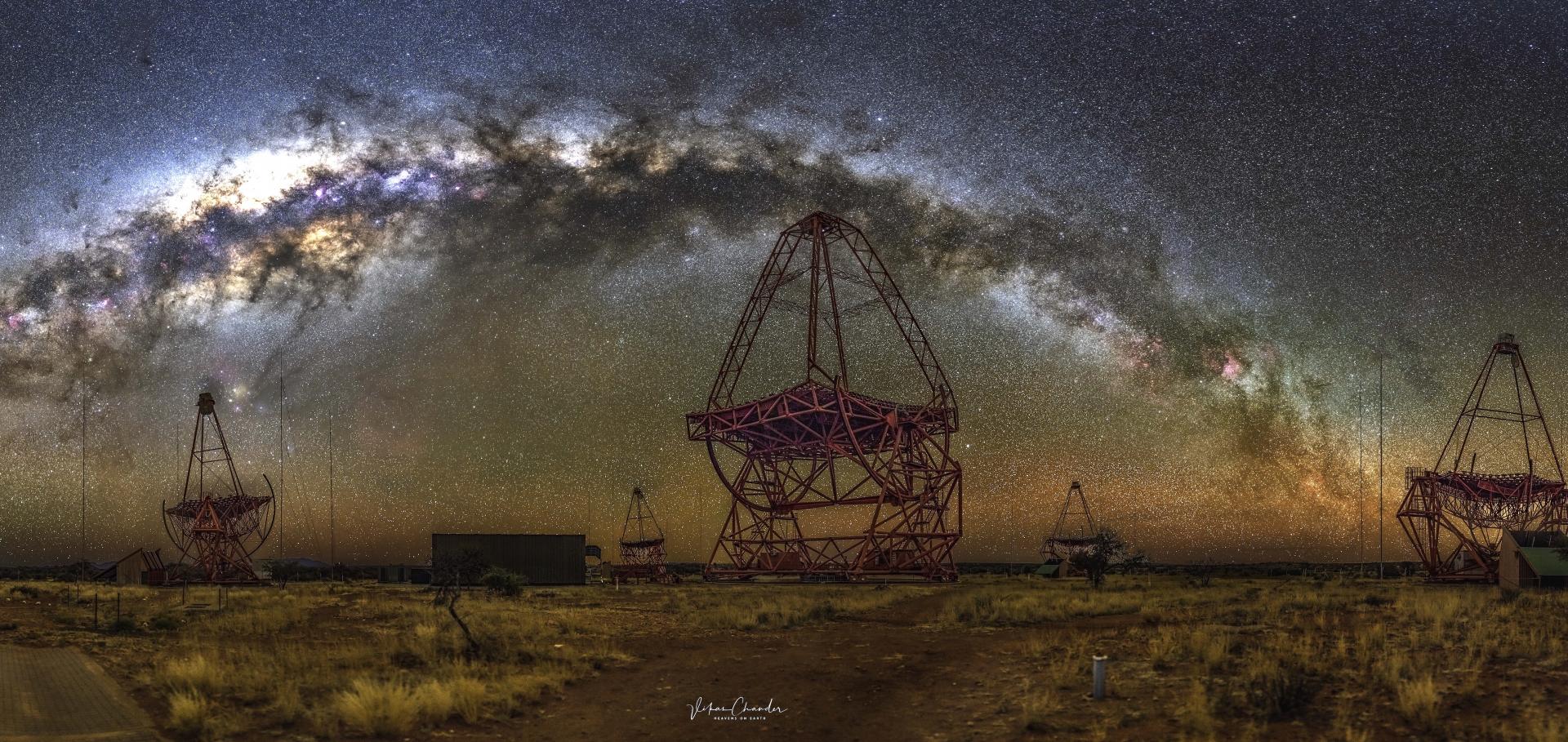
The Tarantula Nebula in the Large Magellanic Cloud is known for its high star formation activity. At its center lies the young massive star cluster R136, providing a significant amount of the energy that makes the nebula shine so brightly at many wavelengths. Recently, young massive star clusters have been suggested to also efficiently produce very high-energy cosmic rays, potentially beyond PeV energies. Here, we report the detection of very-high-energy γ-ray emission from the direction of R136 with the High Energy Stereoscopic System, achieved through a multicomponent, likelihood-based modeling of the data. This supports the hypothesis that R136 is indeed a very powerful cosmic-ray accelerator. Moreover, from the same analysis, we provide an updated measurement of the γ-ray emission from 30 Dor C, the only superbubble detected at TeV energies presently. The γ-ray luminosity above 0.5 TeV of both sources is (2–3) × 1035 erg s−1. This exceeds by more than a factor of 2 the luminosity of HESS J1646−458, which is associated with the most massive young star cluster in the Milky Way, Westerlund 1. Furthermore, the γ-ray emission from each source is extended with a significance of >3σ and a Gaussian width of about 30 pc. For 30 Dor C, a connection between the γ-ray emission and the nonthermal X-ray emission appears likely. Different interpretations of the γ-ray signal from R136 are discussed.The Long-lived Broadband Afterglow of Short Gamma-Ray Burst 231117A and the Growing Radio-Detected Short GRB Population
ArXiv 2407.13822 (2024)
Constraints on Short Gamma-Ray Burst Physics and Their Host Galaxies from Systematic Radio Follow-up Campaigns
(2024)