

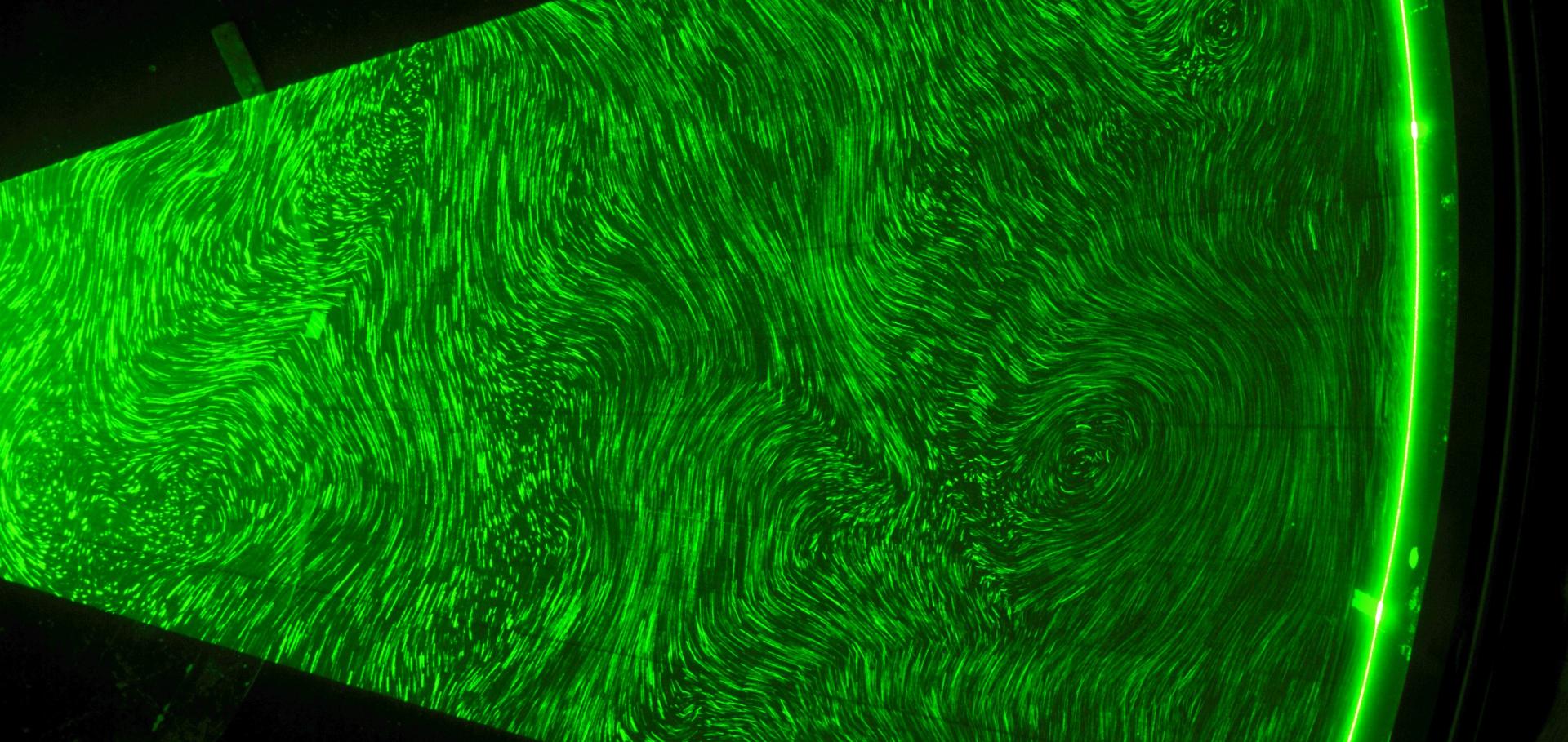
A rotating annulus driven by localized convective forcing: a new atmosphere-like experiment
Experiments in Fluids Springer Berlin Heidelberg 2017:58 (2017) 75
Abstract:
We present an experimental study of flows in a cylindrical rotating annulus convectively forced by local heating in an annular ring at the bottom near the external wall and via a cooled circular disk near the axis at the top surface of the annulus. This new configuration is distinct from the classical thermally-driven annulus analogue of the atmosphere circulation, in which thermal forcing is applied uniformly on the sidewalls, but with a similar aim to investigate the baroclinic instability of a rotating, stratified flow subject to zonally symmetric forcing. Two vertically and horizontally displaced heat sources/sinks are arranged so that, in the absence of background rotation, statically unstable Rayleigh-Bénard convection would be induced above the source and beneath the sink, thereby relaxing strong constraints placed on background temperature gradients in previous experimental configurations based on the conventional rotating annulus. This better emulates local vigorous convection in the tropics and polar regions of the atmosphere whilst also allowing stably-stratified baroclinic motion in the central zone of the annulus, as in midlatitude regions in the Earth’s atmosphere. Regimes of flow are identified, depending mainly upon control parameters that in turn depend on rotation rate and the strength of differential heating. Several regimes exhibit baroclinically unstable flows which are qualitatively similar to those previously observed in the classical thermally-driven annulus, However, in contrast to the classical configuration, they typically exhibit more spatiotemporal complexity. Thus, several regimes of flow demonstrate the equilibrated co-existence of, and interaction between, free convection and baroclinic wave modes. These new features were not previously observed in the classical annulus and validate the new setup as a tool for exploring fundamental atmosphere-like dynamics in a more realistic framework. Thermal structure in the fluid is investigated and found to be qualitatively consistent with previous numerical results, with nearly isothermal conditions respectively above and below the heat source and sink, and stably-stratified, sloping isotherms in the near-adiabatic interior.Ertel potential vorticity versus Bernoulli streamfunction on Mars
QUARTERLY JOURNAL OF THE ROYAL METEOROLOGICAL SOCIETY 143:702 (2017) 37-52
Exploring the Venus global super-rotation using a comprehensive general circulation model
PLANETARY AND SPACE SCIENCE 134 (2016) 1-18
CoRoT 223992193: Investigating the variability in a low-mass, pre-main sequence eclipsing binary with evidence of a circumbinary disk
(2016)