

Phase synchronization between stratospheric and tropospheric quasi-biennial and semi-annual oscillations
Quarterly Journal of the Royal Meteorological Society 138:666 (2012) 1338-1349
Abstract:
A combination of singular systems analysis and analytic phase techniques are used to investigate the possible occurrence in observations of coherent synchronization between quasi-biennial and semi-annual oscillations (QBOs; SAOs) in the stratosphere and troposphere. Time series of zonal mean zonal winds near the Equator are analysed from the ERA-40 and ERA-interim reanalysis datasets over a ∼ 50-year period. In the stratosphere, the QBO is found to synchronize with the SAO almost all the time, but with a frequency ratio that changes erratically between 4:1, 5:1 and 6:1. A similar variable synchronization is also evident in the tropical troposphere between semi-annual and quasi-biennial cycles (known as TBOs). Mean zonal winds from ERA-40 and ERA-interim, and also time series of indices for the Indian and West Pacific monsoons, are commonly found to exhibit synchronization, with SAO/TBO ratios that vary between 4:1 and 7:1. Coherent synchronization between the QBO and tropical TBO does not appear to persist for long intervals, however. This suggests that both the QBO and tropical TBOs may be separately synchronized to SAOs that are themselves enslaved to the seasonal cycle, or to the annual cycle itself. However, the QBO and TBOs are evidently only weakly coupled between themselves and are frequently found to lose mutual coherence when each changes its frequency ratio to its respective SAO. This suggests a need to revise a commonly cited paradigm that advocates the use of stratospheric QBO indices as a predictor for tropospheric phenomena such as monsoons and hurricanes. © 2012 Royal Meteorological Society.Zonal winds at high latitudes on Venus: An improved application of cyclostrophic balance to Venus Express observations
Icarus 217:2 (2012) 629-639
Abstract:
Recent retrievals of zonal thermal winds obtained in a cyclostrophic regime on Venus are generally consistent with cloud tracking measurements at mid-latitudes, but become unphysical in polar regions where the values obtained above the clouds are often less than or close to zero. Using a global atmospheric model, we show that the main source of errors that appear in the polar regions when retrieving the zonal thermal winds is most likely due to uncertainties in the zonal wind intensity in the choice of the lower boundary condition.Here we suggest a new and robust method to better estimate the lower boundary condition for high latitudes, thereby improving the retrieved zonal thermal winds throughout the high latitudes middle atmosphere. This new method is applied to temperature fields derived from Visible and Infrared Thermal Imaging Spectrometer (VIRTIS) data on board the Venus Express spacecraft. We obtain a zonal thermal wind field that is in better agreement with other, more direct methods based on either retrieving the zonal winds from cloud tracking or from direct measurements of the meridional slope of pressure surfaces. © 2011 Elsevier Inc.Data assimilation in the laboratory using a rotating annulus experiment
Quarterly Journal of the Royal Meteorological Society (2012)
Abstract:
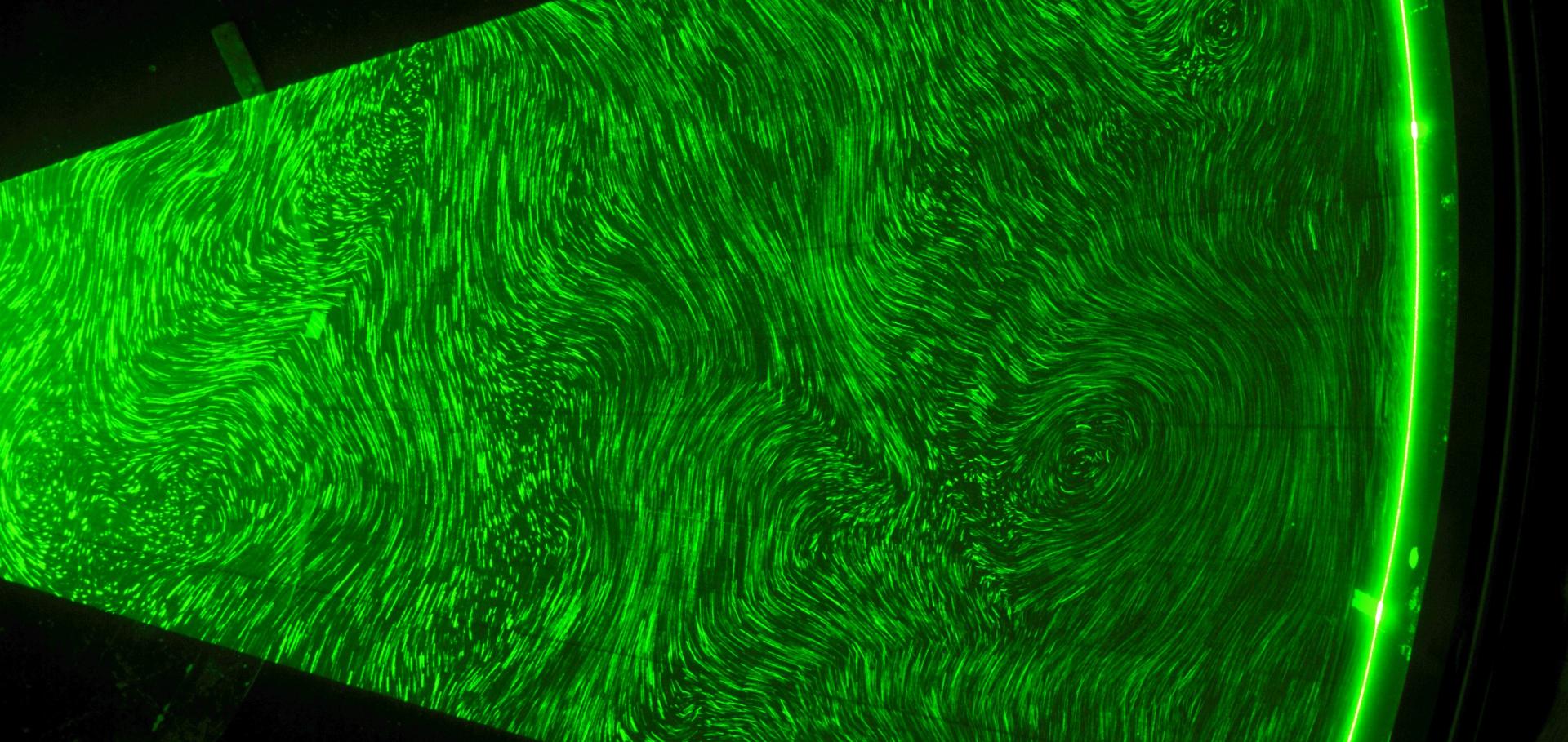
The thermally driven rotating annulus is a laboratory experiment important for the study of the dynamics of planetary atmospheres under controllable and reproducible conditions. We use the analysis correction method to assimilate laboratory data into an annulus model. We analyze the 2S and 3AV regular flow regimes between rotation rates of 0.75 and 0.875 rad s and the 3SV chaotic flow regime between rotation rates of 2.2 and 3.1 rad s. Our assimilated observations are irregularly distributed, which is more meteorologically realistic than gridded observations as used in recent applications of data assimilation to laboratory measurements. We demonstrate that data assimilation can be used successfully and accurately in this context. We examine a number of specific assimilation scenarios: a wave-number transition between two regimes, information propagation from data-rich to data-poor regions, the response of the assimilation to a strong disturbance to the flow, and a vortex-shedding instability phenomenon at high rotation rate. At the highest rotation rates we calculated the barotropic E-vectors using unobserved variables such as temperature and the vertical structure of the velocity field that are only available via the assimilation. These showed that the mean flow is weakened by the action of eddies, going some way towards explaining why vortices are shed at the very highest rotation rates but not at lower rotation. Rossby-wave stability theory suggests that the underlying instability leading to vortex shedding may be baroclinic in character. © 2012 Royal Meteorological Society.Phase synchronization between stratospheric and tropospheric quasi-biennial and semi-annual oscillations
Quarterly Journal of the Royal Meteorological Society (2012)
Ion heat transport studies in JET
Plasma Physics and Controlled Fusion 53:12 (2011)