

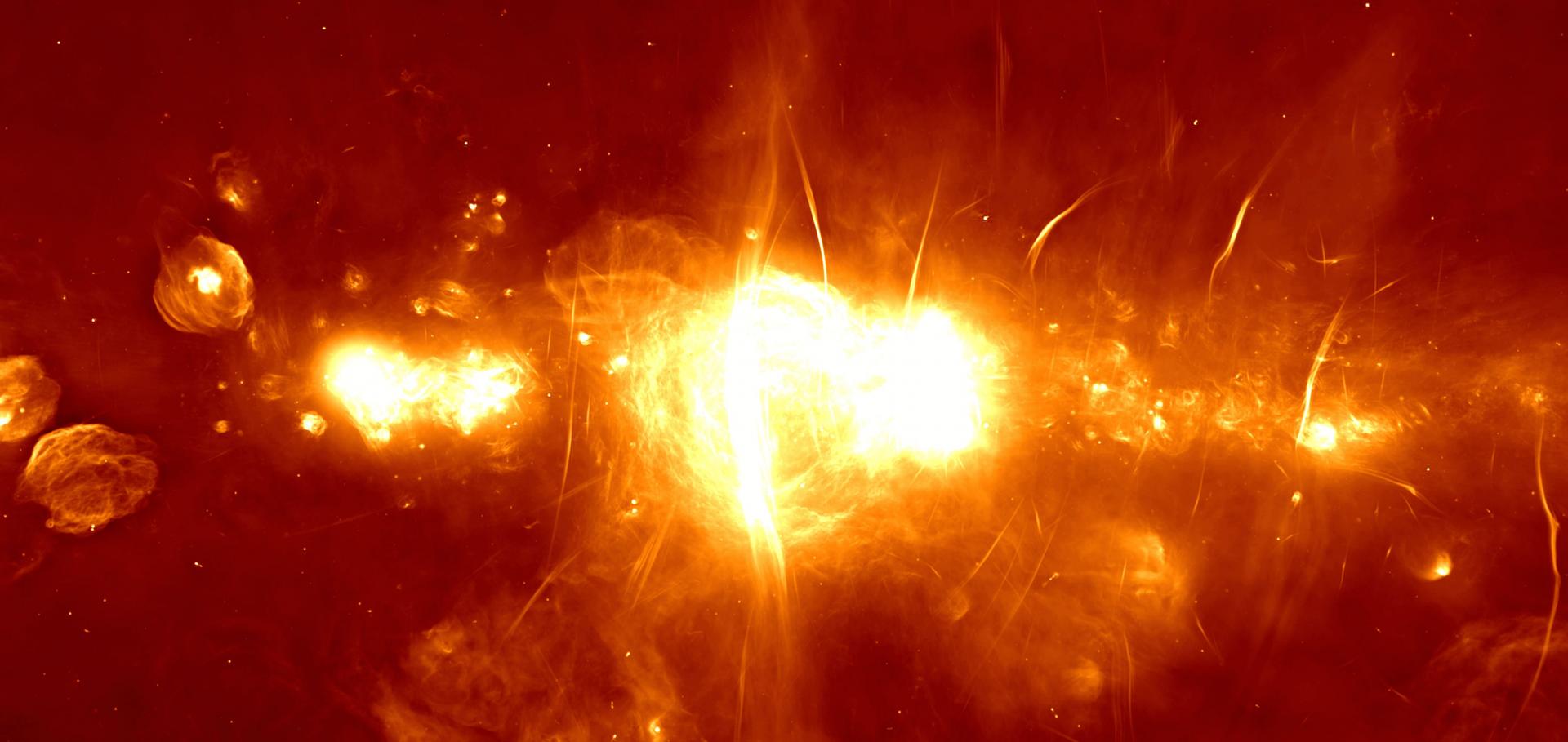
Radio galaxies in simba: a MIGHTEE comparison
Monthly Notices of the Royal Astronomical Society Oxford University Press (OUP) 536:3 (2024) 2873-2890
Double “acct”: A Distinct Double-peaked Supernova Matching Pulsational Pair Instability Models
The Astrophysical Journal Letters American Astronomical Society 977:2 (2024) L41
Abstract:
We present multiwavelength data of SN 2020acct, a double-peaked stripped-envelope supernova (SN) in NGC 2981 at ∼150 Mpc. The two peaks are temporally distinct, with maxima separated by 58 rest-frame days and a factor of 20 reduction in flux between. The first is luminous (Mr = −18.00 ± 0.02 mag) and blue (g − r = 0.27 ± 0.03 mag) and displays spectroscopic signatures of interaction with hydrogen-free circumstellar material. The second peak is fainter (Mr = −17.29 ± 0.03 mag) and has some spectroscopic similarities to an evolved stripped-envelope SN, with strong forbidden [Ca ii] and [O ii] features. No other known double-peaked SN exhibits a light curve similar to that of SN 2020acct. We find the likelihood of two individual SNe occurring in the same star-forming region within that time to be highly improbable, while an implausibly fine-tuned configuration would be required to produce two SNe from a single binary system. We find that the peculiar properties of SN 2020acct match models of pulsational pair instability (PPI), in which the initial peak is produced by collisions of shells of ejected material, shortly followed by core collapse. Pulsations from a star with a 72 M⊙ helium core provide an excellent match to the double-peaked light curve. The local galactic environment has a metallicity of 0.4 Z⊙, a level where massive single stars are not expected to retain enough mass to encounter the PPI. However, late binary mergers or a low-metallicity pocket may allow the required core mass. We measure the rate of SN 2020acct–like events to be <3.3 × 10⁻⁸ Mpc−3 yr−1 at z = 0.07, or <0.1% of the total core-collapse SN rate.Bye-bye, Local-in-matter-density Bias: The Statistics of the Halo Field Are Poorly Determined by the Local Mass Density
The Astrophysical Journal Letters American Astronomical Society 977:2 (2024) ARTN L44
Abstract:
<jats:title>Abstract</jats:title> <jats:p>Bias models relating the dark matter field to the spatial distribution of halos are widely used in current cosmological analyses. Many models predict halos purely from the local Eulerian matter density, yet bias models in perturbation theory require other local properties. We assess the validity of assuming that only the local dark matter density can be used to predict the number density of halos in a model-independent way and in the nonperturbative regime. Utilizing <jats:italic>N</jats:italic>-body simulations, we study the properties of the halo counts field after spatial voxels with near-equal dark matter density have been permuted. If local-in-matter-density (LIMD) biasing were valid, the statistical properties of the permuted and unpermuted fields would be indistinguishable since both represent equally fair draws of the stochastic biasing model. If the Lagrangian radius is greater than approximately half the voxel size and for halos less massive than ∼10<jats:sup>15</jats:sup> <jats:italic>h</jats:italic> <jats:sup>−1</jats:sup> <jats:italic>M</jats:italic> <jats:sub>☉</jats:sub>, we find the permuted halo field has a scale-dependent bias with greater than 25% more power on scales relevant for current surveys. These bias models remove small-scale power by not modeling correlations between neighboring voxels, which substantially boosts large-scale power to conserve the field’s total variance. This conclusion is robust to the choice of initial conditions and cosmology. Assuming LIMD halo biasing cannot, therefore, reproduce the distribution of halos across a large range of scales and halo masses, no matter how complex the model. One must either allow the biasing to be a function of other quantities and/or remove the assumption that neighboring voxels are statistically independent.</jats:p>Evaluating cosmological biases using photometric redshifts for Type Ia Supernova cosmology with the Dark Energy Survey Supernova Program
Monthly Notices of the Royal Astronomical Society Oxford University Press (OUP) (2024) stae2703