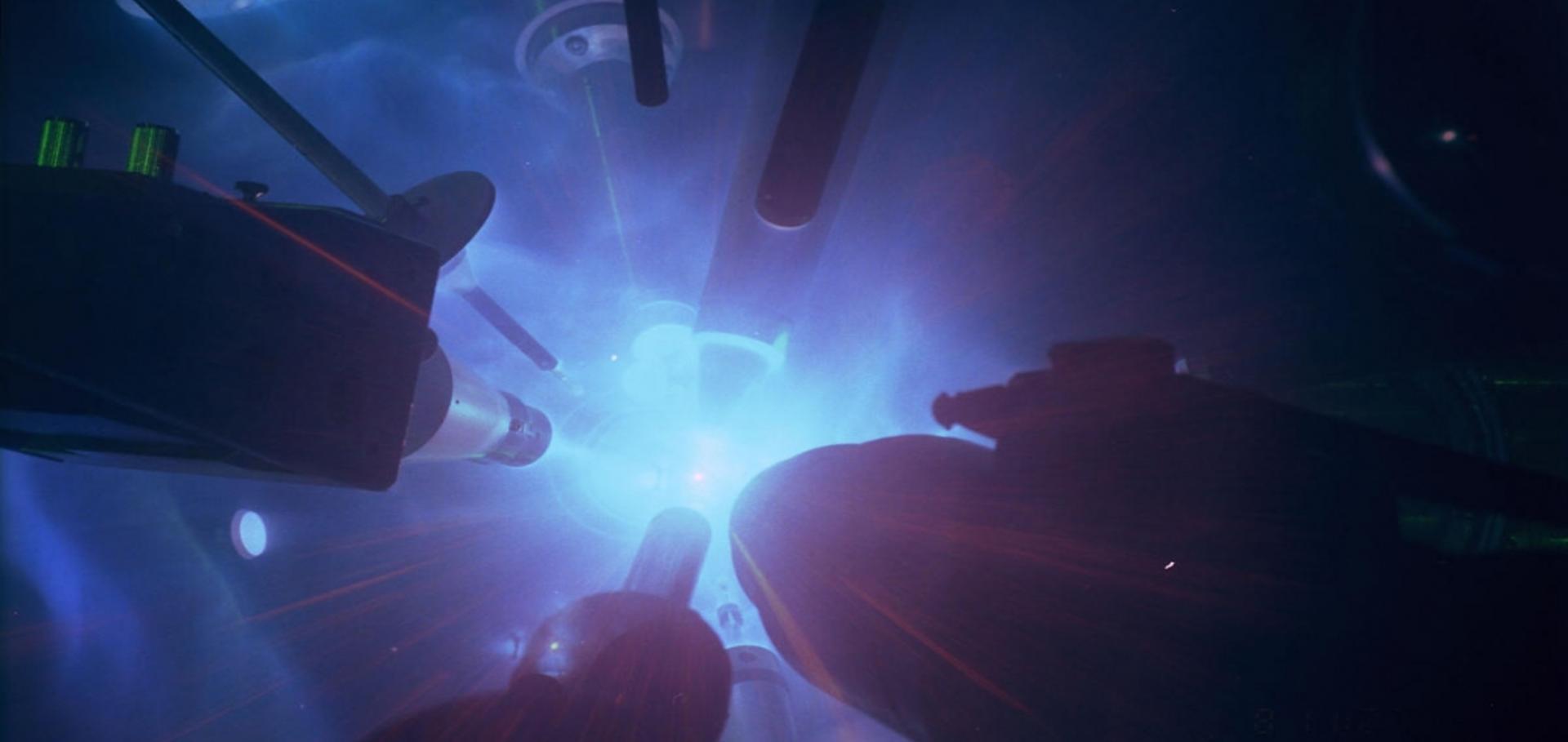
Momentum-Resolved X-Ray Thomson Scattering Benchmark of Electronic-Response Models in Warm Dense Aluminium

Physical Review Letters American Physical Society (APS) 136:24 (2026) 245102

Authors:

Dmitrii S Bespalov, Ulf Zastrau, Zhandos A Moldabekov, Thomas Gawne, Tobias Dornheim, Moyassar Meshhal, Alexis Amouretti, Michal Andrzejewski, Karen Appel, Carsten Baehtz, Erik Brambrink, Khachiwan Buakor, Carolina Camarda, David Chin, Gilbert Collins, Céline Crépisson, Adrien Descamps, Jon Eggert, Luke B Fletcher, Alessandro Forte, Gianluca Gregori, Marion Harmand, Oliver S Humphries, Hauke Höppner, Jonas Kuhlke, William Lynn, Julian Lütgert, Masruri Masruri, Emma E McBride, Ryan Stewart McWilliams, Alan Augusto Sanjuan Mora, Jean-Paul Naedler, Paul Neumayer, Charlotte Palmer, Alexander Pelka, Lea Pennacchioni, Calum Prestwood, Natalia A Pukhareva, Chongbing Qu, Divyanshu Ranjan, Ronald Redmer, Michael Röper, Christoph Sahle, Samuel Schumacher, Jan-Patrick Schwinkendorf, Melanie J Sieber, Madison Singleton, Ethan Smith, Christian Sternemann, Thomas Stevens

Abstract:

The robust diagnosis of conditions generated in warm dense matter experiments remains a persistent challenge. Here, we describe the measurement of shock-compressed aluminium at 50 GPa with angle-resolved femtosecond x-ray Thomson scattering (XRTS) over a wide range of scattering wave vectors at the European X-Ray Free-Electron Laser. The measured plasmon dispersion and line shape show that the standard approach for analyzing XRTS spectra, using uniform-electron-gas models, systematically overestimates the resonance energy by up to 8 eV. We present an approach using methods that agrees within the experimental uncertainty and demonstrates how accounting for shock-induced disorder in shock-compressed systems is critical for their understanding, providing evidence that treatments are required for reliable XRTS inference in warm dense aluminium.

Design of experiments characterising heat conduction in magnetised, weakly collisional plasma

High Power Laser Science and Engineering Cambridge University Press (CUP) (2026) 1-31

Authors:

TA Vincent, P Ariyathilaka, L Creaser, C Danson, D Lamb, J Meinecke, CAJ Palmer, S Pitt, H Poole, C Spindloe, P Thomas, E Tubman, L Wilson, W Garbett, G Gregori, P Tzeferacos, T Hodge, AFA Bott

An axion framework for Particle-in-Cell codes with Monte-Carlo sampling: emission, absorption, and detailed balance in plasmas

(2026)

Authors:

Miles Radford, Ahmed Alsulami, Bertrand Martinez, Pablo Bilbao, Thomas Grismayer, Luis O Silva, Robert Bingham, Gianluca Gregori

Probing keV mass QCD axions with the SACLA X-ray free electron laser

(2026)

Authors:

Charles Heaton, Jack WD Halliday, Taito Osaka, Ichiro Inoue, Sifei Zhang, Ahmed Alsulami, Joshua TY Chu, Mila Fitzgerald, Takaki Hatsui, Motoaki Nakatsutsumi, Haruki Nishino, Atsushi O Tokiyasu, Robert Bingham, Subir Sarkar, Gianluca Gregori

Modeling partially ionized dense plasma using wavepacket molecular dynamics

Physical Review E American Physical Society 113 (2026) 045206

Authors:

Daniel Plummer, Pontus Svensson, Wiktor Jasniak, Sam Vinko, Gianluca Gregori

Abstract:

We develop a wave packet molecular dynamics framework for modeling the structural properties of partially-ionized dense plasmas, based on a chemical model that explicitly includes bound state wavefunctions. Using hydrogen as a representative system, we compute self-consistent charge state distributions through free energy minimization, following the approach of Plummer et al. [Phys. Rev. E 111, 015204 (2025)]. This enables a direct comparison of static equilibrium properties with path integral Monte Carlo data, facilitating an evaluation of the model’s underlying approximations and its ability to capture the complex interplay between ionization and structure in dense plasma environments.