

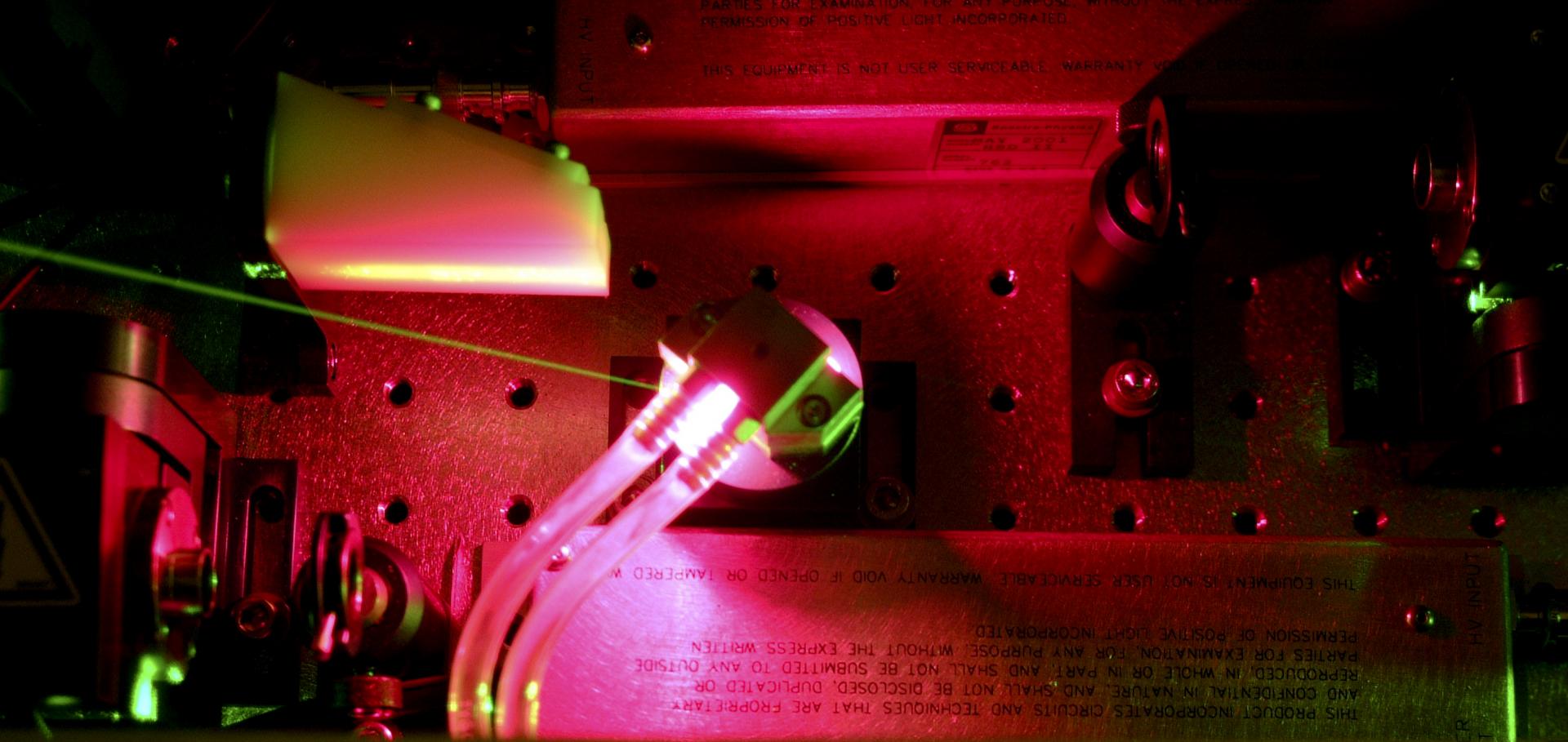
A compact, low cost Marx bank for generating capillary discharge plasmas
Review of Scientific Instruments AIP Publishing 87:093302 (2016)
Abstract:
We describe in detail a low power Compact Marx Bank (CMB) circuit that can provide 20 kV, 500A pulses of approximately 100–200 ns duration. One application is the generation of capillary discharge plasmas of density ≈ 1018 cm3 used in laser plasma accelerators. The CMB is tiggered with a high speed solid state switch and gives a HV output pulse with a ns scale rise time into a 50Ω load (coaxial cable) with < 4 ns voltage jitter. Its small size (10 cm × 25 cm × 5 cm) means that it can be placed right next to the capillary discharge in the target chamber so avoiding the need to impedance match. The electrical energy required per discharge is < 1 J and the CMB can be run at shot repetition rates of >∼ 1 Hz. This low power requirement means the circuit can easily be powered by a small lead acid battery and so therefore can be floated relative to laboratory earth. The CMB is readily scalable and pulses > 45 kV are demonstrated in air discharges.Gaussian-Schell analysis of the transverse spatial properties of high-harmonic beams
(2016)
X-ray characterisation by energy-resolved powder diffraction
Physical Review Accelerators and Beams American Physical Society 19 (2016) 082801
Abstract:
A method for single-shot, non-destructive characterisation of broadband X-ray beams, based on energy-resolved powder diffraction, is described. Monte-Carlo simulations are used to simulate data for X-ray beams in the keV range with parameters similar to those generated by betatron oscillations in a laser-driven plasma accelerator. The retrieved X-ray spectra are found to be in excellent agreement with those of the input beams for realistic numbers of incident photons. It is demonstrated that the angular divergence of the X-rays can be deduced from the deviation of the detected photons from the Debye-Scherrer rings which would be produced by a parallel beam. It is shown that the angular divergence can be measured as a function of the photon energy, yielding the angularly-resolved spectrum of the input X-ray beam.Measurement of the cross-section ratio sigma(psi(2S))/sigma(J/psi(1S)) in deep inelastic exclusive ep scattering at HERA
NUCLEAR PHYSICS B 909 (2016) 934-953
Gaussian-Schell analysis of the transverse spatial properties of high-harmonic beams
Scientific Reports Nature Publishing Group 6 (2016) 30504