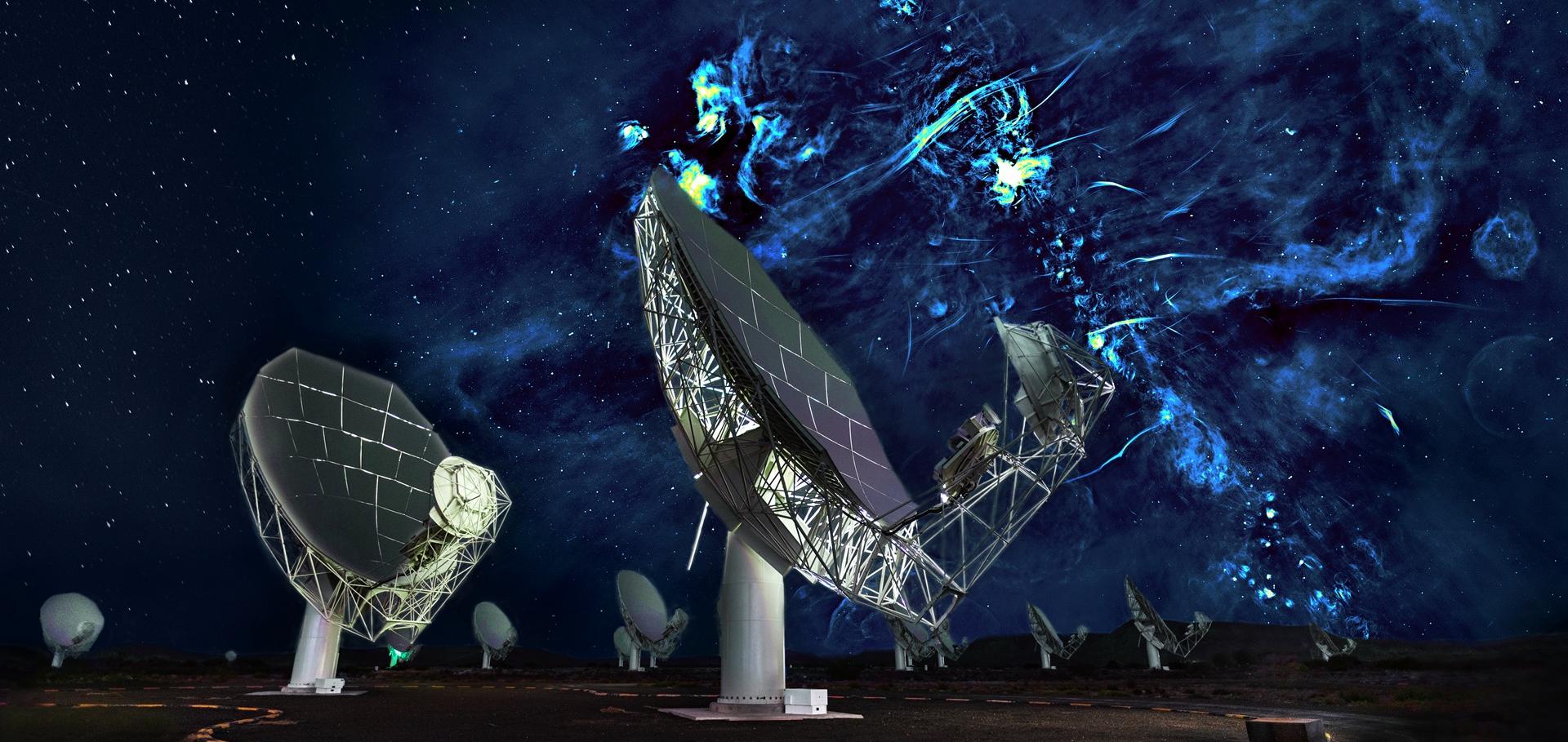
The Thousand-Pulsar-Array programme on MeerKAT -- XII. Discovery of long-term pulse profile evolution in 7 young pulsars
(2024)
Chasing the Break: Tracing the Full Evolution of a Black Hole X-Ray Binary Jet with Multiwavelength Spectral Modeling
The Astrophysical Journal American Astronomical Society 962:2 (2024) 116-116
Abstract:
Black hole (BH) X-ray binaries (XRBs) are ideal targets to study the connection between accretion inflow and jet outflow. Here we present quasi-simultaneous, multiwavelength observations of the Galactic BH system MAXI J1820+070, throughout its 2018–2019 outburst. Our data set includes coverage from the radio through X-ray bands from 17 different instruments/telescopes, and encompasses 19 epochs over a 7 month period, resulting in one of the most well-sampled multiwavelength data sets of a BH XRB outburst to date. With our data, we compile and model the broadband spectra of this source using a phenomenological model that includes emission from the jet, a companion star, and an accretion flow. This modeling allows us to track the evolution of the spectral break in the jet spectrum, a key observable that samples the jet launching region. We find that the spectral break location changes over at least ≈3 orders of magnitude in electromagnetic frequency over this period. Using these spectral break measurements, we link the full cycle of jet behavior, including the rising, quenching, and reignition, to the changing accretion flow properties as the source evolves through its different accretion states. Our analysis shows consistent jet behavior with other sources in similar phases of their outbursts, reinforcing the idea that jet quenching and recovery may be a global feature of BH XRB systems in outburst. Our results also provide valuable evidence supporting a close connection between the geometry of the inner accretion flow and the base of the jetFilling the radio transients gap (or: The case for a dedicated radio transients monitoring array in the southern hemisphere)
(2024)
Cosmology from LOFAR Two-metre Sky Survey data release 2: cross-correlation with the cosmic microwave background
Astronomy and Astrophysics EDP Sciences 681 (2024) A105
Abstract:
AimsWe combined the LOw-Frequency ARray (LOFAR) Two-metre Sky Survey (LoTSS) second data release (DR2) catalogue with gravitational lensing maps from the cosmic microwave background (CMB) to place constraints on the bias evolution of LoTSS-detected radio galaxies, and on the amplitude of matter perturbations.
Methods
We constructed a flux-limited catalogue from LoTSS DR2, and analysed its harmonic-space cross-correlation with CMB lensing maps from Planck, Cℓgk, as well as its auto-correlation, Cℓgg. We explored the models describing the redshift evolution of the large-scale radio galaxy bias, discriminating between them through the combination of both Cℓgk and Cℓgg. Fixing the bias evolution, we then used these data to place constraints on the amplitude of large-scale density fluctuations, parametrised by σ8.
Results
We report the significance of the Cℓgk signal at a level of 26.6σ. We determined that a linear bias evolution of the form bg(z) = bg,D/D(z), where D(z) is the growth rate, is able to provide a good description of the data, and we measured bg,D = 1.41 ± 0.06 for a sample that is flux limited at 1.5 mJy, for scales ℓ < 250 for Cℓgg, and ℓ < 500 for Cℓgk. At the sample’s median redshift, we obtained b(z = 0.82) = 2.34 ± 0.10. Using σ8 as a free parameter, while keeping other cosmological parameters fixed to the Planck values, we found fluctuations of σ8 = 0.75−0.04+0.05. The result is in agreement with weak lensing surveys, and at 1σ difference with Planck CMB constraints. We also attempted to detect the late-time-integrated Sachs-Wolfe effect with LOFAR data; however, with the current sky coverage, the cross-correlation with CMB temperature maps is consistent with zero. Our results are an important step towards constraining cosmology with radio continuum surveys from LOFAR and other future large radio surveys.
The VLBA CANDELS GOODS-North Survey – I. survey design, processing, data products, and source counts
Monthly Notices of the Royal Astronomical Society Oxford University Press 529:3 (2024) 2428-2442