

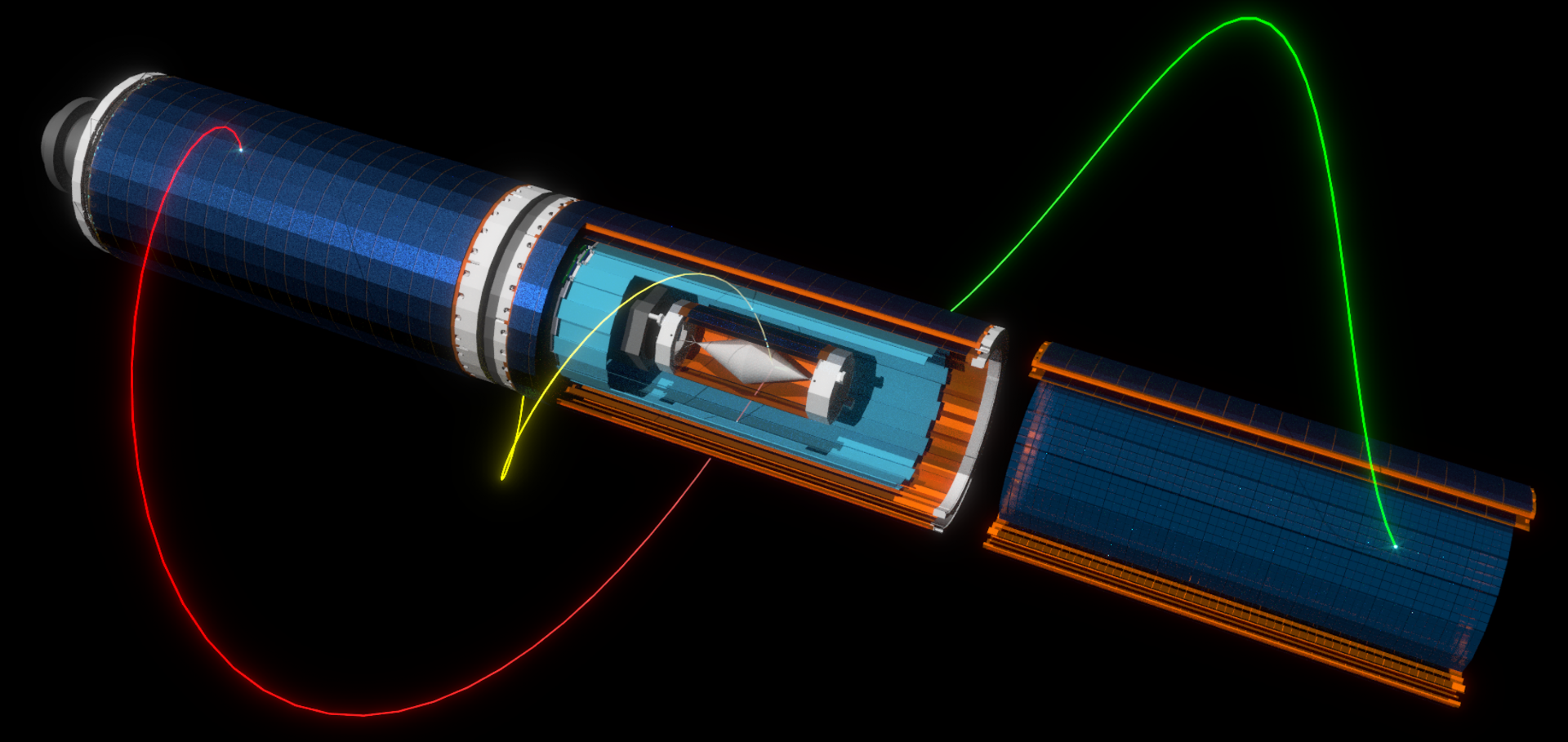
Observation of photon-induced $W^+W^-$ production in $pp$ collisions at $\sqrt{s}=13$ TeV using the ATLAS detector
ArXiv 2010.04019 (2020)
Search for charged-lepton-flavour violation in $Z$-boson decays with the ATLAS detector
ArXiv 2010.02566 (2020)
Search for pair production of scalar leptoquarks decaying into first- or second-generation leptons and top quarks in proton-proton collisions at $\sqrt{s}$ = 13 TeV with the ATLAS detector
ArXiv 2010.02098 (2020)
Operation of the ATLAS trigger system in Run 2
Journal of Instrumentation IOP Publishing 15:10 (2020) ARTN P10004
Abstract:
The ATLAS experiment at the Large Hadron Collider employs a two-level triggersystem to record data at an average rate of 1 kHz from physics collisions,starting from an initial bunch crossing rate of 40 MHz. During the LHC Run 2(2015-2018), the ATLAS trigger system operated successfully with excellentperformance and flexibility by adapting to the various run conditionsencountered and has been vital for the ATLAS Run-2 physics programme. Forproton-proton running, approximately 1500 individual event selections wereincluded in a trigger menu which specified the physics signatures and selectionalgorithms used for the data-taking, and the allocated event rate andbandwidth. The trigger menu must reflect the physics goals for a given datacollection period, taking into account the instantaneous luminosity of the LHCand limitations from the ATLAS detector readout, online processing farm, andoffline storage. This document discusses the operation of the ATLAS triggersystem during the nominal proton-proton data collection in Run 2 with examplesof special data-taking runs. Aspects of software validation, evolution of thetrigger selection algorithms during Run 2, monitoring of the trigger system anddata quality as well as trigger configuration are presented.Fil: Aad, G.. Aix-Marseille Université; FranciaFil: Abbott, B.. Oklahoma State University; Estados UnidosFil: Abbott, D.C.. University of Massachusetts; Estados UnidosFil: Abed Abud, A.. Cern - European Organization for Nuclear Research; SuizaFil: Abeling, K.. Georg-August-Universität Göttingen; AlemaniaFil: Abhayasinghe, D.K.. Royal Holloway University of London; Reino UnidoFil: Abidi, S. H.. University of Toronto; CanadáFil: AbouZeid, O. S.. Czech Academy of Sciences; República ChecaFil: Abraham, N. L.. University of Sussex; Reino UnidoFil: Abramowicz, H.. Universitat Tel Aviv; IsraelFil: Abreu, H.. Technion - Israel Institute of Technology; IsraelFil: Abreu, R.. University of Oregon; Estados UnidosFil: Abulaiti, Y.. Argonne National Laboratory; Estados UnidosFil: Acharya, B. S.. Istituto Nazionale di Fisica Nucleare; Italia. The Abdus Salam. International Centre for Theoretical Physics; ItaliaFil: Achkak, B.. Georg-August-Universität Göttingen; AlemaniaFil: Adam, L.. University of Montreal; CanadáFil: Adam Bourdarios, C.. Universite Grenoble Alpes; Francia. Université Savoie Mont Blanc; FranciaFil: Adamczyk, L.. AGH University of Science and Technology; PoloniaFil: Adamek, L.. University of Toronto; CanadáFil: Adelman, J.. Northern Illinois University; Estados UnidosFil: Adersberger, M.. Ludwig-Maximilians-Universität München; AlemaniaFil: Adiguzel, A.. Bogazici University; TurquíaFil: Adorni,S.. Université de Genève; SuizaFil: Adye, T.. Universite Paris-Saclay;Fil: Affolder, A. A.. University of California Santa Cruz; Estados UnidosFil: Afik, Y.. Technion - Israel Institute of Technology; IsraelFil: Agapopoulou, C.. Universite Paris-Saclay;Fil: Agaras, M. N.. Université Clermont Auvergne; Francia. Centre National de la Recherche Scientifique; FranciaFil: Aggarwal, A.. Radboud Universiteit Nijmegen; Países BajosFil: Orellana, Gonzalo Enrique. Universidad Nacional de La Plata. Facultad de Ciencias Exactas; Argentina. Consejo Nacional de Investigaciones Científicas y Técnicas. Centro Científico Tecnológico Conicet - La Plata. Instituto de Física La Plata. Universidad Nacional de La Plata. Facultad de Ciencias Exactas. Instituto de Física La Plata; ArgentinSearch for phenomena beyond the Standard Model in events with large $b$-jet multiplicity using the ATLAS detector at the LHC
ArXiv 2010.01015 (2020)