Color symmetry and altermagneticlike spin textures in noncollinear antiferromagnets

Physical Review B American Physical Society 112 (2025) 014431

Authors:

Paolo Radaelli, Gautam Gurung

Abstract:

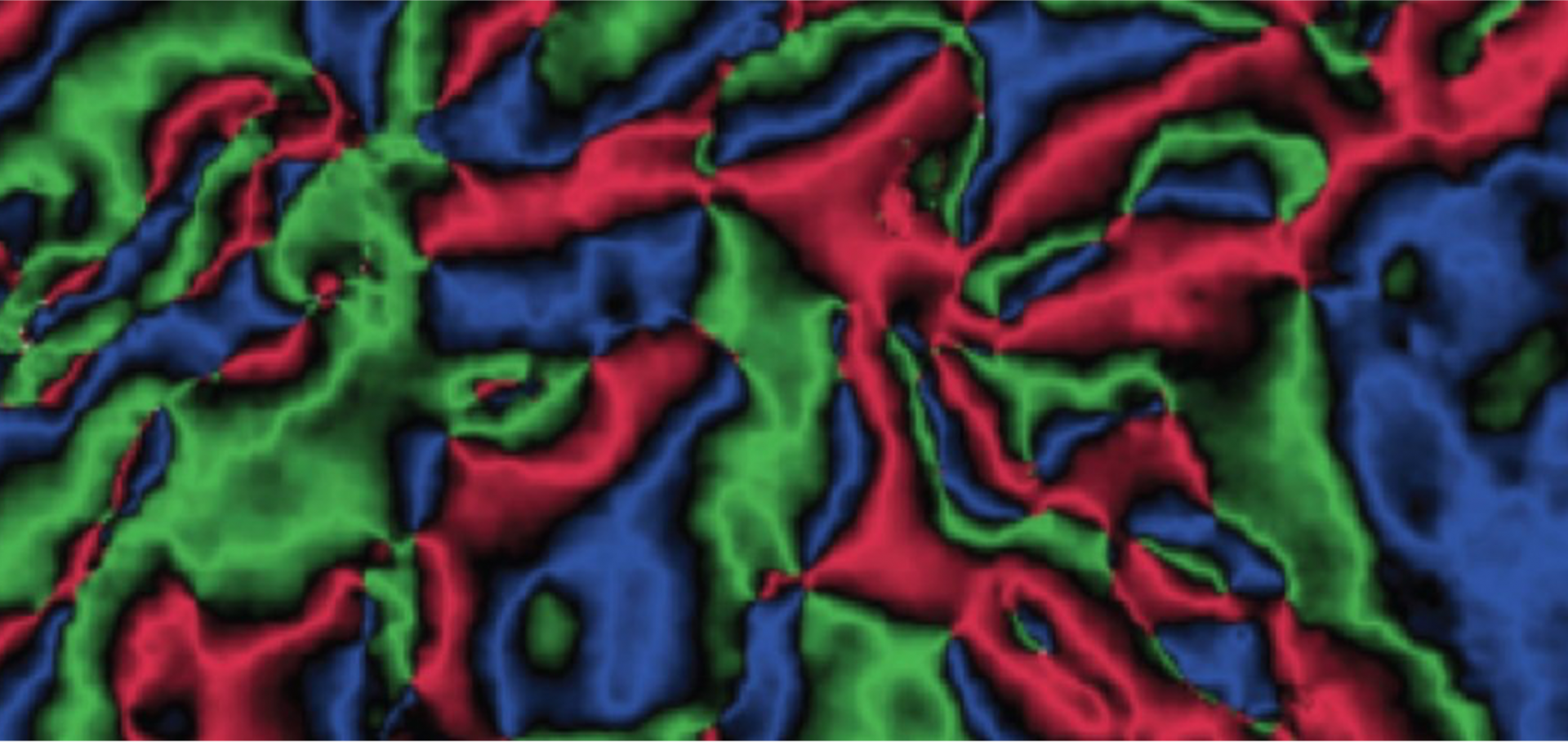
We present a formalism based on colour symmetry to analyse the momentum-space spin textures of non-collinear antiferromagnets. We show that, out of the spin textures allowed by the magnetic point group, . We demonstrate this approach in the case of three complex, non-collinear magnets, Mn3Ir(Ge,Si), Pb2MnO4 and Mn3GaN. For Mn3GaN, we also show that the predictions of colour-symmetry analysis are consistent with density functional theory calculations performed on the same system both with and without spin-orbit coupling.

Unconventional Magnetism, Sliding Ferroelectricity, and Magneto-Optical Kerr Effects in a Multiferroic Bilayer

(2025)

Authors:

Chen Xinfeng, Ding Ning, Paolo Barone, Carlo Rizza, Shuai Dong, Wei Ren, Paolo G Radaelli, Gaoyang Gou, Alessandro Stroppa

Ultrafast non-volatile rewritable ferroaxial switching

(2025)

Authors:

Z Zeng, M Först, M Fechner, D Prabhakaran, PG Radaelli, A Cavalleri

MULTIXS: A new scanning multi-analyzer x-ray emission spectrometer at the GALAXIES beamline at synchrotron SOLEIL.

The Review of scientific instruments 96:5 (2025) 053104

Authors:

James M Ablett, Anthony Berlioux, Dominique Prieur, Jack Harrison, Lars Heller, Sebastian Gliga, Jean-Pascal Rueff

Abstract:

We present the design and performance of a new multi-crystal x-ray emission spectrometer installed at the GALAXIES beamline at Synchrotron SOLEIL. The new instrument, which we name "MULTIXS," can host up to five analyzer crystals and supersedes our previous XES spectrometer design, providing a compact, simple design with all the analyzer crystals contained in the horizontal sample plane. This feature provides a direct view of the sample area and avoids the potential masking of the sample for constrained sample environments. This new design allows for the use of both 0.5 m and 1 m radius spherical analyzer crystals. In addition, the ability to continuously scan the spectrometer energy provides relatively fast scanning with high quality emission data and minimum dead-time overhead.

Unusually High Occupation of Co 3d State in Magnetic Weyl Semimetal Co₃Sn₂S₂

ACS nano 19:9 (2025) 8561-8570

Authors:

Jieyi Liu, Yiheng Yang, Jianlei Shen, Defa Liu, Gohil Singh Thakur, Charles Guillemard, Alevtina Smekhova, Houke Chen, Deepnarayan Biswas, Manuel Valvidares, Enke Liu, Claudia Felser, Tien-Lin Lee, Thorsten Hesjedal, Yulin Chen, Gerrit van der Laan

Abstract:

The physical properties of magnetic topological materials are strongly influenced by their nontrivial band topology coupled with the magnetic structure. Co3Sn2S2 is a ferromagnetic kagome Weyl semimetal displaying giant intrinsic anomalous Hall effect which can be further tuned via elemental doping, such as Ni substitution for Co. Despite significant interest, the exact valency of Co and the magnetic order of the Ni dopants remained unclear. Here, we report a study of Ni-doped Co3Sn2S2 single crystals using synchrotron-based X-ray magnetic circular dichroism (XMCD), X-ray photoelectron emission microscopy (XPEEM), and hard/soft X-ray photoemission spectroscopy (XPS) techniques. We confirm the presence of spin-dominated magnetism from Co in the host material, and also the establishment of ferromagnetic order from the Ni dopant. The oxygen-free photoemission spectrum of the Co 2p core levels in the crystal well resembles that of a metallic Co film, indicating a Co0+ valency. Surprisingly, we find the electron filling in the Co 3d state can reach 8.7-9.0 electrons in these single crystals. Our results highlight the importance of element-specific X-ray spectroscopy in understanding the electronic and magnetic properties that are fundamental to a heavily studied Weyl semimetal, which could aid in developing future spintronic applications based on magnetic topological materials.