

Agriculture's contribution to climate change and role in mitigation is distinct from predominantly fossil CO2-emitting sectors
Frontiers in Sustainable Food Systems Frontiers Media 4 (2021) 518039
Abstract:
Agriculture is a significant contributor to anthropogenic global warming, and reducing agricultural emissions—largely methane and nitrous oxide—could play a significant role in climate change mitigation. However, there are important differences between carbon dioxide (CO2), which is a stock pollutant, and methane (CH4), which is predominantly a flow pollutant. These dynamics mean that conventional reporting of aggregated CO2-equivalent emission rates is highly ambiguous and does not straightforwardly reflect historical or anticipated contributions to global temperature change. As a result, the roles and responsibilities of different sectors emitting different gases are similarly obscured by the common means of communicating emission reduction scenarios using CO2-equivalence. We argue for a shift in how we report agricultural greenhouse gas emissions and think about their mitigation to better reflect the distinct roles of different greenhouse gases. Policy-makers, stakeholders, and society at large should also be reminded that the role of agriculture in climate mitigation is a much broader topic than climate science alone can inform, including considerations of economic and technical feasibility, preferences for food supply and land-use, and notions of fairness and justice. A more nuanced perspective on the impacts of different emissions could aid these conversations.Vertically resolved magma ocean–protoatmosphere evolution: H2 , H2O, CO2, CH4, CO, O2, and N2 as primary absorbers
Journal of Geophysical Research: Planets American Geophysical Union 126:2 (2021) e2020JE006711
Abstract:
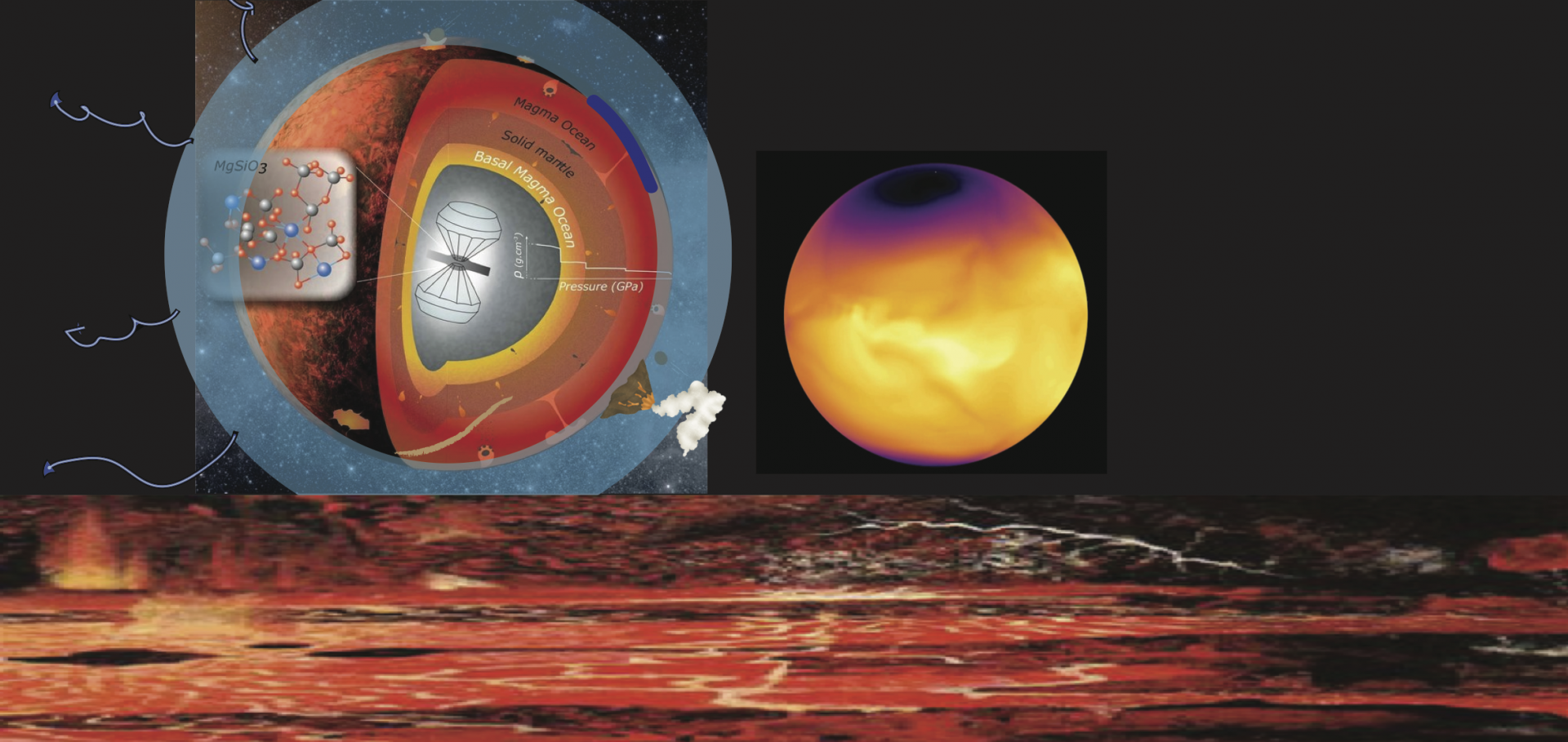
The earliest atmospheres of rocky planets originate from extensive volatile release during magma ocean epochs that occur during assembly of the planet. These establish the initial distribution of the major volatile elements between different chemical reservoirs that subsequently evolve via geological cycles. Current theoretical techniques are limited in exploring the anticipated range of compositional and thermal scenarios of early planetary evolution, even though these are of prime importance to aid astronomical inferences on the environmental context and geological history of extrasolar planets. Here, we present a coupled numerical framework that links an evolutionary, vertically‐resolved model of the planetary silicate mantle with a radiative‐convective model of the atmosphere. Using this method we investigate the early evolution of idealized Earth‐sized rocky planets with end‐member, clear‐sky atmospheres dominated by either H2, H2O, CO2, CH4, CO, O2, or N2. We find central metrics of early planetary evolution, such as energy gradient, sequence of mantle solidification, surface pressure, or vertical stratification of the atmosphere, to be intimately controlled by the dominant volatile and outgassing history of the planet. Thermal sequences fall into three general classes with increasing cooling timescale: CO, N2, and O2 with minimal effect, H2O, CO2, and CH4 with intermediate influence, and H2 with several orders of magnitude increase in solidification time and atmosphere vertical stratification. Our numerical experiments exemplify the capabilities of the presented modeling framework and link the interior and atmospheric evolution of rocky exoplanets with multi‐wavelength astronomical observations.Atmospheric circulation of brown dwarfs and directly imaged exoplanets driven by cloud radiative feedback: global and equatorial dynamics
Monthly Notices of the Royal Astronomical Society Oxford University Press 502:2 (2021) 2198-2219
Abstract:
Brown dwarfs, planetary-mass objects and directly imaged giant planets exhibit significant observational evidence for active atmospheric circulation, raising critical questions about mechanisms driving the circulation, its fundamental nature and time variability. Our previous work has demonstrated the crucial role of cloud radiative feedback on driving a vigorous atmospheric circulation using local models that assume a Cartesian geometry and constant Coriolis parameters. In this study, we extend the models to a global geometry and explore properties of the global dynamics. We show that, under relatively strong dissipation in the bottom layers of the model, horizontally isotropic vortices are prevalent at mid-to-high latitudes while large-scale zonally propagating waves are dominant at low latitudes near the observable layers. The equatorial waves have both eastward and westward phase speeds, and the eastward components with typical velocities of a few hundred m s−1 usually dominate the equatorial time variability. Lightcurves of the global simulations show variability with amplitudes from 0.5 per cent to a few percent depending on the rotation period and viewing angle. The time evolution of simulated lightcurves is critically affected by the equatorial waves, showing wave beating effects and differences in the lightcurve periodicity to the intrinsic rotation period. The vertical extent of clouds is the largest at the equator and decreases poleward due to the increasing influence of rotation with increasing latitude. Under weaker dissipation in the bottom layers, strong and broad zonal jets develop and modify wave propagation and lightcurve variability. Our modelling results help to qualitatively explain several features of observations of brown dwarfs and directly imaged giant planets, including puzzling time evolution of lightcurves, a slightly shorter period of variability in IR than in radio wavelengths, and the viewing angle dependence of variability amplitude and IR colors.Atmospheric circulation of brown dwarfs and directly imaged exoplanets driven by cloud radiative feedback: effects of rotation
Monthly Notices of the Royal Astronomical Society Oxford University Press 502:1 (2021) 678-699
Abstract:
Observations of brown dwarfs (BDs), free-floating planetary-mass objects, and directly imaged extrasolar giant planets (EGPs) exhibit rich evidence of large-scale weather. Cloud radiative feedback has been proposed as a potential mechanism driving the vigorous atmospheric circulation on BDs and directly imaged EGPs, and yet it has not been demonstrated in three-dimensional dynamical models at relevant conditions. Here, we present a series of atmospheric circulation models that self-consistently couple dynamics with idealized cloud formation and its radiative effects. We demonstrate that vigorous atmospheric circulation can be triggered and self-maintained by cloud radiative feedback. Typical isobaric temperature variation could reach over 100 K and horizontally averaged wind speed could be several hundreds of $\, {\rm m\, s^{-1}}$. The circulation is dominated by cloud-forming and clear-sky vortices that evolve over time-scales from several to tens of hours. The typical horizontal length-scale of dominant vortices is closed to the Rossby deformation radius, showing a linear dependence on the inverse of rotation rate. Stronger rotation tends to weaken vertical transport of vapour and clouds, leading to overall thinner clouds. Domain-mean outgoing radiative flux exhibits variability over time-scales of tens of hours due to the statistical evolution of storms. Different bottom boundary conditions in the models could lead to qualitatively different circulation near the observable layer. The circulation driven by cloud radiative feedback represents a robust mechanism generating significant surface inhomogeneity as well as irregular flux time variability. Our results have important implications for near-infrared (IR) colours of dusty BDs and EGPs, including the scatter in the near-IR colour–magnitude diagram and the viewing-geometry-dependent near-IR colours.Cassini Saturn polar velocity fields
University of Oxford (2021)