

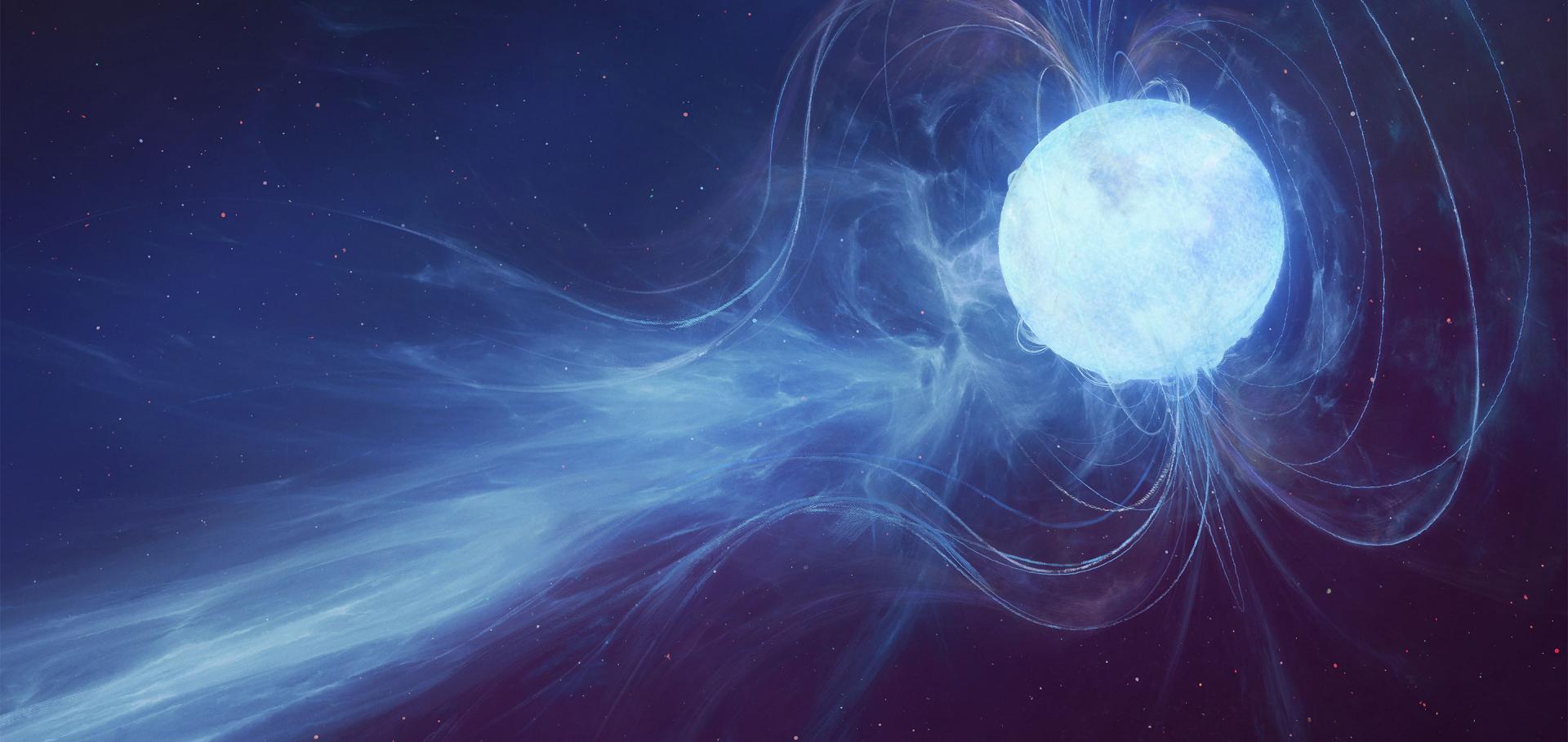
Importance of electron-positron pairs on the maximum possible luminosity of the accretion columns in ULXs
Proceedings of the International Astronomical Union Cambridge University Press (CUP) 16:S363 (2020) 327-328
Radio afterglows of Very High Energy Gamma-ray Bursts
Proceedings of the International Astronomical Union Cambridge University Press (CUP) 16:S363 (2020) 220-223
Recurrent low-level luminosity behaviour after a giant outburst in the Be/X-ray transient 4U 0115+63
Astronomy & Astrophysics EDP Sciences 638 (2020) a152
Relativistic X-ray jets from the black hole X-ray binary MAXI J1820+070
Astrophysical Journal Letters American Astronomical Society 895:2 (2020) L31
Abstract:
The black hole MAXI J1820+070 was discovered during its 2018 outburst and was extensively monitored across the electromagnetic spectrum. Following the detection of relativistic radio jets, we obtained four Chandra X-ray observations taken between 2018 November and 2019 June, along with radio observations conducted with the Very Large Array and MeerKAT arrays. We report the discovery of X-ray sources associated with the radio jets moving at relativistic velocities with a possible deceleration at late times. The broadband spectra of the jets are consistent with synchrotron radiation from particles accelerated up to very high energies (>10 TeV) by shocks produced by the jets interacting with the interstellar medium. The minimal internal energy estimated from the X-ray observations for the jets is ~10^41 erg, significantly larger than the energy calculated from the radio flare alone, suggesting most of the energy is possibly not radiated at small scales but released through late-time interactions.High-resolution VLA low radio frequency observations of the Perseus cluster: radio lobes, mini-halo and bent-jet radio galaxies
(2020)