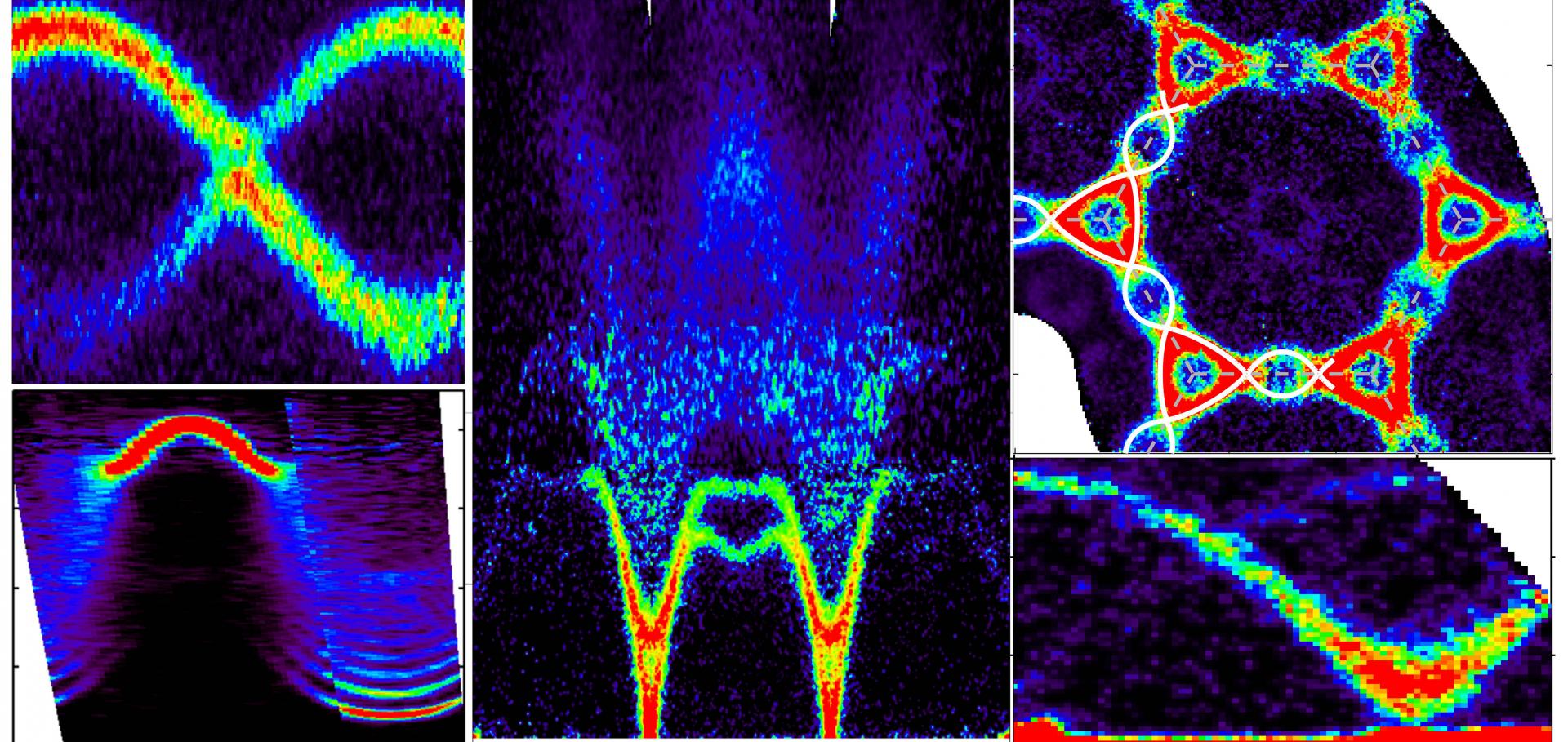
Chiral Antiferromagnetism from Momentum-Space Resonance in a 2D Semiconductor

ArXiv 2609.15854 (2026)

Authors:

R Okuma, T Ikenobe, Y Fujisawa, K Yamagami, HCH Wu, T Nakamura, Y Ihara, H Ishikawa, H Suwa, H Ishizuka, Y Akagi, T Kaneko, CH Hsu, Y Obata, N Tomoda, M Dronova, K Nagasawa, H Saito, D Ueta, H Sagayama, J Yamaura, M Arita, K Yogendra, S Ideta, K Kindo, T Nakajima, SJ Blundell, T Kondo, K Shimada, Y Okamoto, Y Okada

Stabilizing Itinerant Electrons in a Corner-Sharing Kagomé Oxide Nd4Os3ZnO14

Chemistry of Materials 38:17 (2026) 9012-9020

Authors:

R Okuma, Y Fujisawa, CH Hsu, K Kojima, D Nishio-Hamane, K Sumida, A Kimura, A Yasui, K Yamagami, JI Yamaura, Y Okamoto

Abstract:

Kagomé oxides provide a fertile platform for exploring exotic electronic states arising from geometrical frustration and characteristic band topology. Here, we report the synthesis of a 5d transition-metal kagomé oxide, Nd4Os3ZnO14, obtained via high-temperature, high-pressure hydrothermal synthesis. Single-crystal X-ray diffraction reveals a two-dimensional kagomé network formed by corner-sharing OsO6 octahedra, with a nominal osmium valence of +4.67. In-plane resistivity and hard X-ray photoelectron spectroscopy measurements indicate that the semimetallic electronic structure at room temperature evolves into a semiconducting ground state upon cooling, accompanied by a pronounced enhancement of hole mobility. Magnetic susceptibility measurements demonstrate localized Nd3+ moments without long-range magnetic order down to 2 K. The coexistence of a metallic kagomé plane, strong spin–orbit coupling inherent to 5d electrons, and rare-earth magnetism establishes Nd4Os3ZnO14 as a promising platform for investigating correlated electron phenomena in kagomé oxides within the itinerant regime.

Diamminecopper(I) divanadate(IV,V).

IUCrdata 11:Pt 8 (2026) x260886

Authors:

Hibiki Kunisawa, Ryutaro Okuma, Toshihiro Nomura

Abstract:

The crystal structure of diamminecopper(I) divanadate(IV,V), or poly[di-amminecopper(I) [tri-μ3-oxido-di-μ2-oxido-divanadium(IV,V)]], {[Cu(NH3)2]V2O5} n , has been determined by single-crystal X-ray diffraction. The compound crystallizes in the monoclinic space group P21/c and consists of infinite {V2O5}- layers expanding parallel to the bc plane built from edge- and corner-sharing [VO5] square pyramids. Almost linear diamminecopper(I) cations, [Cu(NH3)2]+, are located between the vanadate layers and are linked to the framework through N-H⋯O hydrogen bonds.

Field-tuned incommensurate fan phase in an Ising-like triangular antiferromagnet

(2026)

Authors:

D Flavián, R Okuma, P Manuel, Q Huang, H Zhou, R Coldea

Raman spectroscopy of the van derWaals topological magnet GdGaI

Physical Review B 114:6 (2026)

Authors:

N Jiang, Y Zhang, Y Xia, T Higashihara, R Okuma, JI Yamaura, Y Okada, K Watanabe, T Taniguchi, T Zhang, T Machida, Y Niimi

Abstract:

We report polarization-resolved Raman spectroscopy of a van der Waals compound GdGaI that is a candidate for excitonic insulators. By combining the symmetry analysis with density functional theory calculations, we identify six Raman-active phonons. The spectra exhibit only the expected anharmonic hardening down to 4 K: no additional peaks, no soft modes, and no signatures of zone folding are observed. This result indicates that any lattice distortion is below our experimental sensitivity, supporting an electronically driven origin for the band reconstruction reported by angle-resolved photoemission spectroscopy rather than an electron-phonondriven mechanism. Moreover, we observe a pronounced circular dichroism of the A1g modes under an outof-plane magnetic field. Based on symmetry considerations, we attribute this dichroic response to chiral A1g phonons with opposite angular momenta generated by spin-phonon coupling in the time-reversal-broken state. The temperature evolution of the degree of circular polarization further suggests that circularly polarized Raman spectroscopy detects the emergence of short-range antiferromagnetic correlations. Our results highlight GdGaI as a promising platform in which excitonic order, magnetism, and circularly polarized phonons can be intertwined, and demonstrate that circular-polarization Raman provides a sensitive probe of spin-phonon coupling in excitonic systems.