

Statistical Study of Betatron and Fermi Electron Acceleration at Dipolarization Fronts
Geophysical Research Letters American Geophysical Union (AGU) 53:15 (2026) e2026GL122885
Abstract:
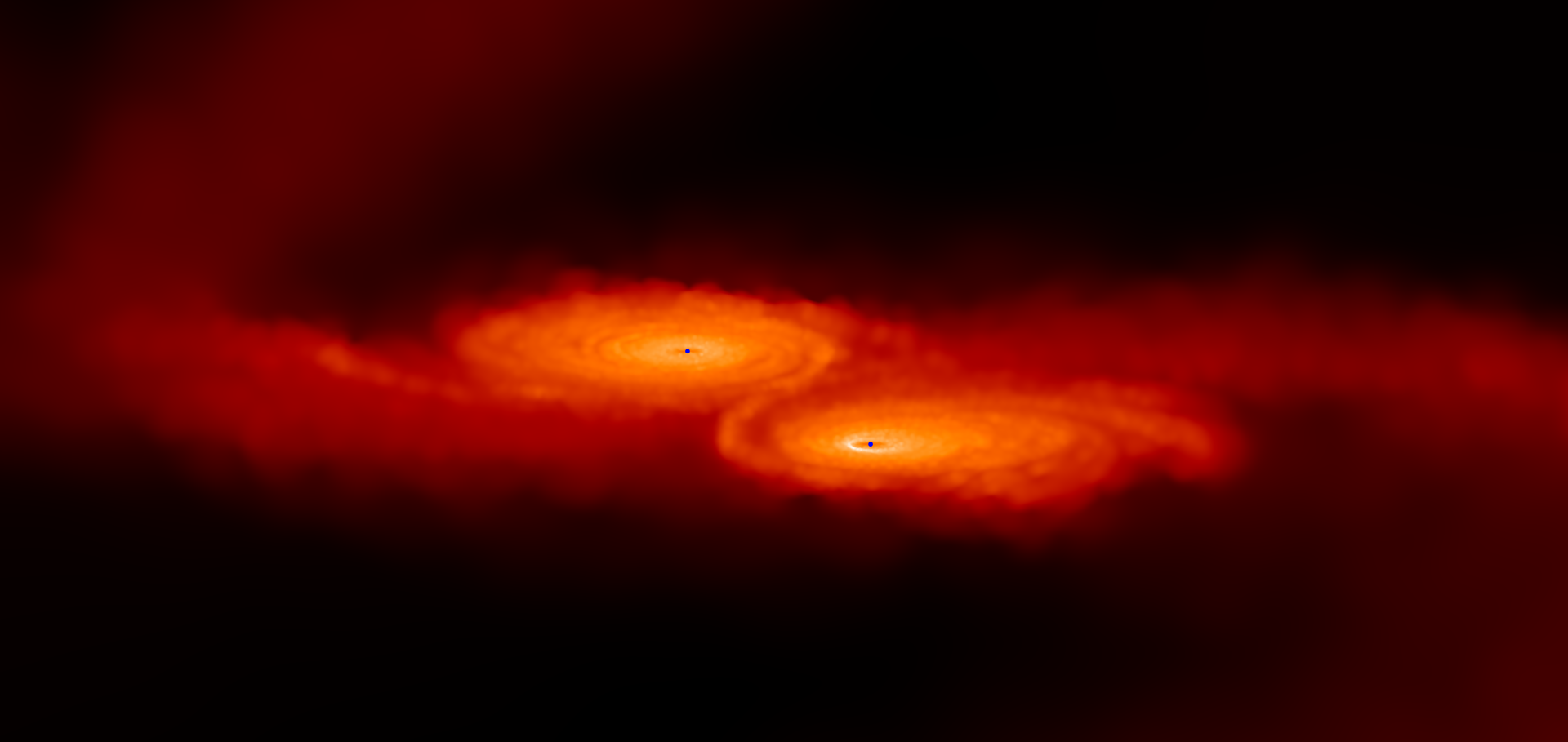
Properties of Black Hole Mergers in Disks of Active Galactic Nuclei
The Astrophysical Journal American Astronomical Society 1007:1 (2026) 67
Abstract:
Ground-based gravitational-wave (GW) observatories have detected approximately 200 binary black hole (BH) mergers. The astrophysical origin of these events is debated, with evidence suggesting that at least a subset originated from dynamic environments characterized by frequent close encounters. Accretion disks in active galactic nuclei (AGNs) are of particular interest, as certain observed features could be more readily produced within such environments. In this paper, we investigate the expected properties of mergers in these environments, and their dependence on various parameters, using 1D N-body simulations combined with a comprehensive semianalytical model. In our fiducial model, the distributions of masses (m1 and m2) and mass ratios (q ≡ m2/m1 ≤ 1) are similar to those observed. However, they depend strongly on the lifetime and density of the AGN disk and on the number and accretion efficiency of BHs, with higher masses predicted as these quantities increase. The most massive mergers, such as GW231123, can be produced either by efficient gas accretion or by hierarchical mergers among ≥3 generations of BHs. The observed negative correlation between q and the average effective spin (χeff), along with the positive correlation between χeff and the chirp mass (Mchirp), can be explained by a combination of efficient gas accretion, which promotes spin alignment, and hierarchical mergers, which produce high-∣χeff∣ and low-q binaries. Hierarchical mergers can also explain the negative correlation between q and the dispersion of χeff, as well as the positive correlation between ∣χeff∣and Mchirp. We present a comprehensive study on how the expected distribution of each of these quantities depends on model parameters and assumptions, which will aid the interpretation of observed GW population properties.Constraining Wave Dark Matter with Galactic-Centre Resonant Dynamics
Monthly Notices of the Royal Astronomical Society Oxford University Press (OUP) (2026) stag1347
Abstract:
Abstract We study the influence of fuzzy-dark-matter cores on the orbits of stars at the Galactic centre. This dark matter candidate condenses into dense, solitonic cores, and, if a super-massive black hole is present at the centre of such a core, its central part forms a ‘gravitational atom’. Here, we calculate the atom’s contribution to the gravitational potential felt by a Galactic-centre star, for a general state of the atom. We study the angular-momentum dynamics this potential induces, and show that it is similar to vector resonant relaxation. Its influence is found to be potentially sufficiently strong that such a dynamical component should be accounted for in Galactic-centre modelling. For the Milky Way, the atom is expected to have some spherical asymmetry, and we use this to derive a stability condition for the disc of young, massive stars at the Galactic centre—if the atom’s mass is too large, then the disc would be destroyed. Thus, the existence of this disc constrains the mass of the particles comprising the solitonic core. We study an example model of the core, where all of the rotation of the core’s inner region is assumed to come from an l = 1 state, and its amplitude is determined by the halo’s spin parameter; such a core is found to be in tension with the stability of the clockwise stellar disc for 4.2 × 10⁻²⁰ eV ≤ ma ≤ 5.4 × 10⁻²⁰ eV at 2σ. Other core models could vary the constrained values of ma. These constraints will tighten significantly with future, improved data.On the transition to large fluxes and access to second stability in gyrokinetic simulations of electromagnetic turbulence in STEP
ArXiv 2607.12682 (2026)
Collisionless whistler heat-flux instability in ultra-high-$β$ plasmas
(2026)