


Note that other projects targeting exoplanet science are offered by the Atmospheric, Oceanic and Planetary Physics sub-department, and listed on their website.
Towards Earth twins with PLATO
Supervisor: Suzanne Aigrain
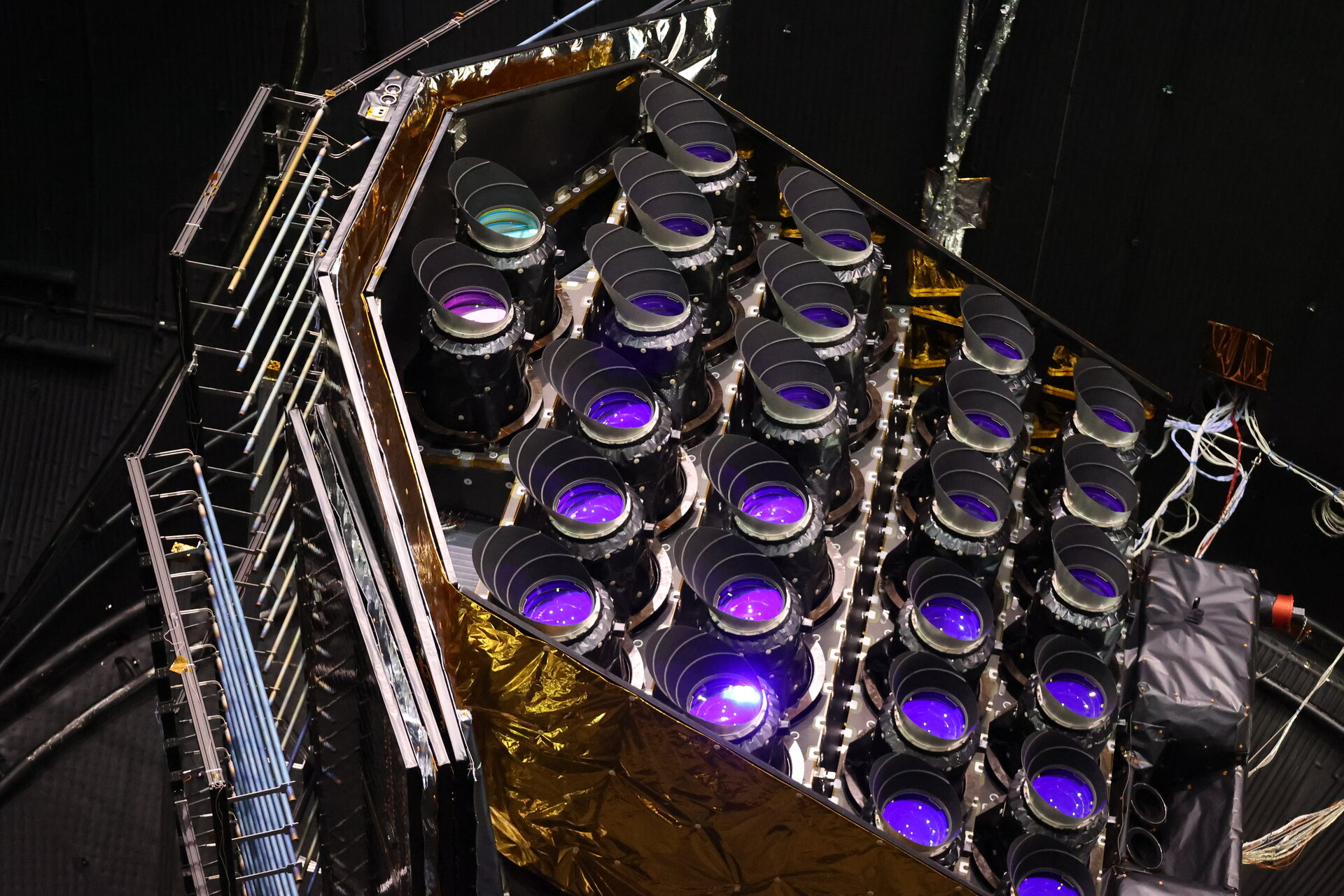
The PLATO space mission, due for launch in March 2027, is the European Space Agency’s next M-class mission. It will search for planetary transits, including those caused by planets with similar sizes and orbits to the Earth, and simultaneously characterise the host stars using asteroseismology. Measuring the masses of the planets using follow-up radial velocity observations from the ground is also a core part of the mission. Starting 6 months into the mission, just as the first science data are beginning to flow, the PhD student get involved in the verification and validation activities for the Exoplanet Analysis System, the pipeline which searches for transits in the light curves and models them. They will also contribute to early science projects designed to demonstrate the capabilities of PLATO before its data and pipelines have been fully validated (for example characterisation of previously know planetary systems that PLATO will observe). As the mission matures, they will have the opportunity to get involved in the discovery and characterisation of new planetary systems.
Pushing the frontiers of exoplanet atmospheric characterisation
Supervisor: Jayne Birkby
Prof Birkby offers the opportunity to explore different avenues that push the frontier of exoplanet atmospheric characterisation.
Avenue 1: From Jupiter’s blazing orange belts and great red spot, to Neptune’s azure hue, the appearance of planetary atmospheres reveals not only the diverse zoo of outcomes from the planet formation process, but holds the key to understanding (exo)planetary composition, internal structure, and evolution. Very recently, JWST has started to reveal the appearance of planets beyond our Solar system, not simply their colour, but also their storms as they rotate in and out of view. The student can choose to dive into this exciting and emerging field of exoplanet weather monitoring to prepare us for the first science with the Extremely Large Telescope. The ELT has a superior angular resolution which allows us to reach true Solar system analogue planets closer in forming near the snow line. The student will show how to use ground-based telescopes to monitor exoplanets, taking existing techniques and advancing them to reach the sub-1% precision level needed to track storms (while trying to see through Earth’s own atmosphere). We will begin with imaging observations from ERIS/VLT to make light curves of exoplanets themselves, and ultimately advance this to high resolution spectroscopy, a powerful technique that the ELT will serve exceptionally well. Exoplanet light curves contain a wealth of information, and we will study any anomaly arising in them, including signatures of exomoons transiting across the planetary disk. The project has potential to use machine learning techniques for light curve analysis and will give the student expectational skills in data analysis and programming.
Avenue 2: The biggest surprise so far in our hunt for Earth 2.0 is the discovery of sub-Neptunes. These worlds have no analogue in our Solar system and yet are the most common outcome of planet formation known to date. Their mass and radius result in degenerate scenarios for what lies beneath their atmospheres, from familiar gas dwarfs, to alien worlds with rocky cores and surfaces of liquid magma or even water, enshrouded by atmospheres of unknown composition. They may even be potential sites for life beyond Earth. To place Earth and our Solar system in context, we must understand sub-Neptunes. The student can choose to work at the very cutting edge of exoplanet observations, pushing instruments to observe these small, enigmatic worlds. We will use high resolution spectroscopy from the VLT, a powerful technique that allows us to isolate the planetary spectrum from its bright host star. The student will combine compositional analyses from atmospheric retrievals with models of atmospheric escape to understand both the structure and potential surfaces on these worlds, as well as their evolution in the presence of intense radiation from active host stars. There is potential to develop the work towards atmosphere-surface interaction modelling with collaborators across Oxford and beyond. We will explore observations both in the infrared and in the optical, pushing the latter towards reflection spectroscopy at high spectral resolution. Reflection spectroscopy is crucial for hunting for biosignatures with the Extremely Large Telescope in the 2030s, but remains to be clearly demonstrated for ground-based telescopes. The student will use existing and new data to further prove its viability for the ELT. The project will give the student expectational skills in data analysis, programming, and has potential for computational modelling too.
Prof Jayne Birkby is excited to welcome enthusiastic, curiosity-driven applicants with a passion for data analysis. The successful candidate will join her group working in these areas of exoplanet atmosphere research in Oxford Astrophysics, and will be encouraged to engage with the broader planetary exploration community within Oxford Physics, including in AOPP, and across the University through the Oxford Planets and Life Initiative (OPAL).
Machine learning-based wavefront control for high-contrast imaging of exo-Earths
Supervisors: Matthias Tecza, Ryan Griffiths
The upcoming Planetary Camera and Spectrograph instrument (PCS) aims to exploit the high angular resolution delivered by the 40 m Extremely Large Telescope to detect and characterise rocky, potentially habitable exoplanets around nearby M and K-dwarf stars [1]. To achieve this, PCS must be sensitive to companions with planet-to-star flux ratios of 10⁻⁸–10⁻⁹ – 103 times fainter than the limits of current instruments. Residual stellar speckles, which are formed by quasi-static imperfections in the imaging system, are the primary limitation for reaching this sensitivity as they obscure light from faint companions and cause false detections [2]. These stellar speckles can, however, be suppressed through manipulation of the phase and amplitude of the light propagating through the instrument - typically using one or two deformable mirrors.
Through deducing the relationship between speckles formed in science images and the applied deformable mirror shapes, we can remove speckles without modifications to the instrument design. Deep reinforcement learning (DRL) offers a promising approach to learning this complex, non-linear relationship and recent studies have demonstrated improvements in image contrast in simulations of broadband imaging [3,4].
This project will explore applying deep reinforcement learning to speckle suppression for spectroscopic imaging. This will involve designing suitable reward functions and policy networks that incorporate spectral information and calibration data. There is scope to explore the effectiveness of different algorithms (e.g. on-/off-policy and model-based/model-free) for improving contrast. The project will also investigate how these methods can be integrated into observing routines and how effectively they track and suppress slowly evolving speckle patterns.
While these studies can be carried out in simulation, this project aims ultimately to validate a DRL-based speckle suppression technique on a high-contrast imaging experiment located in the lab at Oxford [5]. The test bench contains a full adaptive optics and coronagraph simulator coupled to an image-slicer integral field spectrograph. This experimental validation will serve as a vital step before moving to on-sky testing with existing high-contrast imaging instruments. We aim to apply the resulting DRL control method on existing on-sky instruments to make new detections of giant exoplanets by improving their contrast at small angular separations.

Reading List
Science From the Moon
Supervisors: David DeBoer, Kris Zarbadami, Neil Bowles
Note: students interested in this project should apply to the Atmospheric Oceanic and Planetary Physics programme (not the Astrophysics one). Their website, which also lists other projects in planetary physics can be found here.
We uniquely rely on radio telescopes to understand the bulk of baryonic matter in the early Universe and the evolution of the Universe across early Cosmic times. There are two unavoidable limitations to our exploration of the Cosmos with terrestrial-based radio telescopes:
- the prevalence of interfering radio transmissions from human activity, and
- the Earth’s ionosphere and atmosphere, which are opaque or disruptive to many important radio frequency ranges.
These limitations are overcome by reaching above the atmosphere and beyond Earth, a capability that, to date, has generally been the exclusive purview of expensive, government-funded space-based “Great Observatories”.
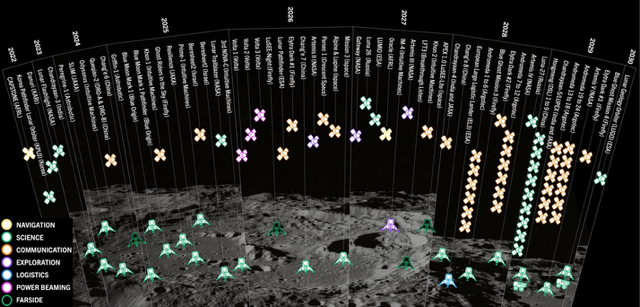
However, we are now on the cusp of a new era, with cost-effective and opportunity-laden access to space (including the lunar surface) becoming a reality. Such unfettered access will enable disparate groups to send instruments there, bringing about a transition from Earth-based observatories to space-based and cislunar telescopes (Fig. 1). Although this shift provides exciting opportunities for new science, it will also introduce sources of radio frequency interference (RFI) to the quietest remaining location to which we have access: the lunar Farside. Measurements from a generally RFI-free environment must be taken before the lunar skies have a multitude of orbiters.
One mission in the planning stage is the Lunar Farside Technosignature and Transients Telescope (LFT3). Being led out of Oxford, this mission would seek to arrive on the lunar farside surface before 2030, to take unique-in-history measurements from <1 - 2700 MHz.. The science case is wide and spans technosignatures, transients, cosmology and lunar studies. This project would explore instrumentation for scientific outcomes for LFT3 and any potential “ride-along” instruments. This could include all mission aspects as well as foundational and preparatory science and instrumentation. The overall goal is science from the Moon, which also includes regolith studies and operations from the Moon. Specifically, this project would work with the LFT3 instrument design and strive to maximize the scientific impact of the data to be collected from the Moon at this unique time.