

Below is a list of available DPhil (PhD) projects in Planetary and Exoplanetary Physics. If you are interested in any of the research areas listed, please contact the relevant supervisor directly. They will be happy to discuss potential projects and answer any questions you may have.
Please note that additional exoplanet projects are available through the DPhil in Astrophysics: Exoplanets and stellar physics | University of Oxford Department of Physics
Some projects may be filled as applications are reviewed. We therefore particularly encourage candidates who are considering applying after the January deadline to contact prospective supervisors in advance to discuss available project options.
Projects available for 2027/28:
- Comet Interceptor: Preparing to observe a pristine comet -
Supervisors: Neil Bowles and Namrah Habib
ESA's F-class mission, Comet Interceptor, will make the first flyby of a long period comet, ideally a dynamically new comet on its first passage through the inner Solar System, or an interstellar object. Long period comets carry material largely unaltered since the Solar System formed, offering a unique opportunity to study the origins and formation of the Solar System. The Space Instrumentation group in AOPP is leading the development of the Modular InfraRed Molecules and Ices Sensor (MIRMIS) instrument onboard the Comet Interceptor spacecraft. MIRMIS is an infrared imaging suite that will map the spatial distribution of temperatures, ices, minerals, and gases in the nucleus and coma of a long period comet. Because the Comet Interceptor target will only be discovered after launch and the flyby will be fast and unrepeatable, careful operational planning is essential. In this project you will utilize and adapt thermal models of cometary nuclei and use them to simulate MIRMIS observations, helping to design and optimize the MIRMIS's observing sequences. Alongside this, you will study the wider population of long-period comets, investigating how their activity, thermal properties and composition evolve as they approach the Sun, and what this means for the likely Comet Interceptor target. Vera C. Rubin Observatory’s Legacy Survey of Space and Time (LSST), which began in 2026, is expected to find many long-period comets and interstellar objects and will likely discover Comet Interceptor’s target. You will also have the opportunity to lead or contribute to observing proposals using the James Webb Space Telescope (JWST) and NASA’s Infrared Telescope Facility (IRTF), using real observations to test and refine your models. You will join an active instrument team and work alongside the wider international Comet Interceptor consortium.
A first degree in physics, mathematics, astrophysics, engineering, or a related discipline is required. Experience with programming (e.g. Python) would be beneficial.
- Science From the Moon -
Supervisors: David DeBoer (Astrophysics), Kris Zarbadami (Astrophysics) and Neil Bowles
We uniquely rely on radio telescopes to understand the bulk of baryonic matter in the early Universe and the evolution of the Universe across early Cosmic times. There are two unavoidable limitations to our exploration of the Cosmos with terrestrial-based radio telescopes:
(1) the prevalence of interfering radio transmissions from human activity, and
(2) the Earth’s ionosphere and atmosphere, which are opaque or disruptive to many important radio frequency ranges.
These limitations are overcome by reaching above the atmosphere and beyond Earth, a capability that, to date, has generally been the exclusive purview of expensive, government-funded space-based “Great Observatories”.
However, we are now on the cusp of a new era, with cost-effective and opportunity-laden access to space (including the lunar surface) becoming a reality. Such unfettered access will enable disparate groups to send instruments there, bringing about a transition from Earth-based observatories to space-based and cislunar telescopes (Fig. 1). Although this shift provides exciting opportunities for new science, it will also introduce sources of radio frequency interference (RFI) to the quietest remaining location to which we have access: the lunar Farside. Measurements from a generally RFI-free environment must be taken before the lunar skies have a multitude of orbiters.
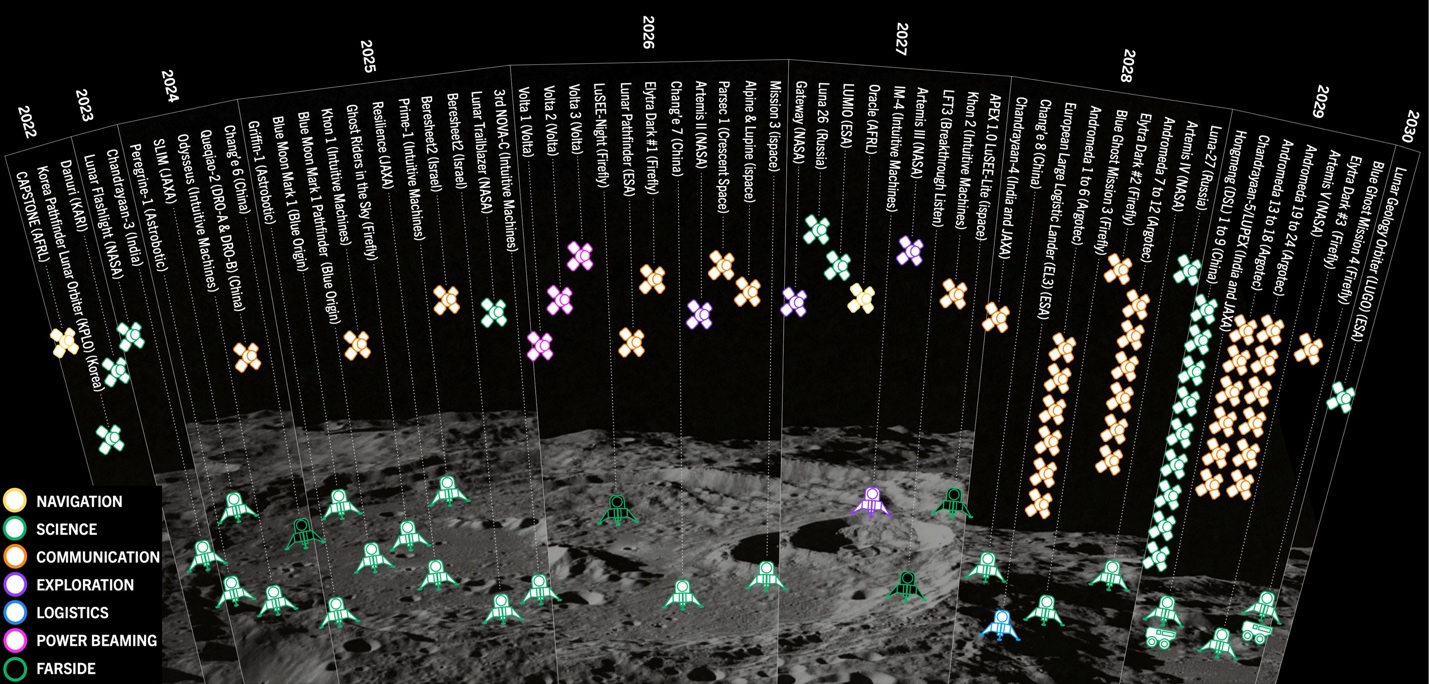
One mission in the planning stage is the Lunar Farside Technosignature and Transients Telescope (LFT3). Being led out of Oxford, this mission would seek to arrive on the lunar farside surface before 2030, to take unique-in-history measurements from 1 - 2700 MHz.. The science case is wide and spans technosignatures, transients, cosmology and lunar studies [https://github.com/ScienceMoonshot/LFT3Memos/blob/main/LFT3_White_Paper.pdf]. This project would explore instrumentation for scientific outcomes for LFT3 and any potential “ride-along” instruments. This could include all mission aspects as well as foundational and preparatory science and instrumentation. The overall goal is science from the Moon, which also includes regolith studies and operations from the Moon. Specifically, this project would work with the LFT3 instrument design and strive to maximize the scientific impact of the data to be collected from the Moon at this unique time.
- Exploring the surfaces of Saturn’s icy satellites -
Supervisor: Carly Howett
Saturn’s icy satellites are diverse and remain enigmatic, despite years of study by NASA’s Cassini mission. The satellites vary in colour, size, and activity. Some, like Mimas, are long dead and show the scars from years of impactor bombardment. While others, like Mimas’ neighbour Enceladus, have active plumes that send ice and dust into space. Understanding the surface of these targets is crucial in understand their role in the Saturn-system, how they interact with Saturn’s rings, high-energy particles, impacting populations, and even whether they could even host life.
Enceladus’ geysers erupt from four fractures that span its south polar region. The resulting plume escapes the moon, forming a ring around Saturn called the E-ring. Exactly why and how the plumes are formed is unknown, but the eruptive material is thought to come from a liquid water ocean, held beneath Enceladus’ icy surface. Whether this ocean supports life is arguably one of the greatest current mysteries of our solar system.
The high-energy electrons that orbit Saturn bombard the surface of Mimas, Tethys and Dione. This bombardment damages their water-ice surfaces, effectively gluing grains in the surface together, which stops it from cooling down at night as much as their surroundings. This surface alteration also changes its colour, making it appear more blue. How this bombardment alters with electron energy, surface depth, and whether such alteration could be occurring elsewhere in the solar system is still poorly understood.
Cassini studied the Saturn system from 2004 until 2017, during which time a wealth of data was obtained on Saturn’s icy satellites. I am seeking one DPhil (PhD) student to continue my work in analysing Cassini’s Composite Infrared Spectrometer (CIRS) data, specifically to analyse eclipse observations made of Saturn’s icy satellites. Eclipse observations are powerful because they allow the very surface (top few mm) of an icy world to be probed. This region is otherwise difficult to study, but yet vital to understanding everything that happens beneath it. Eclipse observations were made of most of Saturn’s icy moons, so could inform on how Enceladus’ plume recoats its surface, and how the very near surface of Mimas/Tethys/Dione is altered by electron bombardment.
The study of icy worlds has a strong future. The upcoming NASA mission “Europa Clipper” will launch in 2024 to study Jupiter’s icy world Europa, and NASA’s Lucy mission launches in late 2021 to study Jupiter’s Trojan asteroids. As a Co-I on both of these missions future opportunities exist for expanding into these targets. The successful candidate would be joining a well-established planetary science group, which is actively involved with many planetary missions and astronomy. International collaborations are include working with other modelling groups located in the USA and Switzerland.
The work will be computationally intensive, using programming languages like IDL and python, so a physics/computing/mathematics background is preferred, and a first degree in Physics, Mathematics or a related discipline is required.
- Modelling Europa -
Supervisor: Carly Howett
Jupiter’s moon Europa is considered one of the most promising candidates for potentially habitable environments beyond Earth. Its icy surface is thought to conceal a global subsurface ocean of liquid water, while evidence of recent or ongoing geological activity suggests that material and energy may be exchanged between the surface and interior. The upcoming arrival of NASA’s Europa Clipper mission in 2030 and ESA’s JUICE mission in the Jupiter system in 2031 will provide unprecedented opportunities to investigate Europa’s surface, subsurface, and thermal environment.
To prepare for the interpretation of these new observations, detailed models of Europa’s surface and near-surface environment are required. This work will use thermophysical modelling to investigate how surface topography, volatile transport, and potential geological activity influence Europa’s thermal and physical properties. In particular, the models will predict the observable signatures produced by these processes and determine how they may be detected by Europa Clipper’s E-THEMIS instrument and JUICE’s Submillimetre Wave Instrument (SWI). These predictions will help connect spacecraft observations with the physical processes shaping Europa’s dynamic icy surface.
- Exploring the Ices of the Outer Solar System in a Lab -
Supervisors: Carly Howett (AOPP) and Hugh Mortimer (STFC at Rutherford Appleton Laboratory)
The surfaces of the outer solar system are diverse and enigmatic. Data taken by spacecraft have shown icy worlds to be enigmatic, and rich with astrobiological potential. Data from Cassini showed Saturn’s moon Enceladus to be highly active, while Hubble Space Telescope (HST) observations hint at plumes on Europa. Multiple missions are currently en route to explore these icy worlds, including Europa Clipper and Juice to study Jupiter’s moons Europa and Ganymede, respectively. However, in order to correctly interpret the returned data we need to understand how the cold, exotic ices in the outer solar system reflect and emit radiation.
This project will help create and develop a new ice laboratory in AOPP, to test the thermophysical properties of ice at extremely low (<50 K) temperatures. However, supporting work may be conducted at the Rutherford Appleton Laboratory, particularly optical design, validation and field work.
Starting with water ice, before moving into more exotic ices (carbon monoxide, nitrogen, methane, carbon dioxide), the initial aim is to measure emissivity at cryogenic temperatures. The results will be tested against existing Cassini and New Horizons data, and eventually Europa Clipper and Juice data.
- Seeing Asteroids in a New Light -
In 2027, NASA’s Lucy mission will begin its encounters with Jupiter’s Trojan asteroids, its primary targets. These asteroids are thought to be ancient remnants of Solar System formation and may provide important insights into its evolution. Lucy will encounter two targets in 2027 (Eurybates and Polymele, along with their moons), another two in 2028 (Leucus and Orus), and a near-equal-mass binary in 2033 (Patroclus and Menoetius). This builds on observations of the two main-belt asteroids encountered during Lucy’s cruise phase, Dinkinesh and Donaldjohanson.
Lucy carries the MVIC instrument, a colour TDI camera that will image the targets in five colour channels, allowing variations in surface colour to be identified. Such variations could be indicative of volatile transport, activity, or geological processes such as mass wasting. This project will focus on characterising these colour variations and linking the results to possible formation mechanisms. This will likely include thermal modelling to predict where volatiles might be lost or trapped. It could also include spectroscopic studies comparing the observed colour variations with Lucy’s LEISA data (1–3.6 µm) to investigate potential compositional differences, as well as L’TES data (6–75 µm) to compare model predictions with observed surface temperatures and thermal properties.
The work could also be extended to targets visited by other spacecraft and/or to predictions for future spacecraft encounters (e.g., by Lucy or Emirates Mission to the Asteroid Belt).
It is expected that the student will work closely with members of the Lucy team.
- Differentiable atmospheric modelling: Learning from data between Earth’s and exoplanetary climates -
Supervisors: Milan Kloewer and Thaddeus Komacek
Atmospheric general circulation models are the backbone of climate models, being used to understand and predict climate change on Earth. Founded in physical laws, general circulation models can be generalised to exoplanetary atmospheres. While many atmospheric processes on Earth are well understood and accurately simulated as evident through the success of weather forecasting, some processes such as cloud formation and precipitation are less certain. Societally-relevant surface climate and extreme events like heat waves, however, strongly depend on those. At the same time, observations can constrain such uncertainties, improving climate predictions on Earth. On exoplanets this will reveal insights about the parameter regimes in which planetary habitability is possible. How to make atmospheric models automatically learn from observational data?
This project will build on top of SpeedyWeather, an atmospheric general circulation model written in the Julia programming language. SpeedyWeather is easy to use and extend, inspired by modern software engineering, covering functionality from data visualisation to high-performance computing. The candidate will continue to develop its differentiability through the automatic differentiation framework Enzyme. Differentiating through SpeedyWeather, we can optimise the unknown or less certain parameters determining the planetary surface climate and resulting habitability in the same way as neural networks are trained towards observations. And we can add neural networks to SpeedyWeather forming a hybrid physics and data-driven model.
For exoplanets, observations of gas giants down to hot terrestrial planets are currently used to constrain their atmospheric composition and thermal structure. Critically, upcoming space missions such as the Large Interferometer for Exoplanets and Habitable Worlds Observatory will have the ability to measure the thermal emission and reflected light of Earth-like exoplanets, enabling a direct test of our Earth-based understanding of planetary climate. This SpeedyWeather/Enzyme framework will enable novel rapid inverse characterization of exoplanetary atmospheres with a 3D model that can be applied to exoplanet observations.
Part 2 of this project will scale up the same method to the Earth’s atmosphere, increasing data and complexity. For earth, the current surface climate is observable, but a model may still mispredict frequencies and intensities of extreme events like heat waves under global warming. But with automatic differentiation we can train the model to correct for the missing physics of heat waves towards a more reliable generalisation into future climates, assessing the Earth’s habitability under global warming.
This PhD project will bridge several fields: The applicant is expected to have a strong background on the spectrum between physics, mathematics, and computer science, with enthusiasm for computer science and machine learning. Prior experience with Julia is not required, but experience with another programming language like Python, Matlab, C(++), or Fortran is preferred.
- Peering through the clouds of Uranus and Neptune -
Supervisor: Patrick Irwin
Uranus and Neptune, known as the “Ice Giants” are amongst the most mysterious and poorly understood planets in our solar system. The Voyager 2 fly-bys in 1986 and 1989, respectively, provided our only close-up views of these worlds and revealed that Uranus is in almost perfect radiative balance with the Sun, while Neptune emits thermally more than 2.5 times the solar radiation it receives. Perhaps as a result of this imbalance, the atmospheric circulation of Uranus was found to be rather quiescent, while that of Neptune was seen to be extraordinarily dynamic and active.
More than a quarter of a century later, the spatial resolution of ground-based telescopes has been transformed by the development of adaptive optics. The activity of Uranus’s atmosphere was seen to increase dramatically through its equinox in 2007, while Neptune’s atmosphere has shown enormous variations in cloud activity. Our group has been monitoring and these developments with an extensive programme of near-infrared ground-based observations at the Gemini-North Telescope in Hawai’i and ESO’s Very Large Telescope in Chile. Near infrared reflectance spectroscopy enables us to determine the vertical and horizontal distribution of cloud and gaseous abundances in these atmospheres. Using our world-leading NEMESIS retrieval code, our team has been at the forefront of recent discoveries, including: 1) the first positive detection of hydrogen sulphide in the atmosphere of Uranus (https://www.ox.ac.uk/news/science-blog/what-do-uranuss-cloud-tops-have-common-rotten-eggs); 2) the first ground-based detection of a dark spot in Neptune’s atmosphere and its first spectral characterisation (https://www.eso.org/public/ireland/news/eso2314); and 3) a new calculation of Uranus’s radiative heat balance showing that it actually emits slightly more radiation than it receives in sunlight (https://science.nasa.gov/missions/hubble/nasa-oxford-discover-warmer-uranus-than-once-thought/).
The aim of this project is to develop and extend our observing programme and combine these observations with thermal infrared determinations and recently acquired observations made with the James Webb Space Telescope. The combination of thermal emission and reflected sunlight observations will enable us to build up a self-consistent picture of the circulation and cloud-forming processes at work on the ice giants during a period of rapid change. The project would build upon a recently completed study that has greatly extended our retrieval ability though the application of a new python code development of NEMESIS, called archnemesis (https://archnemesis.readthedocs.io/en/latest/), and also through machine-learning techniques. This project is timely as a dedicated space mission to one of the Ice Giants was recommended by the 2022 NASA Decadal Survey in Planetary Science. Hence, the Ice Giants are currently a ‘hot topic’!
Since this project will be computationally intensive, using python and other codes (e.g., Fortran), a physics/computing/mathematics degree is preferred.
- Submillimetre spectroscopy of Mars -
Supervisors: Patrick Irwin and Colin Wilson (ESA)
Observations of Mars with wavelengths in the 100-600 GHz frequency range have the potential to measure temperature, gas composition and wind speeds. There have been measurements from ground-based observatories, notably James Clerk Maxwell Telescope (JCMT) and the Atacama Large Millimetre Array (ALMA), and from space-based telescopes (Herschel Space Observatory). Future submillimetre instruments under consideration for future Mars orbiters and landers could provide observations of winds, temperature structure and volatiles which would greatly improve our understanding of the Martian atmosphere.
In this project, modern radiative transfer tools would be used to retrieve atmospheric parameters from existing observations, and predict the performance from future instruments to optimise their design. In addition, the student may also conduct and analyse data from new ground-based observations.
This project would likely be carried out with partners, which could include the European Space Agency, Paris Observatory, and NASA’s Goddard Spaceflight Center.
Since this project will be computationally intensive, using python and other codes (e.g., Fortran), a physics/computing/mathematics degree is preferred.
- Weather in exoplanet atmospheres -
Supervisor: Thaddeus Komacek
Planetary atmospheres are not static entities, rather they are dynamic with emergent short-timescale variability - i.e., “weather.” All Solar System planetary atmospheres undergo time-variability, so it is expected that exoplanet atmospheres are also variable. The variability of exoplanet atmospheres has been potentially inferred from recent space- and ground-based observations, and the James Webb Space Telescope (JWST) will enable characterisation of the detailed properties of such atmospheric variability for hot gas giant exoplanets. There is a need to develop both analytic theory and numerical simulations to ascertain the nature of the atmospheric variability on close-in exoplanets that are expected to be tide-locked to their host star. Previous work has predicted the expected level of variability from either idealised numerical simulations or a small number of simulations of specific planets, but there is no theory for how the variability on tide-locked planets scales with planetary properties and the inclusion of non-linear feedbacks due to processes such as latent heat and clouds.
One DPhil (PhD) student is sought for this project to study weather in tide-locked exoplanet atmospheres. I am open to working on hot gas giant planets that can be characterised with JWST and/or temperate rocky planets that serve as comparison sets to Earth. This DPhil student will work in collaboration with members of the planetary climate group at Oxford and outside collaborators including experts in atmospheric dynamics and experts in atmospheric observational characterisation. The student will use the ADAM (SPARC/MITgcm) model and/or the ExoCAM general circulation models to simulate atmospheric variability, and will also use pencil-and-paper theory to understand the mechanisms driving variability in greater detail. As part of this project, the student will work to advance and modernise the SPARC/MITgcm and/or ExoCAM modelling frameworks, in collaboration with their userbases.
This work will require a thorough understanding of fluid dynamics and radiative transfer, which require a solid background in mechanics, electricity and magnetism, thermodynamics, and quantum mechanics, as well as the mathematical methods of physics. As a result, a degree in physics, mathematics, geophysical sciences, astrophysics, or a related discipline is required. This project will be computationally intensive, with coding in Fortran (MITgcm, ExoCAM), Python (gCMCRT and PSG post-processing and analysis of ExoCAM and MITgcm), and MATLAB (MITgcm). A keen familiarity with computer programming is required, while prior experience with Fortran, Python, and MATLAB is desirable but not required.
- Simulating the combined impacts of clouds and hazes on the climate and observable properties of the diverse range of exoplanets -
Supervisor: Thaddeus Komacek
Clouds and/or hazes are found on every planet in the Solar System with a thick atmosphere and can have a profound impact on the climate and observable properties of exoplanets. They are expected to be present in all exoplanetary regimes that are currently observationally accessible, including in the atmospheres of close-in hot and warm Jupiters and temperate and warm Sub-Neptunes. Clouds and hazes in these atmospheres have already been found to impact their observable properties accessible with ground- and space-based telescopes through the muting of spectral features in transmission, reflected light patterns accessible via phase curves, and population-level trends in spectra. In addition, clouds and hazes are expected to shape the climates of temperate terrestrial exoplanets in the habitable zones of a range of host stars, and may significantly mute key spectral features of biosignatures or habitability indicators in transmission. As a result, comprehensive 3D models that incorporate cloud and haze microphysics are required to make the best use of current and future observational data of exoplanet atmospheres.
One DPhil (PhD) student is sought for this project to study the impacts of clouds and hazes on exoplanetary atmospheric circulation, climate, and observable properties. I am open to working on simulations in a range of planetary regimes, including terrestrial planets, sub-Neptunes, and gas giants in a variety of irradiation regimes. This DPhil student will work in collaboration with members of the planetary climate group at Oxford, outside collaborators who are experts in atmospheric dynamics and cloud and haze microphysics, and the SPARC/MITgcm and/or ExoCAM hot Jupiter userbases more broadly. As part of this project, the student will work to advance and modernise the SPARC/MITgcm and/or ExoCAM modelling frameworks, in collaboration with their userbases.
This work will require a thorough understanding of fluid dynamics and radiative transfer, which require a solid background in mechanics, electricity and magnetism, thermodynamics, and quantum mechanics, as well as the mathematical methods of physics. As a result, a degree in physics, mathematics, geophysical sciences, astrophysics, or a related discipline is required. This project will be computationally intensive, with coding in Fortran (MITgcm, ExoCAM), Python (gCMCRT and PSG post-processing and analysis of ExoCAM and MITgcm), and MATLAB (MITgcm). A keen familiarity with computer programming is required, while prior experience with Fortran, Python, and MATLAB is desirable but not required.
- Towards a self-consistent view of Martian atmospheric photochemistry: assimilating satellite data with a Mars 3-D general circulation model -
Supervisor: Paul Palmer (joining the University of Oxford in 2027)
The seasonal detection of hydrogen chloride (HCl) in the Martian atmosphere by the ExoMars Trace Gas Orbiter (TGO) has posed one of the most significant challenges to our current understanding of Martian photochemistry. Existing atmospheric gas-phase photochemical models cannot explain the rapid appearance and disappearance of HCl, highlighting important gaps in our knowledge of the coupled hydrogen oxide (HOx) and oxygen (Ox) chemical networks, and the interactions between the Martian atmosphere, surface and dust cycle.
In this DPhil project, you will develop a novel data-assimilation framework for Martian atmospheric chemistry, using a Local Ensemble Transform Kalman Filter (LETKF) to combine observations from multiple satellite instruments with the state-of-the-art Mars Planetary Climate Model, a three-dimensional general circulation model that includes interactive photochemistry. Working closely with UK and international collaborators, you will assimilate measurements from the ACS (Atmospheric Chemistry Suite) and NOMAD (Nadir and Occultation for MArs Discovery) instruments aboard ExoMars TGO to produce the first self-consistent global reanalysis of Martian photochemistry.
By assimilating observations of HCl, ozone and water vapour, you will infer the abundance of short-lived HOx species that cannot currently be measured directly but play a critical role in controlling Martian photochemistry. This will provide a powerful new framework for testing competing hypotheses, identifying deficiencies in current chemical schemes, and determining the processes responsible for observed atmospheric variability. Your results will provide new insights into the coupling between the Martian surface and atmosphere and help improve the atmospheric models that support future robotic and human exploration of Mars.
This interdisciplinary project offers an opportunity to work at the interface of planetary science, atmospheric chemistry, numerical modelling, data assimilation and data science, contributing to a new frontier in planetary research.
Requirements
This is a computational and data analysis project so some knowledge of coding would be useful (e.g., Python, FORTRAN).
Bibliography
Benne, B, P. I. Palmer, B. M. Taysum, K. D. Olsen, F. Lefevre, A 3-D model simulation of hydrogen chloride photochemistry Mars: comparison with satellite data, 699, A362, A&A, https://doi.org/10.1051/0004-6361/202553872, 2025
Taysum, B., P. I. Palmer, K. Olsen, M. Luginin, N. Ignatiev, A. Trokhimovskiy, A. Shakun, A. Grigoriev, F. Montmessin, O. Korablev, Observed seasonal changes in Martian hydrogen chloride explained by heterogeneous chemistry, Astronomy and Astrophysics, 687, A191, https://doi.org/10.1051/0004-6361/202449546, 2024.
The MPCM
- Modelling atmospheric chemistry and dynamics on a Venus-like exoplanet -
Supervisor: Paul Palmer (joining the University of Oxford in 2027)
Earth and Venus are remarkably similar in size and density, yet one supports life while the other became the hottest and most inhospitable planet in the Solar System. Despite decades of study, major questions remain about Venus' evolution, particularly the development of its atmosphere.
In this DPhil project, you will use recent discoveries of Venus-like exoplanets, such as Gliese 12 b, to investigate how planets with similar starting conditions can evolve so differently. You will use a planetary climate model to simulate plausible environmental conditions on Gliese 12 b, a Venus-sized planet orbiting an M-type star every 12.8 days. Although much closer to its host star than Venus is to the Sun, it receives a comparable level of radiation.
You will carry out atmospheric chemistry simulations based on established Venusian chemical networks, including gas-phase and heterogeneous processes, while incorporating new developments as they emerge. By exploring a range of initial conditions drawn from the literature, you will examine how atmospheric composition and climate evolve, including the potential existence and persistence of atmospheric habitable zones. To assess the detectability of these atmospheres, you will generate synthetic observations for future Extremely Large Telescope (ELT) facilities.
Working with colleagues at the Astronomy Technology Centre in Edinburgh, you will have the opportunity to explore the capabilities of the Mid-infrared ELT Imager and Spectrograph (METIS), whose combination of high spatial and spectral resolution will provide new opportunities to characterise exoplanet atmospheres and identify molecular species through high-dispersion spectroscopy.
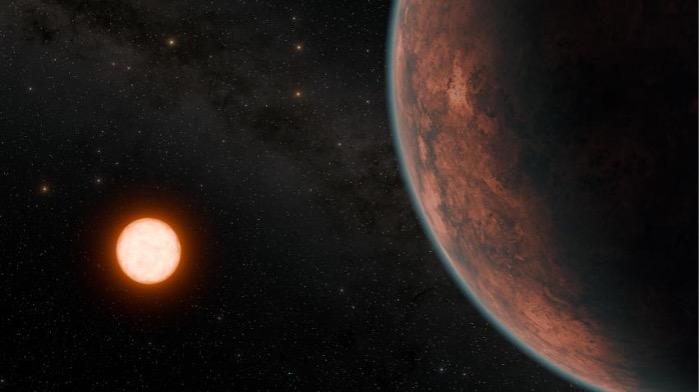
Gliese 12 b, which orbits a cool, red dwarf star located just 12.1 parsecs away. In this artist’s concept, Gliese 12 b is shown retaining a thin atmosphere. Credit NASA/JPL-Caltech/R. Hurt (Caltech-IPAC). License type: Attribution (CC BY 4.0)
Requirements
This is a computational and data analysis project so some knowledge of coding would be useful (e.g., Python, FORTRAN).
Bibliography
Gliese 12 b:
https://academic.oup.com/mnras/article/531/1/1276/7679807
https://iopscience.iop.org/article/10.3847/2041-8213/ad3642
Venus photochemistry and clouds:
https://www.sciencedirect.com/science/article/pii/S0019103523000246?via%3Dihub
METIS: