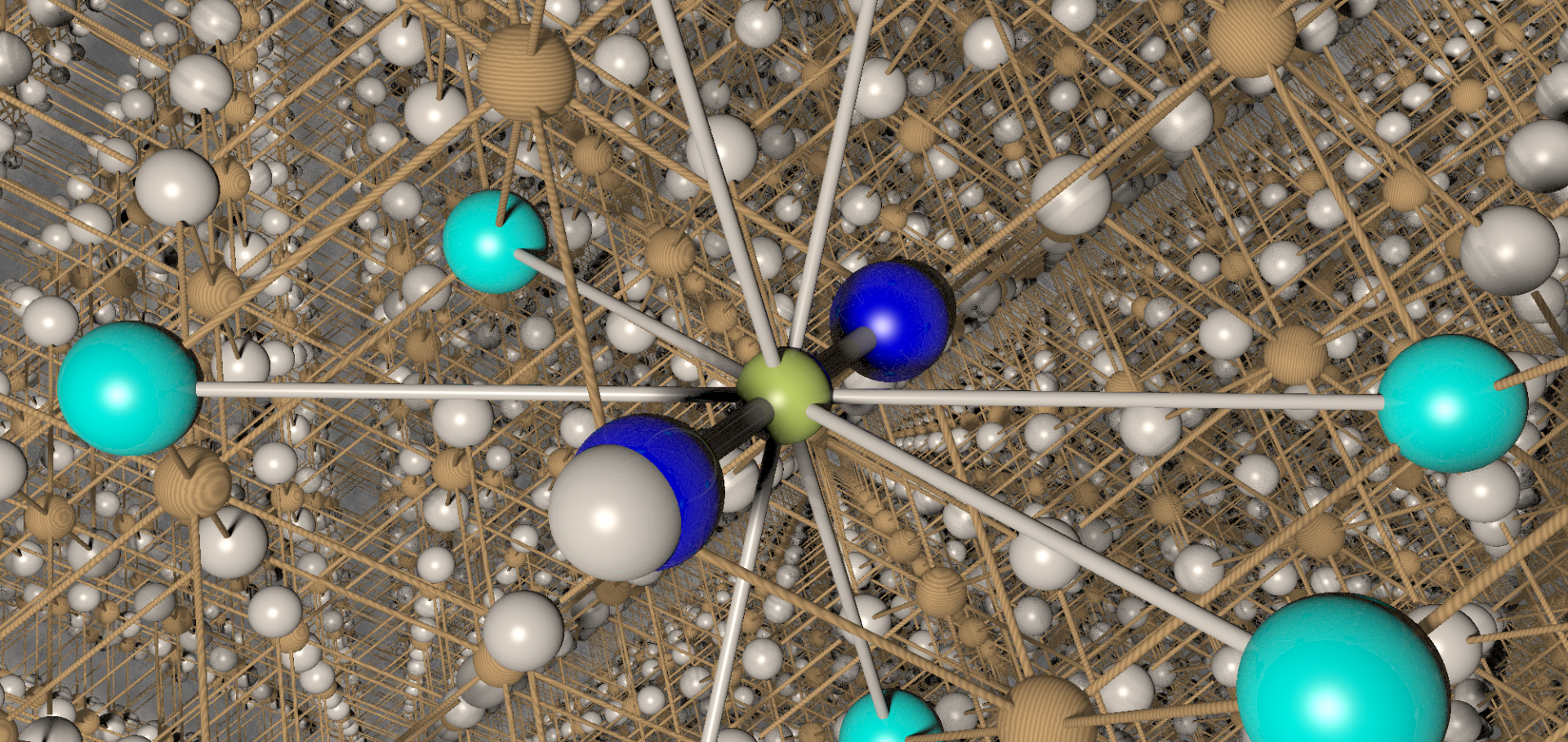
Compositional control of the superconducting properties of LiFeAs.
J Am Chem Soc 132:30 (2010) 10467-10476
Abstract:
The response of the superconducting state and crystal structure of LiFeAs to chemical substitutions on both the Li and the Fe sites has been probed using high-resolution X-ray and neutron diffraction measurements, magnetometry, and muon-spin rotation spectroscopy. The superconductivity is extremely sensitive to composition: Li-deficient materials (Li(1-y)Fe(1+y)As with Fe substituting for Li) show a very rapid suppression of the superconducting state, which is destroyed when y exceeds 0.02, echoing the behavior of the Fe(1+y)Se system. Substitution of Fe by small amounts of Co or Ni results in monotonic lowering of the superconducting transition temperature, T(c), and the superfluid stiffness, rho(s), as the electron count increases. T(c) is lowered monotonically at a rate of 10 K per 0.1 electrons added per formula unit irrespective of whether the dopant is Co and Ni, and at higher doping levels superconductivity is completely suppressed. These results and the demonstration that the superfluid stiffness in these LiFeAs-derived compounds is higher than in all of the iron pnictide materials underlines the unique position that LiFeAs occupies in this class.Muon spin relaxation investigation of magnetic ordering in the hybrid organic-inorganic perovskites [(CH3 )2 NH 2 ]M(HCOO)3 (M=Ni,Co,Mn,Cu )
Physical Review B - Condensed Matter and Materials Physics 82:1 (2010)
Abstract:
Muon spin relaxation measurements are reported on samples of dimethylammonium metal formates containing magnetic divalent nickel, cobalt, manganese, and copper ions. These hybrid organic-inorganic perovskites exhibit weak ferromagnetism and are, apart from the copper system, multiferroics with well-separated magnetic and antiferroelectric transitions. We use muons to follow the sublattice magnetization, observing the effect of the spin reorientation transitions below TN and the criticality approaching TN. The multiferroic samples have three-dimensional antiferromagnetic interactions but the copper sample shows quasi-one-dimensional behavior due to its Jahn-Teller distorted structure with a ratio of its interchain and intrachain exchange constants | J′ /J | ≃0.037. © 2010 The American Physical Society.Giant magnetic hardness in the synthetic mineral ferrimagnet K 2 CoII3 (OH)2 (SO4 ) 3 (H2O)2
Chemistry of Materials 22:13 (2010) 4090-4095
Abstract:
Wepresent the synthesis, single-crystal X-ray (173 K) and powder neutron (2-30 K) structures and its thermal, optical and magnetic properties of K 2CoII3(OH)2(SO4) 2(H2O)2. It is a ferrimagnet (TC= 29.7 K) constructed of Co3(OH)2 diamond chains connected by sulfate and it displays hysteresis loops ranging from being soft with nearly zero coercivity between 29 and 10 K to very hard reaching coercive field exceeding 70 kOe at 1.8 K. This dramatic change is associated with the changes in domain shape due to the strong exchange anisotropy. Considerable frequency dependence of the acsusceptibilities is observed in the ordered state.Measurements on a single crystal have established the magnetic axes to be a-axis (easy), b-axis (intermediate), and c-axis (hard). © 2010 American Chemical Society.Muon spin relaxation investigation of magnetic ordering in the hybrid organic-inorganic perovskites [(CH3)2NH2]M(HCOO)3, M = Ni,Co,Mn,Cu
(2010)
Superconductivity and fluctuating magnetism in quasi two-dimensional kappa-(BEDT-TTF)2Cu[N(CN)2]Br probed with implanted muons
(2010)