
Home
Department Of Physics text logo
  • Research
    • Our research
    • Our research groups
    • Our research in action
    • Research funding support
    • Summer internships for undergraduates
  • Study
    • Undergraduates
    • Postgraduates
  • Engage
    • For young people
    • For teachers
    • For the public
    • For alumni
    • For business
  • Support
Menu
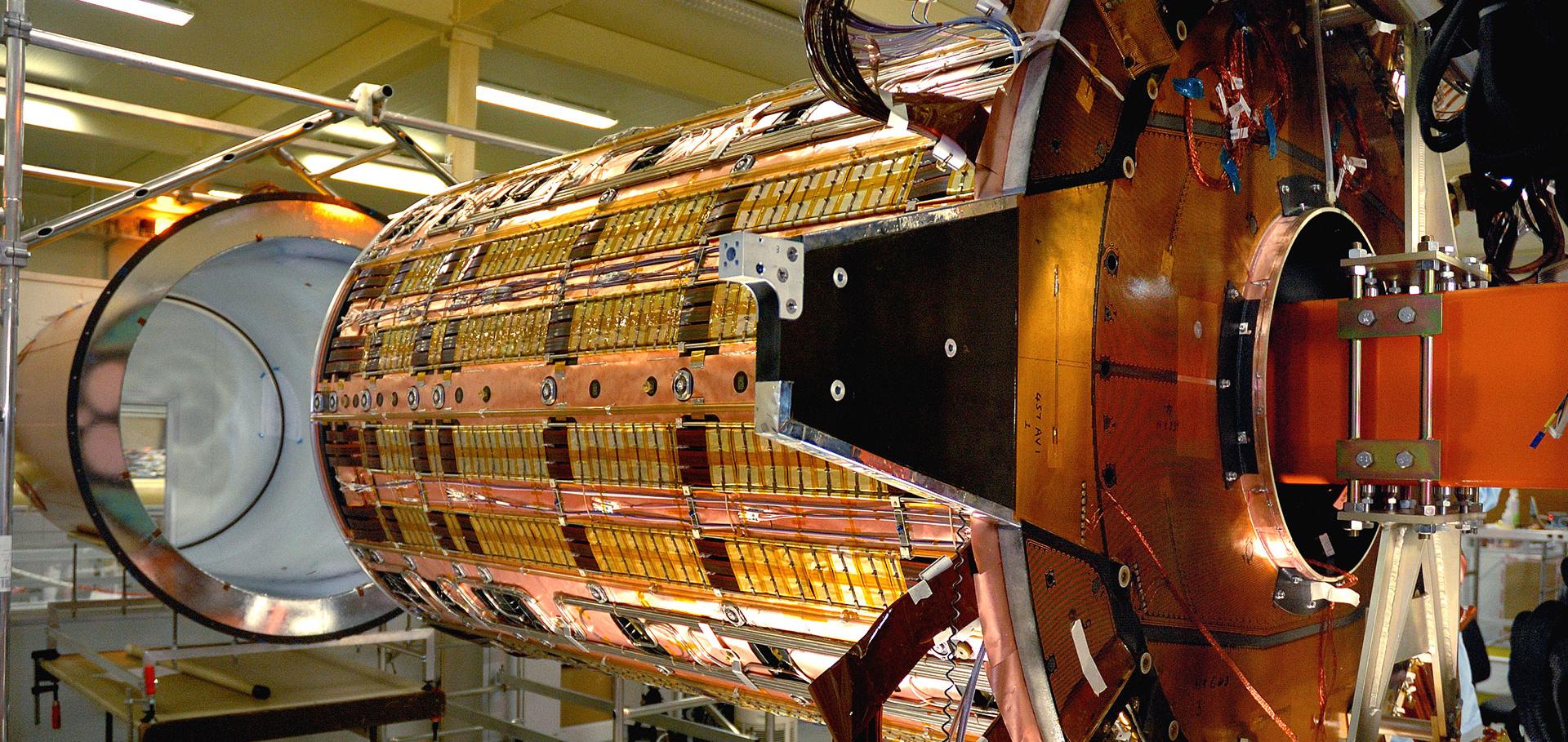
Insertion of STC into TRT at the Department of Physics, Oxford
Credit: CERN

Professor Daniela Bortoletto

Professor and Head of Particle Physics

Research theme

  • Instrumentation
  • Fundamental particles and interactions

Sub department

  • Particle Physics

Research groups

  • AION/Magis
  • ATLAS
  • Future Colliders
  • Mu3e
  • OPMD
daniela.bortoletto@physics.ox.ac.uk
Telephone: 01865 (2)73635
Denys Wilkinson Building, room 608c1
  • About
  • Students
  • Research
  • Teaching
  • Publications

Measurement of the top-quark mass using decays with a J/ψ meson at s = 13 TeV with the ATLAS detector

Journal of High Energy Physics Springer 2026:4 (2026) 99

Authors:

G Aad, E Aakvaag, B Abbott, S Abdelhameed, K Abeling, NJ Abicht, SH Abidi, M Aboelela, A Aboulhorma, H Abramowicz, Y Abulaiti, BS Acharya, A Ackermann, C Adam Bourdarios, L Adamczyk, SV Addepalli, MJ Addison, J Adelman, A Adiguzel, T Adye, AA Affolder, Y Afik, MN Agaras, A Aggarwal, C Agheorghiesei

Abstract:

The top-quark mass is measured using top-quark decays producing an isolated lepton and J/ψ meson reconstructed in its μ+μ− decay mode. The data sample was recorded with the ATLAS detector in proton-proton collisions at a centre-of-mass energy of s=13 TeV during Run 2 of the Large Hadron Collider, corresponding to an integrated luminosity of 140 fb−1. The measurement is based on the invariant mass m(ℓμ+μ−) of the system made of the isolated lepton ℓ from the W boson decay and the non-isolated μ+μ− pair from a J/ψ decay of a b-hadron, exploiting its sensitivity to the top-quark mass. An unbinned maximum-likelihood fit to the m(ℓμ+μ−) distribution is performed to extract the top-quark mass. The top-quark mass is measured to be mtop = 172.17 ± 0.80 (stat) ± 0.81 (syst) ± 1.07 (recoil) GeV, with a total uncertainty of 1.56 GeV. The third uncertainty arises from changing the dipole parton shower gluon-recoil scheme used in top-quark decays.
More details from the publisher
Details from ORA
More details

A Data-Driven Fast Simulation Approach for MAPS-based Detectors and their Optimization

ArXiv 2604.05893 (2026)

Authors:

Dumitru Vlad Berlea, Lucian Fasselt, Prafulla Behera, Daniela Bortoletto, Craig Buttar, Theertha Chembakan, Valerio Dao, Ganapati Dash, Sebastian Haberl, Tomohiro Inada, Fuat Kerem Isik, Cigdem Issever, Xuan Li, Long Li, Heinz Pernegger, Petra Riedler, Walter Snoeys, Carlos Solans Sánchez, Anna Swoboda, Ilkay Turk Cakir, Milou van Rijnbach, Anusree Vijay, Julian Weick, Steven Worm
Details from ArXiV

Measurement of charged-particle production in $\sqrt{s_\text{NN}}=9.62$ TeV proton-oxygen collisions as a probe of cosmic-ray air showers with the ATLAS detector

ArXiv 2604.05512 (2026)
Details from ArXiV

Charge collection parameterization of MALTA2, a depleted monolithic active pixel sensor

Journal of Instrumentation IOP Publishing 21:04 (2026) C04001

Authors:

L Fasselt, P Behera, DV Berlea, D Bortoletto, C Buttar, T Chembakan, V Dao, G Dash, S Haberl, T Inada, FK Isik, P Jana, X Li, L Li, H Pernegger, P Riedler, W Snoeys, CA Solans Sánchez, A Swoboda, I Turk Cakir, M van Rijnbach, M Vázquez Núñez, A Vijay, J Weick, S Worm

Abstract:

A fast simulation method is presented for a depleted monolithic active pixel sensor, which uses a data driven parameterization of the charge collection and propagation. This approach provides an efficient alternative to TCAD simulations, particularly for sensors whose proprietary process details — such as doping profiles or implant geometries — are unavailable. Data was obtained with a MALTA2 sensor fabricated in a 180 nm CMOS imaging technology on 30 µm epitaxial silicon using the MALTA beam telescope at CERN SPS. The model reproduces the measured in-pixel efficiency with high accuracy and enables a realistic yet computationally lightweight analog pixel simulation. This method will be further employed in optimizing the digital sensor design for applications in high-rate particle tracking and high-granularity calorimetry.
More details from the publisher
Details from ORA

Measurement of coherent exclusive J/ψ → μ + μ − production in ultraperipheral Pb+Pb collisions at s NN = 5.36 TeV with the ATLAS detector

Journal of High Energy Physics Springer 2026:4 (2026) 20

Authors:

G Aad, E Aakvaag, B Abbott, S Abdelhameed, K Abeling, NJ Abicht, SH Abidi, M Aboelela, A Aboulhorma, H Abramowicz, Y Abulaiti, BS Acharya, A Ackermann, C Adam Bourdarios, L Adamczyk, SV Addepalli, MJ Addison, J Adelman, A Adiguzel, T Adye, AA Affolder, Y Afik, MN Agaras, A Aggarwal, C Agheorghiesei

Abstract:

The ATLAS experiment has performed a measurement of coherent exclusive J/ψ → μ+μ− production in ultraperipheral Pb+Pb collisions at sNN=5.36 TeV. The data was recorded at the Large Hadron Collider (LHC) during 2023, and corresponds to an integrated luminosity of 79 μb−1. Exclusive J/ψ candidates were selected with a dedicated track-sensitive trigger based on the ATLAS transition radiation tracker. The analysis involves reconstruction of the dimuon invariant mass based on muon tracks from the inner detector, as the muon transverse momentum range of interest precludes the use of the standard muon reconstruction and identification algorithms. Differential cross sections are measured as a function of J/ψ rapidity and are compared with theoretical predictions. After extrapolation to sNN=5.02 TeV, they are also compared with previous measurements performed by other experiments using data from LHC Run 2. While the results agree reasonably well with theoretical predictions, they are in tension with previous Run-2 results for the central rapidity region.
More details from the publisher
Details from ORA
More details

Pagination

  • First page First
  • Previous page Prev
  • …
  • Page 19
  • Page 20
  • Page 21
  • Page 22
  • Current page 23
  • Page 24
  • Page 25
  • Page 26
  • Page 27
  • …
  • Next page Next
  • Last page Last

Footer Menu

  • Contact us
  • Giving to the Dept of Physics
  • Work with us
  • Media

User account menu

  • Log in

Follow us

FIND US

Clarendon Laboratory,

Parks Road,

Oxford,

OX1 3PU

CONTACT US

Tel: +44(0)1865272200

University of Oxfrod logo Department Of Physics text logo
IOP Juno Champion logo Athena Swan Silver Award logo

© University of Oxford - Department of Physics

Cookies | Privacy policy | Accessibility statement

Built by: Versantus

  • Home
  • Research
  • Study
  • Engage
  • Our people
  • News & Comment
  • Events
  • Our facilities & services
  • About us
  • Giving to Physics
  • Current students
  • Staff intranet