

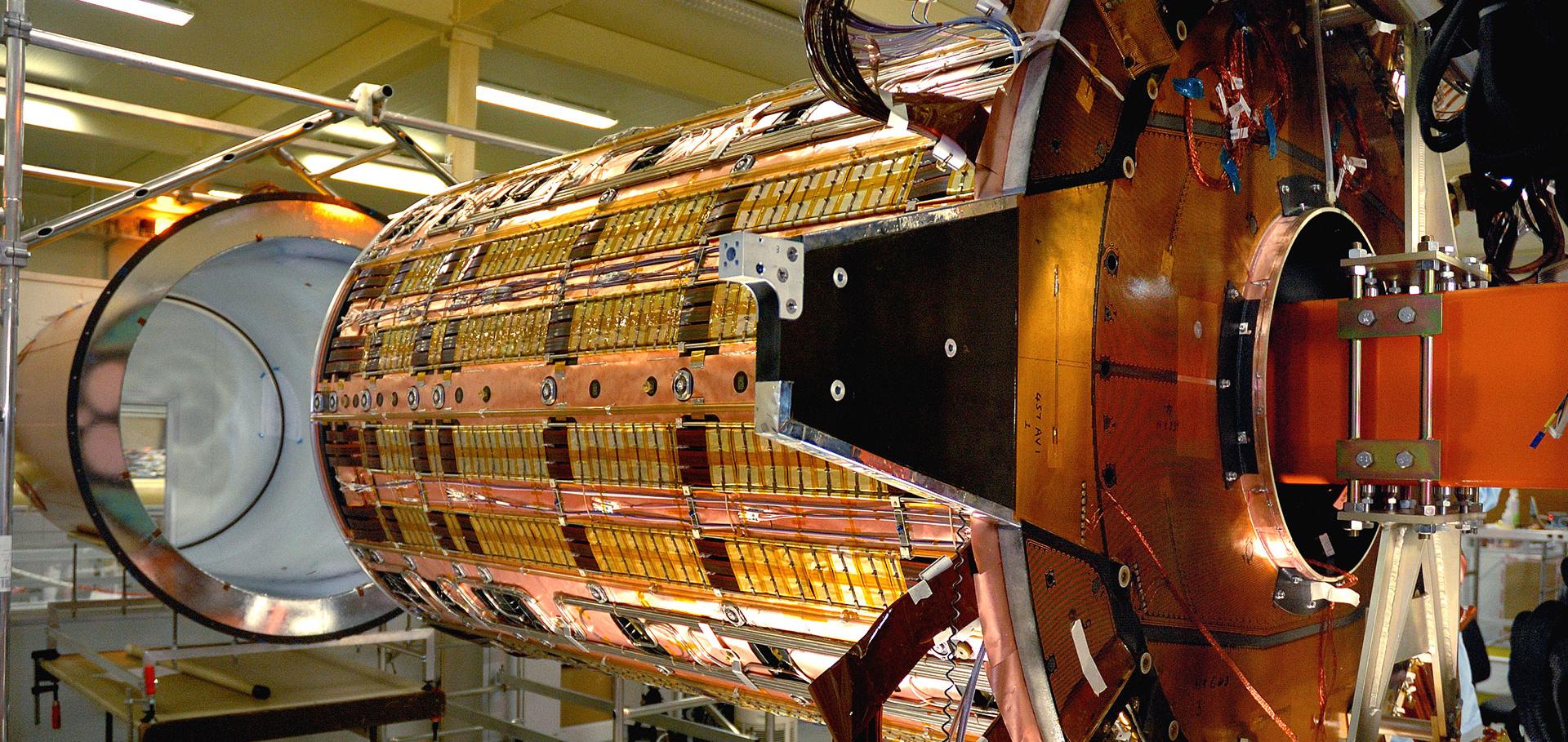

Characterisation of the first wafer-scale prototype for the ALICE ITS3 upgrade: The monolithic stitched sensor (MOSS)
Nuclear Instruments and Methods in Physics Research Section A Accelerators Spectrometers Detectors and Associated Equipment Elsevier (2026) 171297
Abstract:
This paper presents the characterisation and testing of the first wafer-scale monolithic stitched sensor (MOSS) prototype developed for the ALICE ITS3 upgrade that is to be installed during the LHC Long Shutdown 3 (2026–2030). The MOSS chip design is driven by the truly cylindrical detector geometry that imposes that each layer is built out of two wafer-sized, bent silicon chips. The stitching technique is employed to fabricate sensors with dimensions of 1.4 cm × 25.9 cm, thinned to 50 μ m. The chip architecture, the in-pixel front-end, the laboratory and in-beam characterisation, the susceptibility to single-event effects, and the series testing are discussed. The testing campaign validates the design of a wafer-scale stitched sensor and the performance of the pixel matrix to be within the ITS3 requirements. The MOSS chip demonstrates the feasibility of the ITS3 detector concept and provides insights for further optimisation and development.Future Circular Collider Feasibility Study Report
The European Physical Journal C SpringerOpen 85:12 (2025) 1468
Abstract:
Volume 1 of the FCC Feasibility Report presents an overview of the physics case, experimental programme, and detector concepts for the Future Circular Collider (FCC). This volume outlines how FCC would address some of the most profound open questions in particle physics, from precision studies of the Higgs and EW bosons and of the top quark, to the exploration of physics beyond the Standard Model. The report reviews the experimental opportunities offered by the staged implementation of FCC, beginning with an electron-positron collider (FCC-ee), operating at several centre-of-mass energies, followed by a hadron collider (FCC-hh). Benchmark examples are given of the expected physics performance, in terms of precision and sensitivity to new phenomena, of each collider stage. Detector requirements and conceptual designs for FCC-ee experiments are discussed, as are the specific demands that the physics programme imposes on the accelerator in the domains of the calibration of the collision energy, and the interface region between the accelerator and the detector. The report also highlights advances in detector, software and computing technologies, as well as the theoretical tools/reconstruction techniques that will enable the precision measurements and discovery potential of the FCC experimental programme. The content and structure of this report are guided by the scope and priorities defined in the mandate of the FCC Feasibility Study. It is therefore not intended to serve as an exhaustive review of the full physics potential of FCC. Several topics, already covered in earlier reports such as the FCC CDR, are not reiterated here or are addressed only briefly, in alignment with the study’s focus. This volume reflects the outcome of a global collaborative effort involving hundreds of scientists and institutions, aided by a dedicated community-building coordination, and provides a targeted assessment of the scientific opportunities and experimental foundations of the FCC programme.Search for resonant leptoquark production via lepton-jet signatures in pp collisions at s = 13 TeV and s = 13.6 TeV with the ATLAS detector
Journal of High Energy Physics Springer 2025:12 (2025) 180
Abstract:
This paper presents a search for physics beyond the Standard Model targeting a heavy resonance visible in the invariant mass of the lepton-jet system. The analysis focuses on final states with a high-energy lepton and jet, and is optimised for the resonant production of leptoquarks — a novel production mode mediated by the lepton content of the proton originating from quantum fluctuations. Four distinct and orthogonal final states are considered: e+light jet, μ+light jet, e+b-jet, and μ+b-jet, constituting the first search at the Large Hadron Collider for resonantly produced leptoquarks with couplings to electrons and muons. Events with an additional same-flavour lepton, as expected from higher-order diagrams in the signal process, are also included in each channel. The search uses proton-proton collision data from the full Run 2, corresponding to an integrated luminosity of 140 fb−1 at a centre-of-mass energy of s=13 TeV, and from a part of Run 3 (2022–2023), corresponding to 55 fb−1 at s=13.6 TeV. No significant excess over Standard Model predictions is observed. The results are interpreted as exclusion limits on scalar leptoquark S~1 production, substantially improving upon previous ATLAS constraints from leptoquark pair production for large coupling values. The excluded S~1 mass ranges depend on the coupling strength, reaching up to 3.4 TeV for quark-lepton couplings yde = 1.0, and up to 4.3 TeV, 3.1 TeV, and 2.8 TeV for ysμ, ybe, and ybμ couplings set to 3.5, respectively.Measurement of inclusive dijet cross-sections in proton-proton collisions at $\sqrt{s} = 13$ TeV with the ATLAS detector
ArXiv 2512.19073 (2025)
Calibration of the jet energy scale and resolution of small-radius jets using semileptonic $t\bar{t}$ events with the ATLAS detector
ArXiv 2512.17482 (2025)