
Home
Department Of Physics text logo
  • Research
    • Our research
    • Our research groups
    • Our research in action
    • Research funding support
    • Summer internships for undergraduates
  • Study
    • Undergraduates
    • Postgraduates
  • Engage
    • For young people
    • For teachers
    • For the public
    • For alumni
    • For business
  • Support
Menu
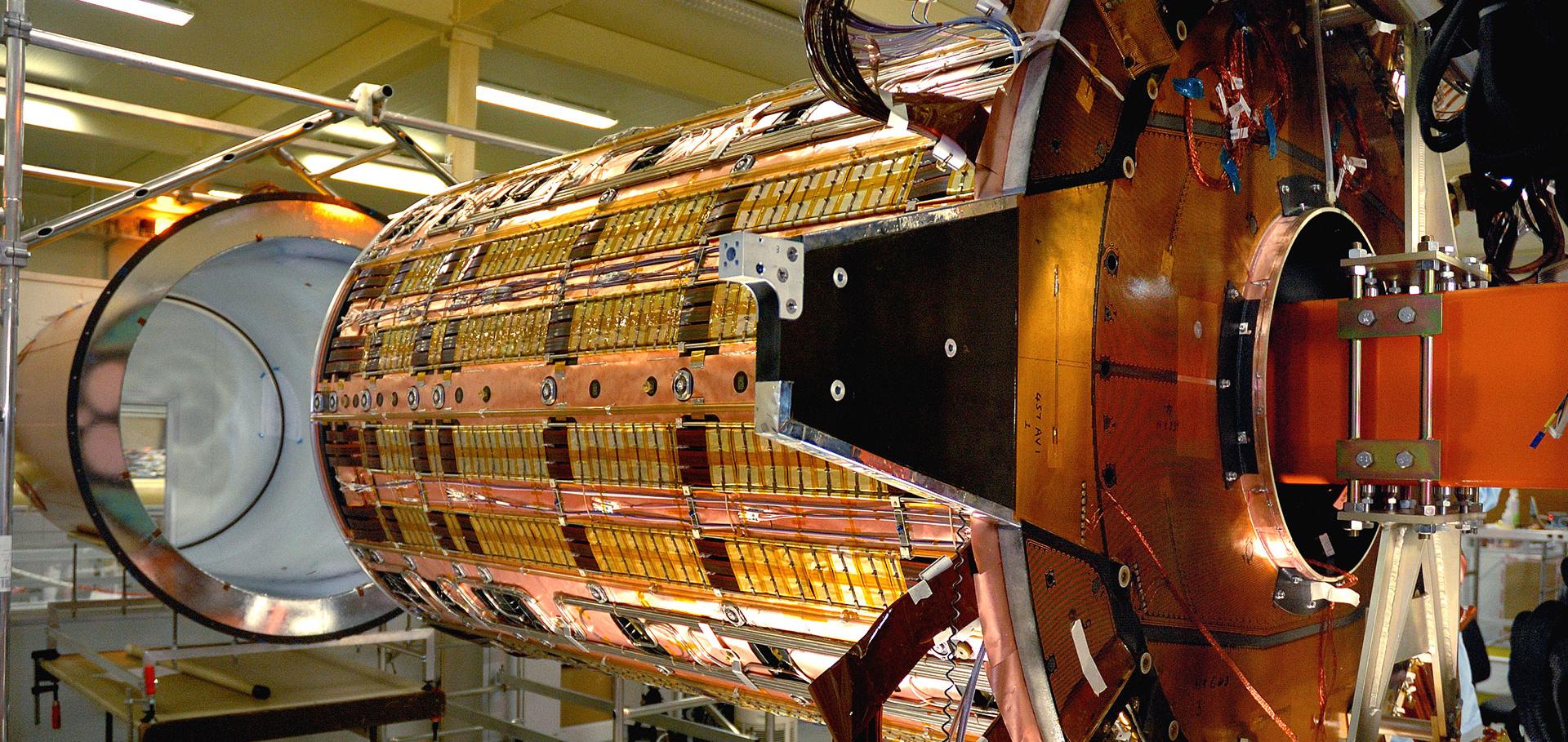
Insertion of STC into TRT at the Department of Physics, Oxford
Credit: CERN

Professor Daniela Bortoletto

Professor and Head of Particle Physics

Research theme

  • Instrumentation
  • Fundamental particles and interactions

Sub department

  • Particle Physics

Research groups

  • AION/Magis
  • ATLAS
  • Future Colliders
  • Mu3e
  • OPMD
daniela.bortoletto@physics.ox.ac.uk
Telephone: 01865 (2)73635
Denys Wilkinson Building, room 608c1
  • About
  • Students
  • Research
  • Teaching
  • Publications

Search for hadronic decays of W and Z bosons in photon events in pp̄ collisions at s=1.96TeV

Physical Review D Particles Fields Gravitation and Cosmology 80:5 (2009)

Authors:

T Aaltonen, J Adelman, T Akimoto, MG Albrow, BA González, S Amerio, D Amidei, A Anastassov, A Annovi, J Antos, M Aoki, G Apollinari, A Apresyan, T Arisawa, A Artikov, W Ashmanskas, A Attal, A Aurisano, F Azfar, P Azzi-Bacchetta, P Azzurri, N Bacchetta, W Badgett, A Barbaro-Galtieri, VE Barnes, BA Barnett, S Baroiant, V Bartsch, G Bauer, PH Beauchemin, F Bedeschi, P Bednar, S Behari, G Bellettini, J Bellinger, A Belloni, D Benjamin, A Beretvas, J Beringer, T Berry, A Bhatti, M Binkley, D Bisello, I Bizjak, RE Blair, C Blocker, B Blumenfeld, A Bocci, A Bodek, V Boisvert, G Bolla, A Bolshov, D Bortoletto, J Boudreau, A Boveia, B Brau, A Bridgeman, L Brigliadori, C Bromberg, E Brubaker, J Budagov, HS Budd, S Budd, K Burkett, G Busetto, P Bussey, A Buzatu, KL Byrum, S Cabrera, M Campanelli, M Campbell, F Canelli, A Canepa, D Carlsmith, R Carosi, S Carrillo, S Carron, B Casal, M Casarsa, A Castro, P Catastini, D Cauz, M Cavalli-Sforza, A Cerri, L Cerrito, SH Chang, YC Chen, M Chertok, G Chiarelli, G Chlachidze, F Chlebana, K Cho, D Chokheli, JP Chou, G Choudalakis, SH Chuang, K Chung, WH Chung, YS Chung, CI Ciobanu

Abstract:

We report on a search for the process pp̄→γ+W/Z with W/Z→qq̄ in events containing two jets and a photon at the center-of-mass energy s=1.96TeV, using 184pb-1 of data collected by the CDF II detector. A neural network event selection has been developed to optimize the rejection of the large QCD production background; it is shown that this method gives a significant improvement in both signal-to-noise ratio and signal sensitivity, as compared with an event selection based on conventional cuts. An upper limit is presented for the γ+W/Z production cross section with the W and Z decaying hadronically. © 2009 The American Physical Society.
More details from the publisher

Search for anomalous production of events with a photon, jet, b-quark jet, and missing transverse energy

Physical Review D - Particles, Fields, Gravitation and Cosmology 80:5 (2009)

Authors:

T Aaltonen, J Adelman, T Akimoto, BA González, S Amerio, D Amidei, A Anastassov, A Annovi, J Antos, G Apollinari, A Apresyan, T Arisawa, A Artikov, W Ashmanskas, A Attal, A Aurisano, F Azfar, P Azzurri, W Badgett, A Barbaro-Galtieri, VE Barnes, BA Barnett, V Bartsch, G Bauer, PH Beauchemin, F Bedeschi, D Beecher, S Behari, G Bellettini, J Bellinger, D Benjamin, A Beretvas, J Beringer, A Bhatti, M Binkley, D Bisello, I Bizjak, RE Blair, C Blocker, B Blumenfeld, A Bocci, A Bodek, V Boisvert, G Bolla, D Bortoletto, J Boudreau, A Boveia, B Brau, A Bridgeman, L Brigliadori, C Bromberg, E Brubaker, J Budagov, HS Budd, S Budd, S Burke, K Burkett, G Busetto, P Bussey, A Buzatu, KL Byrum, S Cabrera, C Calancha, M Campanelli, M Campbell, F Canelli, A Canepa, B Carls, D Carlsmith, R Carosi, S Carrillo, S Carron, B Casal, M Casarsa, A Castro, P Catastini, D Cauz, V Cavaliere, M Cavalli-Sforza, A Cerri, L Cerrito, SH Chang, YC Chen, M Chertok, G Chiarelli, G Chlachidze, F Chlebana, K Cho, D Chokheli, JP Chou, G Choudalakis, SH Chuang, K Chung, WH Chung, YS Chung, T Chwalek, CI Ciobanu, MA Ciocci, A Clark, D Clark

Abstract:

We present a signature-based search for the anomalous production of events containing a photon, two jets, of which at least one is identified as originating from a b quark, and missing transverse energy (E T). The search uses data corresponding to 2.0fb-1 of integrated luminosity from pp̄ collisions at a center-of-mass energy of s=1.96TeV, collected with the CDF II detector at the Fermilab Tevatron. From 6.69747×10⁶ events with a photon candidate with transverse energy ET>25GeV, we find 617 events with E T>25GeV and two or more jets with ET>15GeV, at least one identified as originating from a b quark, versus an expectation of 607±113 events. Increasing the requirement on E T to 50 GeV, we find 28 events versus an expectation of 30±11 events. We find no indications of non-standard-model phenomena. © 2009 The American Physical Society.
More details from the publisher
More details

First Measurement of the b-jet Cross Section in Events with a W Boson in p-pbar Collisions at sqrt{s} = 1.96 TeV

ArXiv 0909.1505 (2009)

Authors:

The CDF Collaboration, T Aaltonen
Details from ArXiV

Measurement of the top quark mass using the invariant mass of lepton pairs in soft muon b-tagged events

Physical Review D - Particles, Fields, Gravitation and Cosmology 80:5 (2009)

Authors:

T Aaltonen, J Adelman, T Akimoto, B Álvarez González, S Amerio, D Amidei, A Anastassov, A Annovi, J Antos, G Apollinari, A Apresyan, T Arisawa, A Artikov, W Ashmanskas, A Attal, A Aurisano, F Azfar, W Badgett, A Barbaro-Galtieri, VE Barnes, BA Barnett, P Barria, P Bartos, V Bartsch, G Bauer, PH Beauchemin, F Bedeschi, D Beecher, S Behari, G Bellettini, J Bellinger, D Benjamin, A Beretvas, J Beringer, A Bhatti, M Binkley, D Bisello, I Bizjak, RE Blair, C Blocker, B Blumenfeld, A Bocci, A Bodek, V Boisvert, G Bolla, D Bortoletto, J Boudreau, A Boveia, B Brau, A Bridgeman, L Brigliadori, C Bromberg, E Brubaker, J Budagov, HS Budd, S Budd, S Burke, K Burkett, G Busetto, P Bussey, A Buzatu, KL Byrum, S Cabrera, C Calancha, M Campanelli, M Campbell, F Canelli, A Canepa, B Carls, D Carlsmith, R Carosi, S Carrillo, S Carron, B Casal, M Casarsa, A Castro, P Catastini, D Cauz, V Cavaliere, M Cavalli-Sforza, A Cerri, L Cerrito, SH Chang, YC Chen, M Chertok, G Chiarelli, G Chlachidze, F Chlebana, K Cho, D Chokheli, JP Chou, G Choudalakis, SH Chuang, K Chung, WH Chung, YS Chung, T Chwalek, CI Ciobanu, MA Ciocci, A Clark

Abstract:

We present the first measurement of the mass of the top quark in a sample of tt̄→ ν̄bb̄qq̄ events (where =e,μ) selected by identifying jets containing a muon candidate from the semileptonic decay of heavy-flavor hadrons (soft muon b tagging). The pp̄ collision data used correspond to an integrated luminosity of 2fb-1 and were collected by the CDF II detector at the Fermilab Tevatron Collider. The measurement is based on a novel technique exploiting the invariant mass of a subset of the decay particles, specifically the lepton from the W boson of the t→Wb decay and the muon from a semileptonic b decay. We fit template histograms, derived from simulation of tt̄ events and a modeling of the background, to the mass distribution observed in the data and measure a top quark mass of 180.5±12.0(stat) ±3.6(syst)GeV/c2, consistent with the current world average value. © 2009 The American Physical Society.
More details from the publisher
More details

Search for the neutral current top quark decay t→Zc using the ratio of Z-boson+4jets to W-boson+4jets production

Physical Review D Particles Fields Gravitation and Cosmology 80:5 (2009)

Authors:

T Aaltonen, J Adelman, T Akimoto, B Alvarez González, S Amerio, D Amidei, A Anastassov, A Annovi, J Antos, G Apollinari, A Apresyan, T Arisawa, A Artikov, W Ashmanskas, A Attal, A Aurisano, F Azfar, P Azzurri, W Badgett, A Barbaro-Galtieri, VE Barnes, BA Barnett, V Bartsch, G Bauer, PH Beauchemin, F Bedeschi, D Beecher, S Behari, G Bellettini, J Bellinger, D Benjamin, A Beretvas, J Beringer, A Bhatti, M Binkley, D Bisello, I Bizjak, RE Blair, C Blocker, B Blumenfeld, A Bocci, A Bodek, V Boisvert, G Bolla, D Bortoletto, J Boudreau, A Boveia, B Brau, A Bridgeman, L Brigliadori, C Bromberg, E Brubaker, J Budagov, HS Budd, S Budd, S Burke, K Burkett, G Busetto, P Bussey, A Buzatu, KL Byrum, S Cabrera, C Calancha, M Campanelli, M Campbell, F Canelli, A Canepa, B Carls, D Carlsmith, R Carosi, S Carrillo, S Carron, B Casal, M Casarsa, A Castro, P Catastini, D Cauz, V Cavaliere, M Cavalli-Sforza, A Cerri, L Cerrito, SH Chang, YC Chen, M Chertok, G Chiarelli, G Chlachidze, F Chlebana, K Cho, D Chokheli, JP Chou, G Choudalakis, SH Chuang, K Chung, WH Chung, YS Chung, T Chwalek, CI Ciobanu, MA Ciocci, A Clark, D Clark

Abstract:

We have used the Collider Detector at Fermilab (CDF-II) to search for the flavor-changing neutral-current (FCNC) top-quark decay t→Zc using a technique employing ratios of W and Z production, measured in pp̄ data corresponding to an integrated luminosity of 1.52fb-1. The analysis uses a comparison of two decay chains, pp̄→tt̄→WbWb→νbjjb and pp̄→tt̄→ZcWb→cjjb, to cancel systematic uncertainties in acceptance, efficiency, and luminosity. We validate the modeling of acceptance and efficiency for lepton identification over the multiyear data set using another ratio of W and Z production, in this case the observed ratio of inclusive production of W to Z bosons. To improve the discrimination against standard model backgrounds to top-quark decays, we calculate the top-quark mass for each event with two leptons and four jets assuming it is a tt̄ event with one of the top quarks decaying to Zc. For additional background discrimination we require at least one jet to be identified as originating from a b quark. No significant signal is found and we set an upper limit on the FCNC branching ratio Br(t→Zc) using a likelihood constructed from the cjjb top-quark mass distribution and the number of νbjjb events. Limits are set as a function of the helicity of the Z boson produced in the FCNC decay. For 100% longitudinally-polarized Z bosons we find limits of 8.3% and 9.3% (95% C.L.) depending on the assumptions regarding the theoretical top-quark pair production cross section. © 2009 The American Physical Society.
More details from the publisher
More details

Pagination

  • First page First
  • Previous page Prev
  • …
  • Page 711
  • Page 712
  • Page 713
  • Page 714
  • Current page 715
  • Page 716
  • Page 717
  • Page 718
  • Page 719
  • …
  • Next page Next
  • Last page Last

Footer Menu

  • Contact us
  • Giving to the Dept of Physics
  • Work with us
  • Media

User account menu

  • Log in

Follow us

FIND US

Clarendon Laboratory,

Parks Road,

Oxford,

OX1 3PU

CONTACT US

Tel: +44(0)1865272200

University of Oxfrod logo Department Of Physics text logo
IOP Juno Champion logo Athena Swan Silver Award logo

© University of Oxford - Department of Physics

Cookies | Privacy policy | Accessibility statement

Built by: Versantus

  • Home
  • Research
  • Study
  • Engage
  • Our people
  • News & Comment
  • Events
  • Our facilities & services
  • About us
  • Giving to Physics
  • Current students
  • Staff intranet