Home
Department Of Physics text logo
  • Research
    • Our research
    • Our research groups
    • Our research in action
    • Research funding support
    • Summer internships for undergraduates
  • Study
    • Undergraduates
    • Postgraduates
  • Engage
    • For alumni
    • For business
    • For schools
    • For the public
  • Support
Menu
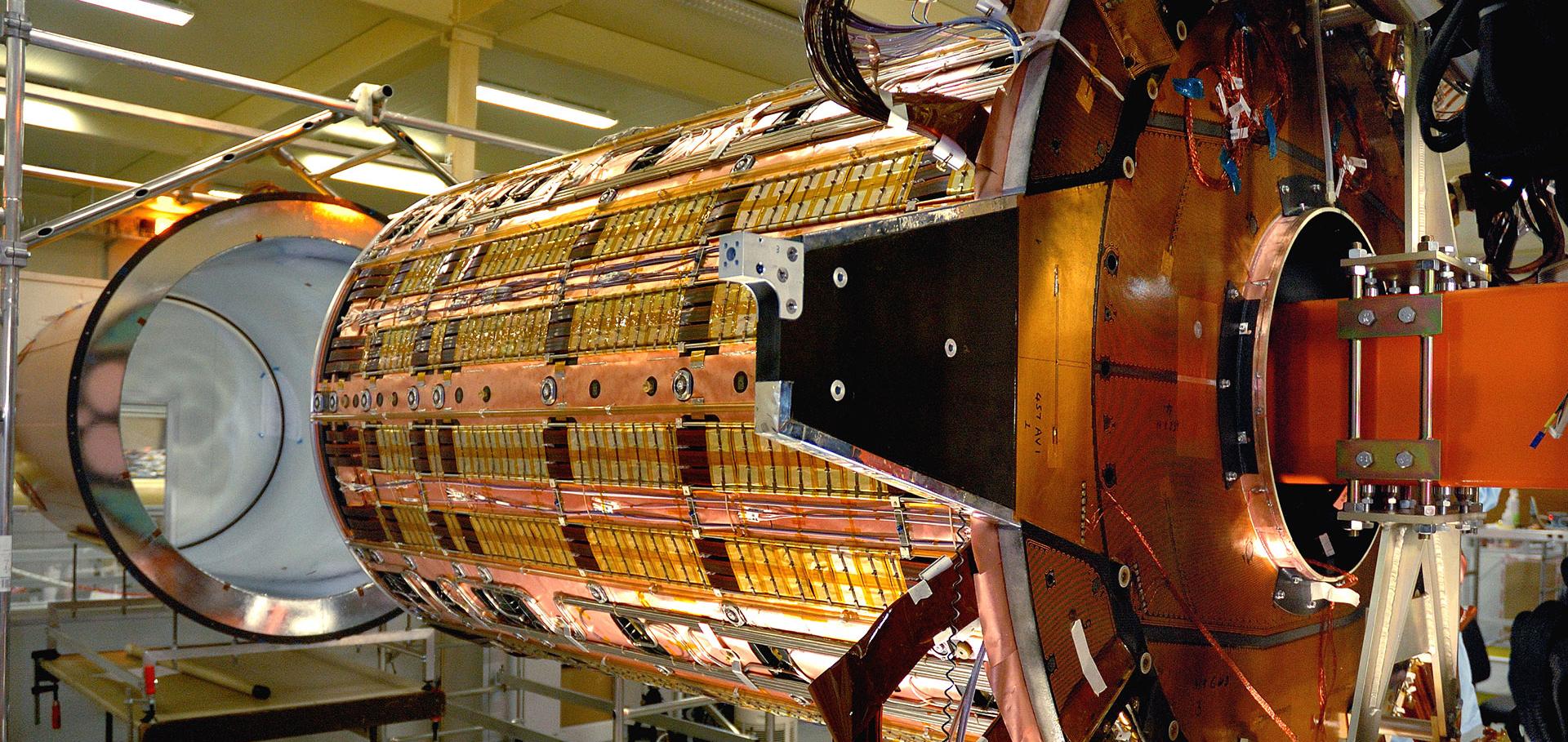
Insertion of STC into TRT at the Department of Physics, Oxford
Credit: CERN

Professor Brian Foster OBE, FRS

Donald H. Perkins Professor of Experimental Physics

Research theme

  • Accelerator physics
  • Fundamental particles and interactions

Sub department

  • Particle Physics

Research groups

  • Future Colliders
  • Plasma-Wakefield Accelerator Group
Brian.Foster@physics.ox.ac.uk
Telephone: 01865 (2)73323
Denys Wilkinson Building, room 611
Oxford May Music - An annual festival of science and music
  • About
  • Publications

Measurement of the neutral current cross section and F2 structure function for deep inelastic e+p scattering at HERA

European Physical Journal C 21:3 (2001) 443-471

Authors:

S Chekanov, M Derrick, D Krakauer, S Magill, B Musgrave, A Pellegrino, J Repond, R Stanek, R Yoshida, MCK Mattingly, P Antonioli, G Bari, M Basile, L Bellagamba, D Boscherini, A Bruni, G Bruni, G Cara Romeo, L Cifarelli, F Cindolo, A Contin, M Corradi, S De Pasquale, P Giusti, G Iacobucci, G Levi, A Margotti, T Massam, R Nania, F Palmonari, A Pesci, G Sartorelli, A Zichichi, G Aghuzumtsyan, I Brock, R Deffner, S Goers, H Hartmann, E Hilger, P Irrgang, HP Jakob, A Kappes, UF Katz, R Kerger, O Kind, E Paul, J Rautenberg, H Schnurbusch, A Stifutkin, J Tandler, KC Voss, A Weber, H Wieber, DS Bailey, NH Brook, JE Cole, B Foster, GP Heath, HF Heath, S Robins, E Rodrigues, J Scott, RJ Tapper, M Wing, M Capua, A Mastroberardino, M Schioppa, G Susinno, HY Jeoung, JY Kim, JH Lee, IT Lim, KJ Ma, MY Pac, A Caldwell, M Helbich, W Liu, X Liu, B Mellado, S Paganis, S Sampson, WB Schmidke, F Sciulli, J Chwastowski, A Eskreys, J Figiel, K Klimek, K Olkiewicz, MB Przybycień, P Stopa, L Zawiejski, B Bednarek, K Jeleń, D Kisielewska, AM Kowal, M Kowal, T Kowalski, B Mindur, E Rulikowska-Zarebska, L Suszycki

Abstract:

The cross section and the proton structure function F2 for neutral current deep inelastic e+p scattering have been measured with the ZEUS detector at HERA using an integrated luminosity of 30 pb-1. The data were collected in 1996 and 1997 at a centre-of-mass energy of 300 GeV. They cover the kinematic range 2.7 < Q2 < 30000 GeV2 and 6-10-5 < cursive Greek chi < 0.65. The variation of F2 with cursive Greek chi and Q2 is well described by next-to-leading-order perturbative QCD as implemented in the DGLAP evolution equations.
More details from the publisher
More details

Study of the effective transverse momentum of partons in the proton using prompt photons in photoproduction at HERA

Physics Letters, Section B: Nuclear, Elementary Particle and High-Energy Physics 511:1 (2001) 19-32

Authors:

S Chekanov, M Derrick, D Krakauer, S Magill, B Musgrave, A Pellegrino, J Repond, R Stanek, R Yoshida, MCK Mattingly, P Antonioli, G Bari, M Basile, L Bellagamba, D Boscherini, A Bruni, G Bruni, G Cara Romeo, L Cifarelli, F Cindolo, A Contin, M Corradi, S de Pasquale, P Giusti, G Iacobucci, G Levi, A Margotti, T Massam, R Nania, F Palmonari, A Pesci, G Sartorelli, A Zichichi, G Aghuzumtsyan, I Brock, S Goers, H Hartmann, E Hilger, P Irrgang, HP Jakob, A Kappes, UF Katz, R Kerger, O Kind, E Paul, J Rautenberg, H Schnurbusch, A Stifutkin, J Tandler, KC Voss, A Weber, H Wieber, DS Bailey, NH Brook, JE Cole, B Foster, GP Heath, HF Heath, S Robins, E Rodrigues, J Scott, RJ Tapper, M Capua, A Mastroberardino, M Schioppa, G Susinno, HY Jeoung, JY Kim, JH Lee, IT Lim, KJ Ma, MY Pac, A Caldwell, M Helbich, W Liu, X Liu, B Mellado, S Paganis, S Sampson, WB Schmidke, F Sciulli, J Chwastowski, A Eskreys, J Figiel, K Klimek, K Olkiewicz, MB Przybycień, P Stopa, L Zawiejski, B Bednarek, K Jeleń, D Kisielewska, AM Kowal, T Kowalski, E Rulikowska-Zarebska, L Suszycki, D Szuba, A Kotański, LAT Bauerdick, U Behrens

Abstract:

The photoproduction of prompt photons, together with an accompanying jet, has been measured with the ZEUS detector at HERA using an integrated luminosity of 38.6 pb-1. A study of the effective transverse momentum, (kT), of partons in the proton, as modelled within the framework of the PYTHIA Monte Carlo, gives a value of (kT) = 1.69 ± 0.18 -0.20+0.18 GeV for the γp centre-of-mass energy range 134 < W < 251 GeV. This result is in agreement with the previously observed trend in hadron-hadron scattering for (kT) to rise with interaction energy. © 2001 Elsevier Science B.V.
More details from the publisher
More details

Multiplicity moments in deep inelastic scattering at HERA

Physics Letters Section B Nuclear Elementary Particle and High Energy Physics 510:1-4 (2001) 36-54

Authors:

S Chekanov, M Derrick, D Krakauer, S Magill, B Musgrave, A Pellegrino, J Repond, R Stanek, R Yoshida, MCK Mattingly, P Antonioli, G Bari, M Basile, L Bellagamba, D Boscherini, A Bruni, G Bruni, G Cara Romeo, L Cifarelli, F Cindolo, A Contin, M Corradi, S de Pasquale, P Giusti, G Iacobucci, G Levi, A Margotti, T Massam, R Nania, F Palmonari, A Pesci, G Sartorelli, A Zichichi, G Aghuzumtsyan, I Brock, S Goers, H Hartmann, E Hilger, P Irrgang, HP Jakob, A Kappes, UF Katz, R Kerger, O Kind, E Paul, J Rautenberg, H Schnurbusch, A Stifutkin, J Tandler, KC Voss, A Weber, H Wieber, DS Bailey, NH Brook, JE Cole, B Foster, GP Heath, HF Heath, S Robins, E Rodrigues, J Scott, RJ Tapper, M Wing, M Capua, A Mastroberardino, M Schioppa, G Susinno, HY Jeoung, JY Kim, JH Lee, IT Lim, KJ Ma, MY Pac, A Caldwell, M Helbich, W Liu, X Liu, B Mellado, S Paganis, S Sampson, WB Schmidke, F Sciulli, J Chwastowski, A Eskreys, J Figiel, K Klimek, K Olkiewicz, MB Przybycien, P Stopa, L Zawiejski, B Bednarek, K Jeleń, D Kisielewska, AM Kowal, M Kowal, T Kowalski, B Mindur, L Suszycki, D Szuba, E Rulikowska-Zarebska

Abstract:

Multiplicity moments of charged particles in deep inelastic e+p scattering have been measured with the ZEUS detector at HERA using an integrated luminosity of 38.4 pb-1. The moments for Q2 > 1000 GeV2 were studied in the current region of the Breit frame. The evolution of the moments was investigated as a function of restricted regions in polar angle and, for the first time, both in the transverse momentum and in absolute momentum of final-state particles. Analytic perturbative QCD predictions in conjunction with the hypothesis of Local Parton-Hadron Duality (LPHD) reproduce the trends of the moments in polar-angle regions, although some discrepancies are observed. For the moments restricted either in transverse or absolute momentum, the analytic results combined with the LPHD hypothesis show considerable deviations from the measurements. The study indicates a large influence of the hadronisation stage on the multiplicity distributions in the restricted phase-space regions studied here, which is inconsistent with the expectations of the LPHD hypothesis. © 2001 Published by Elsevier Science B.V.
More details from the publisher
More details

Design and performance of the Level 1 Calorimeter Trigger for the BABAR detector

IEEE Transactions on Nuclear Science 48:3 I (2001) 541-546

Authors:

PD Dauncey, JC Andress, TJ Adye, NI Chevalier, BJ Claxton, N Dyce, B Foster, S Galagedera, A Kurup, A Mass, JD McFall, P McGrath, SJ Nash, DR Price, U Schäfer, I Scott, DCH Wallom

Abstract:

Since May 1999 the BABAR detector has been taking data at the PEP-II asymmetric electron-positron collider at the Stanford Linear Accelerator Center, CA. This experiment requires a very large data sample and the PEP-II accelerator uses intense beams to deliver the high collision rates needed. This poses a severe challenge to the BABAR trigger system, which must reject the large rate of background signals resulting from the high beam currents whilst accepting the collisions of interest with very high efficiency. One of the systems that performs this task is the Level 1 Calorimeter Trigger, which identifies energy deposits left by particles in the BABAR calorimeter. It is a digital, custom, fixed latency system which makes heavy use of high-speed FPGA devices to allow flexibility in the choice of data filtering algorithms. Results from several intermediate processing stages are read out, allowing the selection algorithm to be fully analyzed and optimized offline. In addition, the trigger is monitored in real time by sampling these data and cross-checking each stage of the trigger calculation against a software model. The design, implementation, construction and performance of the Level 1 Calorimeter Trigger during the first year of BABAR operation are presented.
More details from the publisher

Design and performance of the level 1 calorimeter trigger for the BABAR detector

IEEE T NUCL SCI 48:3 (2001) 541-546

Authors:

PD Dauncey, JC Andress, TJ Adye, NI Chevalier, BJ Claxton, N Dyce, B Foster, S Galagedera, A Kurup, A Mass, JD McFall, P McGrath, SJ Nash, DR Price, U Schafer, I Scott, DCH Wallom

Abstract:

Since May 1999 the BABAR detector has been taking data at the PEP-II asymmetric electron-positron collider at the Stanford Linear Accelerator Center, CA. This experiment requires a very large data sample and the PEP-Il accelerator uses intense beams to deliver the high collision rates needed. This poses a severe challenge to the BABAR trigger system, which must reject the large rate of background signals resulting from the high beam currents whilst accepting the collisions of interest with very high efficiency. One of the systems that performs this task is the Level 1 Calorimeter Trigger, which identifies energy deposits left by particles in the BABAR calorimeter. It is a digital, custom, fixed latency system which makes heavy use of high-speed FPGA devices to allow flexibility in the choice of data filtering algorithms. Results from several intermediate processing stages are read out, allowing the selection algorithm to be fully analyzed and optimized offline. In addition, the trigger is monitored in real time by sampling these data and cross-checking each stage of the trigger calculation against a software model. The design, implementation, construction and performance of the Level 1 Calorimeter Trigger during the first year of BABAR operation are presented.
More details from the publisher

Pagination

  • First page First
  • Previous page Prev
  • …
  • Page 65
  • Page 66
  • Page 67
  • Page 68
  • Current page 69
  • Page 70
  • Page 71
  • Page 72
  • Page 73
  • …
  • Next page Next
  • Last page Last

Footer Menu

  • Contact us
  • Giving to the Dept of Physics
  • Work with us
  • Media

User account menu

  • Log in

Follow us

FIND US

Clarendon Laboratory,

Parks Road,

Oxford,

OX1 3PU

CONTACT US

Tel: +44(0)1865272200

University of Oxfrod logo Department Of Physics text logo
IOP Juno Champion logo Athena Swan Silver Award logo

© University of Oxford - Department of Physics

Cookies | Privacy policy | Accessibility statement

Built by: Versantus

  • Home
  • Research
  • Study
  • Engage
  • Our people
  • News & Comment
  • Events
  • Our facilities & services
  • About us
  • Giving to Physics
  • Current students
  • Staff intranet