

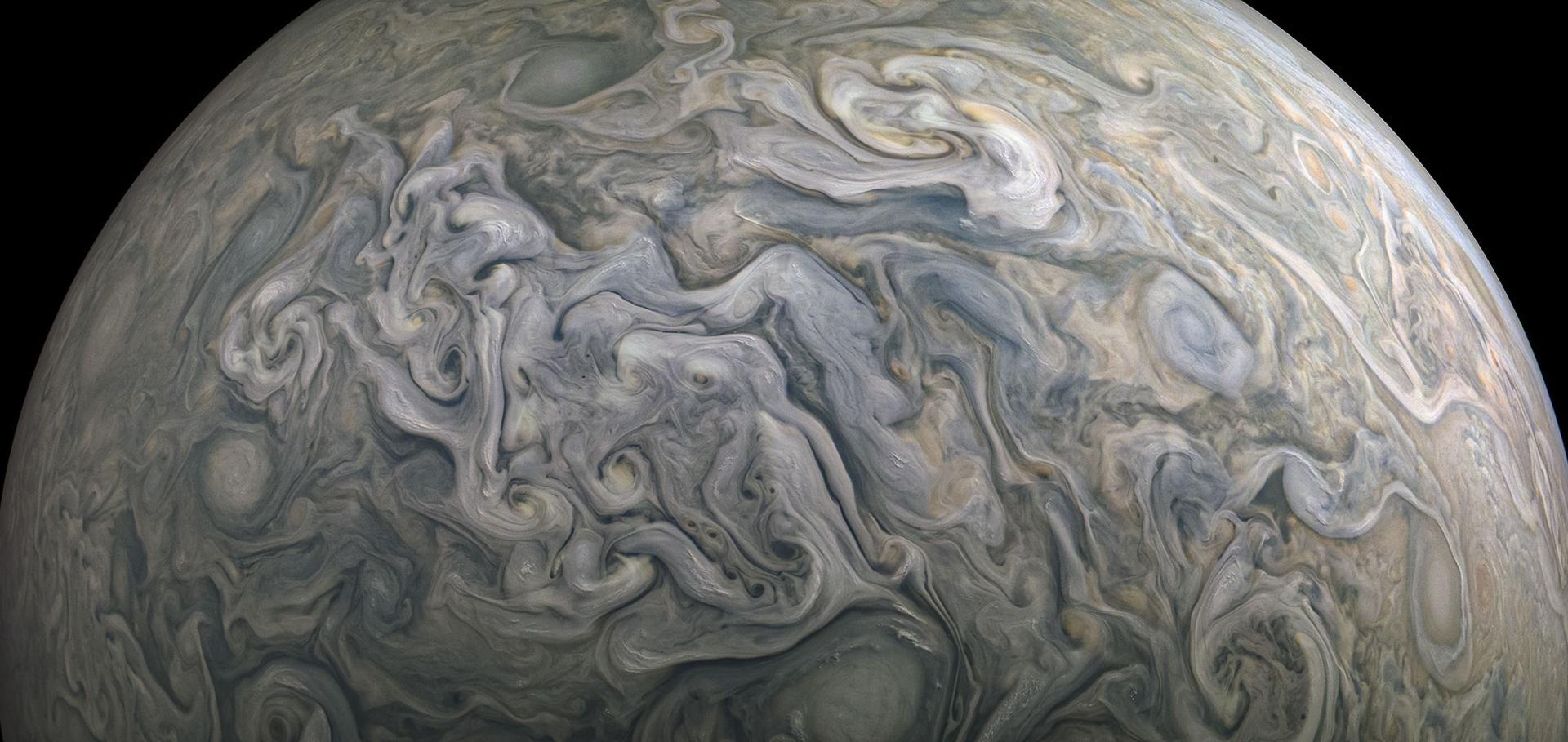

Meridional variations on C2H2 in Jupiter's stratosphere from Juno UVS observations
Journal of Geophysical Research: Planets American Geophysical Union 126:8 (2021) e2021JE006928
Abstract:
The Ultraviolet Spectrograph (UVS) instrument on the Juno mission records far-ultraviolet reflected sunlight from Jupiter. These spectra are sensitive to the abundances of chemical species in the upper atmosphere and to the distribution of the stratospheric haze layer. We combine observations from the first 30 perijoves of the mission in order to study the meridional distribution of acetylene (C2H2) in Jupiter's stratosphere. We find that the abundance of C2H2 decreases toward the poles by a factor of 2–4, in agreement with previous analyses of mid-infrared spectra. This result is expected from insolation rates: near the equator, the UV solar flux is higher, allowing more C2H2 to be generated from the UV photolysis of CH4. The decrease in abundance toward the poles suggests that horizontal mixing rates are not rapid enough to homogenize the latitudinal distribution.No evidence of phosphine in the atmosphere of Venus from independent analyses
Nature Astronomy Springer Nature 5:7 (2021) 631-635
Isotopic fractionation of water and its photolytic products in the atmosphere of Mars
Nature Astronomy Springer Nature 5:9 (2021) 943-950
Abstract:
The current Martian atmosphere is about five times more enriched in deuterium than Earth’s, providing direct testimony that Mars hosted vastly more water in its early youth than nowadays. Estimates of the total amount of water lost to space from the current mean D/H value depend on a rigorous appraisal of the relative escape between deuterated and non-deuterated water. Isotopic fractionation of D/H between the lower and the upper atmospheres of Mars has been assumed to be controlled by water condensation and photolysis, although their respective roles in influencing the proportions of atomic D and H populations have remained speculative. Here we report HDO and H2O profiles observed by the Atmospheric Chemistry Suite (ExoMars Trace Gas Orbiter) in orbit around Mars that, once combined with expected photolysis rates, reveal the prevalence of the perihelion season for the formation of atomic H and D at altitudes relevant for escape. In addition, while condensation-induced fractionation is the main driver of variations of D/H in water vapour, the differential photolysis of HDO and H2O is a more important factor in determining the isotopic composition of the dissociation products.Photolysis controls the isotopic composition of water products escaping Mars’ atmosphere
Nature Astronomy Springer Nature 5 (2021) 943-950
Abstract:
The current Martian atmosphere is about five times more enriched in deuterium than Earth’s, providing direct testimony that Mars hosted vastly more water in its early youth than nowadays. Estimates of the total amount of water lost to space from the current mean D/H value depend on a rigorous appraisal of the relative escape between deuterated and non-deuterated water. Isotopic fractionation of D/H between the lower and the upper atmospheres of Mars has been assumed to be controlled by water condensation and photolysis, although their respective roles in influencing the proportions of atomic D and H populations have remained speculative. Here we report HDO and H2O profiles observed by the Atmospheric Chemistry Suite (ExoMars Trace Gas Orbiter) in orbit around Mars that, once combined with expected photolysis rates, reveal the prevalence of the perihelion season for the formation of atomic H and D at altitudes relevant for escape. In addition, while condensation-induced fractionation is the main driver of variations of D/H in water vapour, the differential photolysis of HDO and H2O is a more important factor in determining the isotopic composition of the dissociation products.Longitudinal variations in the stratosphere of Uranus from the Spitzer infrared spectrometer
Icarus Elsevier 365 (2021) 114506