Home
Department Of Physics text logo
  • Research
    • Our research
    • Our research groups
    • Our research in action
    • Research funding support
    • Summer internships for undergraduates
  • Study
    • Undergraduates
    • Postgraduates
  • Engage
    • For young people
    • For teachers
    • For the public
    • For alumni
    • For business
  • Support
Menu
Atomic and Laser Physics
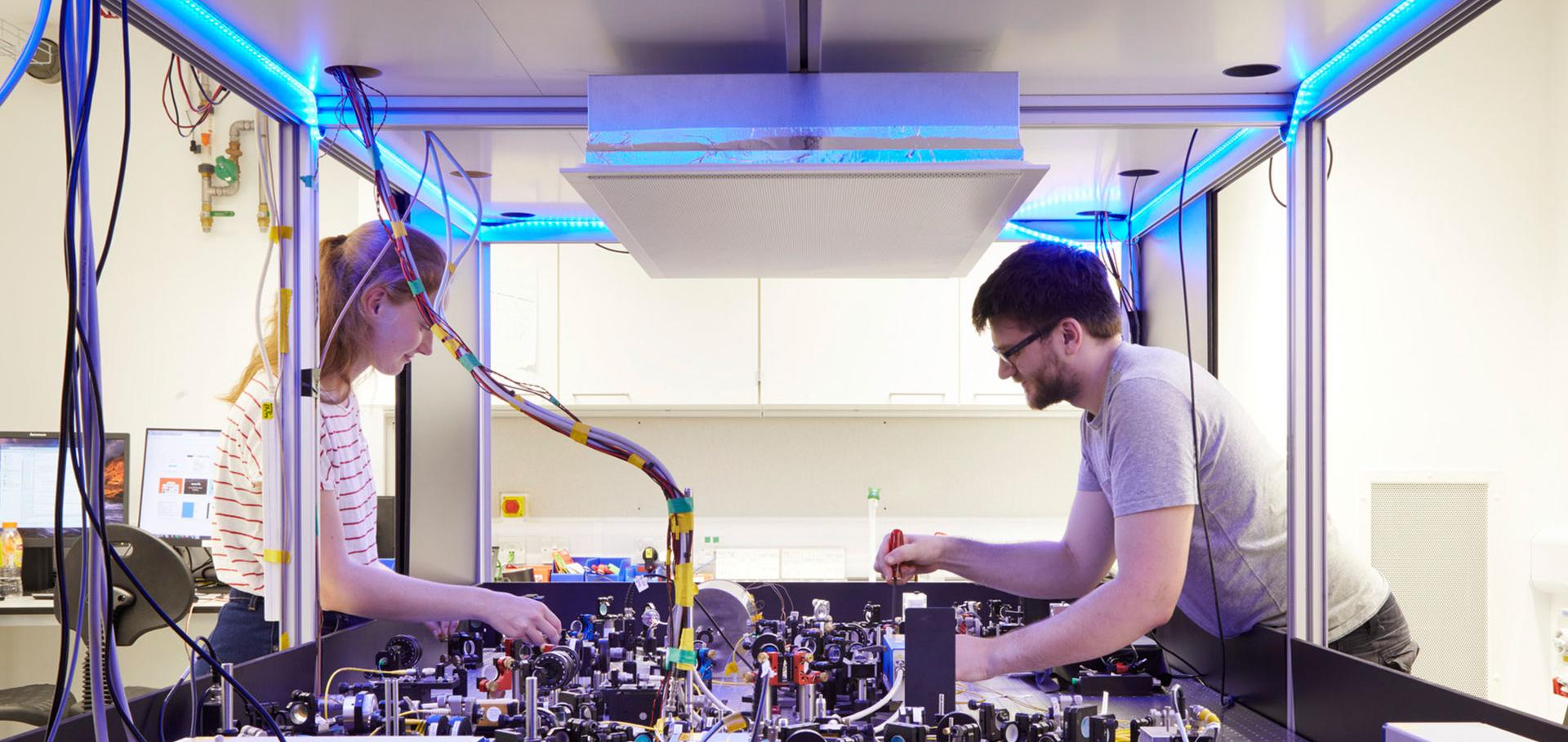
Credit: Jack Hobhouse

Ronan Lahaye

Post Doctoral Research Assistant

Research theme

  • Accelerator physics
  • Lasers and high energy density science
  • Plasma physics

Sub department

  • Atomic and Laser Physics

Research groups

  • Laser-plasma accelerator group
ronan.lahaye@physics.ox.ac.uk
Clarendon Laboratory
  • About
  • Publications

Highly-efficient electron ponderomotive acceleration in underdense plasmas

ArXiv 2408.0056 (2024)

Authors:

Lorenzo Martelli, Olena Kononenko, Igor Andriyash, Jonathan Wheeler, Julien Gautier, Jean-Philippe Goddet, Amar Tafzi, Ronan Lahaye, Camilla Giaccaglia, Alessandro Flacco, Vidmantas Tomkus, Migle Mackevičiūtė, Juozas Dudutis, Valdemar Stankevic, Paulius Gečys, Gediminas Račiukaitis, Henri Kraft, Xuan Quyen Dinh, Cédric Thaury
Details from ArXiV

Use of spatiotemporal couplings and an axiparabola to control the velocity of peak intensity.

Optics letters 49:4 (2024) 814-817

Authors:

Aaron Liberman, Ronan Lahaye, Slava Smartsev, Sheroy Tata, Salome Benracassa, Anton Golovanov, Eitan Levine, Cedric Thaury, Victor Malka

Abstract:

This paper presents the first experimental realization of a scheme that allows for the tuning of the velocity of peak intensity of a focal spot with relativistic intensity. By combining a tunable pulse-front curvature with the axial intensity deposition characteristics of an axiparabola, an aspheric optical element, this system provides control over the dynamics of laser-wakefield accelerators. We demonstrate the ability to modify the velocity of peak intensity of ultrashort laser pulses to be superluminal or subluminal. The experimental results are supported by theoretical calculations and simulations, strengthening the case for the axiparabola as a pertinent strategy to achieve more efficient acceleration.
More details from the publisher
More details
More details

Characterization of spatiotemporal couplings with far-field beamlet cross-correlation

Journal of Optics IOP Publishing 24:11 (2022) 115503-115503

Authors:

Slava Smartsev, Sheroy Tata, Aaron Liberman, Michael Adelberg, Arujash Mohanty, Eitan Y Levine, Omri Seemann, Yang Wan, Eyal Kroupp, Ronan Lahaye, Cédric Thaury, Victor Malka

Abstract:

International audienceAbstract We present a novel, straightforward method for the characterization of spatiotemporal couplings in ultra-short laser pulses. The method employs far-field interferometry and inverse Fourier transform spectroscopy, built on the theoretical basis derived in this paper. It stands out in its simplicity: it requires few non-standard optical elements and simple analysis algorithms. This method was used to measure the space-time intensity of our 100 TW class laser and to test the efficacy of a refractive doublet as a suppressor of pulse front curvature (PFC). The measured low-order spatiotemporal couplings agreed with ray-tracing simulations. In addition, we demonstrate a one-shot measurement technique, derived from our central method, which allows for quick and precise alignment of the compressor by pulse front tilt (PFT) minimization and for optimal refractive doublet positioning for the suppression of PFC
More details from the publisher
Details from ORA
More details

Controlled acceleration of GeV electron beams in an all-optical plasma waveguide

Light: Science & Applications Springer Nature [academic journals on nature.com] 11:1 (2022) 180-180

Authors:

Kosta Oubrerie, Adrien Leblanc, Olena Kononenko, Ronan Lahaye, Igor A Andriyash, Julien Gautier, Jean-Philippe Goddet, Lorenzo Martelli, Amar Tafzi, Kim Ta Phuoc, Slava Smartsev, Cédric Thaury

Abstract:

Laser-plasma accelerators (LPAs) produce electric fields of the order of 100 GV m-1, more than 1000 times larger than those produced by radio-frequency accelerators. These uniquely strong fields make LPAs a promising path to generate electron beams beyond the TeV, an important goal in high-energy physics. Yet, large electric fields are of little benefit if they are not maintained over a long distance. It is therefore of the utmost importance to guide the ultra-intense laser pulse that drives the accelerator. Reaching very high energies is equally useless if the properties of the electron beam change completely from shot to shot, due to the intrinsic lack of stability of the injection process. State-of-the-art laser-plasma accelerators can already address guiding and control challenges separately by tweaking the plasma structures. However, the production of beams that are simultaneously high quality and high energy has yet to be demonstrated. This paper presents a novel experiment, coupling laser-plasma waveguides and controlled injection techniques, facilitating the reliable and efficient acceleration of high-quality electron beams up to 1.1 GeV, from a 50 TW-class laser.
More details from the publisher
Details from ORA
More details
More details

Axiparabola: a new tool for high-intensity optics

Journal of Optics IOP Publishing 24:4 (2022) 045503-045503

Authors:

Kosta Oubrerie, Igor A Andriyash, Ronan Lahaye, Slava Smartsev, Victor Malka, Cédric Thaury

Abstract:

Abstract An axiparabola is a reflective aspherical optics that focuses a light beam into an extended focal line. The light intensity and group velocity profiles along the focus are adjustable through the proper design. The on-axis light velocity can be controlled, for instance, by adding spatio-temporal couplings via chromatic optics on the incoming beam. Therefore the energy deposition along the axis can be either subluminal or superluminal as required in various applications. This article first explores how the axiparabola design defines its properties in the geometric optics approximation. Then the obtained description is considered in numerical simulations for two cases of interest for laser-plasma acceleration. We show that the axiparabola can be used either to generate a plasma waveguide to overcome diffraction or for driving a dephasingless wakefield accelerator.
More details from the publisher
More details

Pagination

  • First page First
  • Previous page Prev
  • Page 1
  • Current page 2
  • Page 3
  • Next page Next
  • Last page Last

Footer Menu

  • Contact us
  • Giving to the Dept of Physics
  • Work with us
  • Media

User account menu

  • Log in

Follow us

FIND US

Clarendon Laboratory,

Parks Road,

Oxford,

OX1 3PU

CONTACT US

Tel: +44(0)1865272200

University of Oxfrod logo Department Of Physics text logo
IOP Juno Champion logo Athena Swan Silver Award logo

© University of Oxford - Department of Physics

Cookies | Privacy policy | Accessibility statement

Built by: Versantus

  • Home
  • Research
  • Study
  • Engage
  • Our people
  • News & Comment
  • Events
  • Our facilities & services
  • About us
  • Giving to Physics
  • Current students
  • Staff intranet