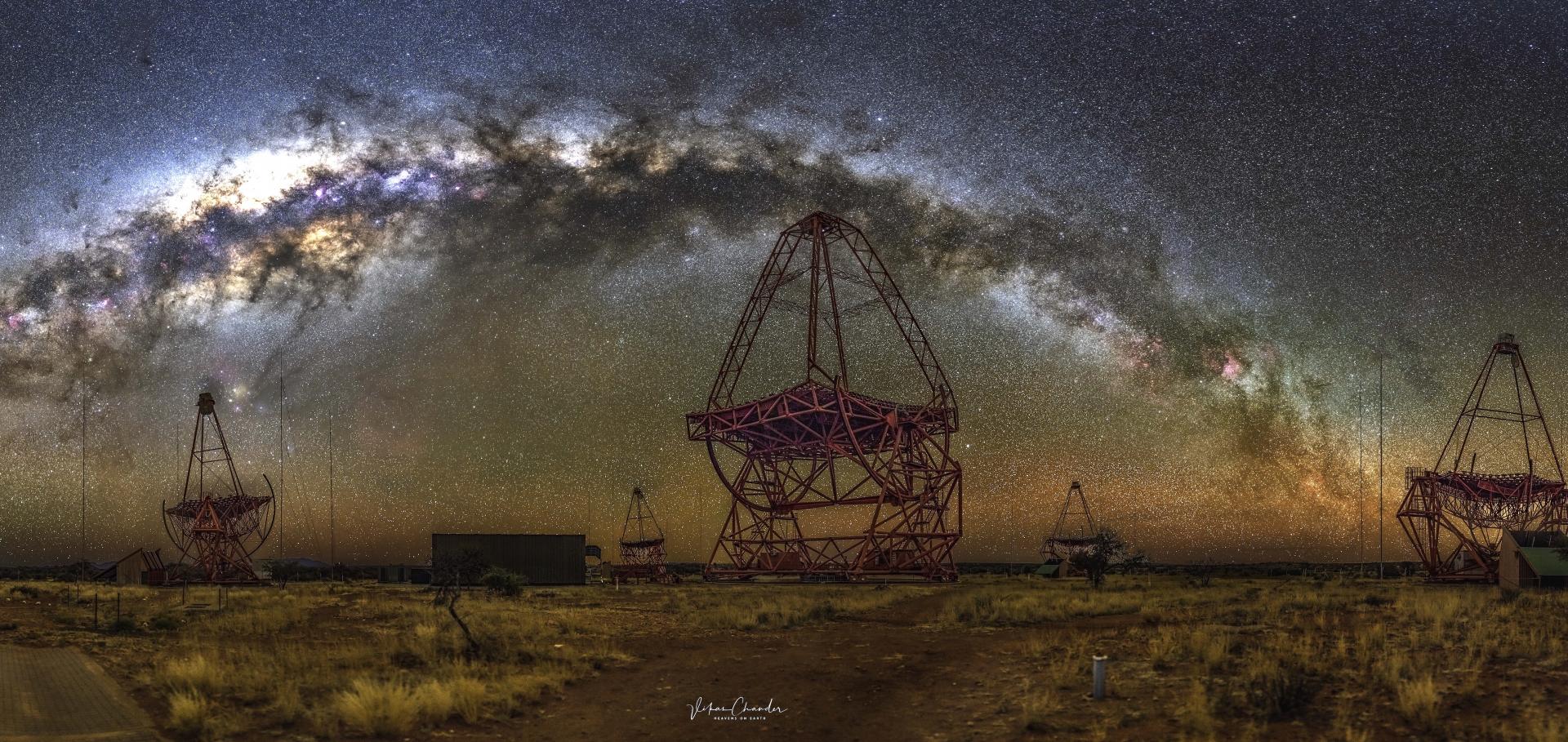
Time-resolved hadronic particle acceleration in the recurrent Nova RS Ophiuchi
(2022)
Authors:
HESS Collaboration, F Aharonian, F Ait Benkhali, EO Angüner, H Ashkar, M Backes, V Baghmanyan, V Barbosa Martins, R Batzofin, Y Becherini, D Berge, K Bernlöhr, B Bi, M Böttcher, C Boisson, J Bolmont, M de Bony de Lavergne, M Breuhaus, R Brose, F Brun, S Caroff, S Casanova, M Cerruti, T Chand, A Chen, G Cotter, J Damascene Mbarubucyeye, A Djannati-Ataï, A Dmytriiev, V Doroshenko, C Duffy, K Egberts, J-P Ernenwein, S Fegan, K Feijen, A Fiasson, G Fichet de Clairfontaine, G Fontaine, M Füßling, S Funk, S Gabici, YA Gallant, S Ghafourizadeh, G Giavitto, L Giunti, D Glawion, JF Glicenstein, M-H Grondin, G Hermann, JA Hinton, M Hörbe, W Hofmann, C Hoischen, TL Holch, M Holler, D Horns, Zhiqiu Huang, M Jamrozy, F Jankowsky, I Jung-Richardt, E Kasai, K Katarzyński, U Katz, D Khangulyan, B Khélifi, S Klepser, W Kluźniak, Nu Komin, R Konno, K Kosack, D Kostunin, S Le Stum, A Lemière, M Lemoine-Goumard, J-P Lenain, F Leuschner, T Lohse, A Luashvili, I Lypova, J Mackey, D Malyshev, D Malyshev, V Marandon, P Marchegiani, A Marcowith, G Martí-Devesa, R Marx, G Maurin, M Meyer, A Mitchell, R Moderski, L Mohrmann, A Montanari, E Moulin, J Muller, T Murach, K Nakashima, M de Naurois, A Nayerhoda, J Niemiec, A Priyana Noel, P O'Brien, S Ohm, L Olivera-Nieto, E de Ona Wilhelmi, M Ostrowski, S Panny, M Panter, RD Parsons, G Peron, S Pita, V Poireau, DA Prokhorov, H Prokoph, G Pühlhofer, M Punch, A Quirrenbach, P Reichherzer, A Reimer, O Reimer, M Renaud, B Reville, F Rieger, G Rowell, B Rudak, H Rueda Ricarte, E Ruiz-Velasco, V Sahakian, S Sailer, H Salzmann, DA Sanchez, A Santangelo, M Sasaki, J Schäfer, F Schüssler, HM Schutte, U Schwanke, M Senniappan, JNS Shapopi, R Simoni, A Sinha, H Sol, A Specovius, S Spencer, Ł Stawarz, S Steinmassl, C Steppa, T Takahashi, T Tanaka, AM Taylor, R Terrier, C Thorpe-Morgan, M Tsirou, N Tsuji, R Tuffs, Y Uchiyama, T Unbehaun, C van Eldik, B van Soelen, J Veh, C Venter, J Vink, SJ Wagner, F Werner, R White, A Wierzcholska, Yu Wun Wong, A Yusafzai, M Zacharias, D Zargaryan, AA Zdziarski, A Zech, SJ Zhu, S Zouari, N Żywucka