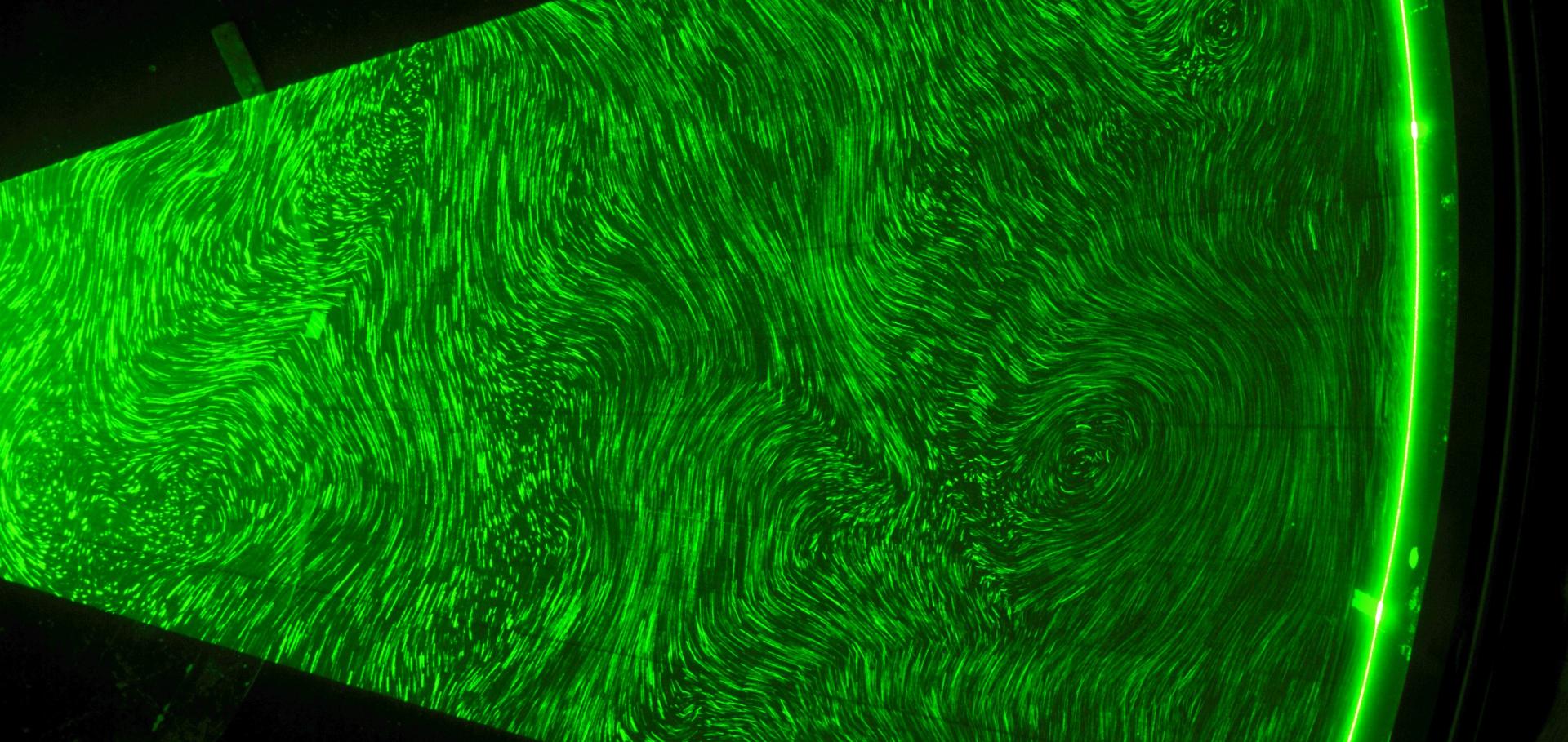
Inverse centrifugal effect induced by collective motion of vortices in rotating thermal convection

Nature Communications Nature Research 12:1 (2021) 5585

Authors:

Shan-Shan Ding, Kai Leong Chong, Jun-Qiang Shi, Guang-Yu Ding, Hao-Yuan Lu, Ke-Qing Xia, Jin-Qiang Zhong

Abstract:

AbstractWhen a fluid system is subject to strong rotation, centrifugal fluid motion is expected, i.e., denser (lighter) fluid moves outward (inward) from (toward) the axis of rotation. Here we demonstrate, both experimentally and numerically, the existence of an unexpected outward motion of warm and lighter vortices in rotating thermal convection. This anomalous vortex motion occurs under rapid rotations when the centrifugal buoyancy is sufficiently strong to induce a symmetry-breaking in the vorticity field, i.e., the vorticity of the cold anticyclones overrides that of the warm cyclones. We show that through hydrodynamic interactions the densely distributed vortices can self-aggregate into coherent clusters and exhibit collective motion in this flow regime. Interestingly, the correlation of the vortex velocity fluctuations within a cluster is scale-free, with the correlation length being proportional ( ≈ 30%) to the cluster length. Such long-range correlation leads to the counterintuitive collective outward motion of warm vortices. Our study brings insights into the vortex dynamics that are widely present in nature.

Comments on Barker and Astoul (2021)

(2021)

Abstract:

The tidal evolution of interacting binaries when the orbital period is short compared to the primary star's convective time scale is a problem of long-standing. Terquem (2021) has argued that, when this temporal ordering scheme is obeyed, the rate of energy transfer from tides to convection (denoted $D_R$) is given by the product of the averaged Reynolds stress associated with the tidal velocity and the mean shear associated with the convective flow. In a recent response, Barker and Astoul (2021, hereafter BA21) claim to show that $D_R$ (in this form) cannot contribute to tidal dissipation. Their analysis is based on a study of Boussinesq and anelastic models. Here, we demonstrate that BA21 misidentify the correct term responsible for energy transfer between tides and convection. As a consequence, their anelastic calculations do not prove that the $D_R$ formulation is invalidated as an energy-loss coupling between tides and convection. BA21 also carry out a calculation in the Boussinesq approximation. Here, their claim that $D_R$ once again does not contribute is based on boundary conditions that do not apply to any star or planet that radiates energy from its surface, which is a key dissipational process in the problem we consider.

Energy exchanges in Saturn’s polar regions from Cassini observations: Part I: Eddy-zonal flow interactions

(2021)

Authors:

Peter L Read, Arrate Antuñano, Greg Colyer, Simon Cabanes, Teresa del Rio-Gaztelurrutia, Agustín Sánchez-Lavega

Characterizing Regimes of Atmospheric Circulation in Terms of Their Global Superrotation

Journal of the Atmospheric Sciences American Meteorological Society 78:4 (2021) 1245-1258

Authors:

Neil T Lewis, Greg J Colyer, Peter L Read

Abstract:

Abstract The global superrotation index S compares the integrated axial angular momentum of the atmosphere to that of a state of solid-body corotation with the underlying planet. The index S is similar to a zonal Rossby number, which suggests it may be a useful indicator of the circulation regime occupied by a planetary atmosphere. We investigate the utility of S for characterizing regimes of atmospheric circulation by running idealized Earthlike general circulation model experiments over a wide range of rotation rates Ω, 8Ω E to Ω E /512, where Ω E is Earth’s rotation rate, in both an axisymmetric and three-dimensional configuration. We compute S for each simulated circulation, and study the dependence of S on Ω. For all rotation rates considered, S is on the same order of magnitude in the 3D and axisymmetric experiments. For high rotation rates, S ≪ 1 and S ∝ Ω −2 , while at low rotation rates S ≈ 1/2 = constant. By considering the limiting behavior of theoretical models for S , we show how the value of S and its local dependence on Ω can be related to the circulation regime occupied by a planetary atmosphere. Indices of S ≪ 1 and S ∝ Ω −2 define a regime dominated by geostrophic thermal wind balance, and S ≈ 1/2 = constant defines a regime where the dynamics are characterized by conservation of angular momentum within a planetary-scale Hadley circulation. Indices of S ≫ 1 and S ∝ Ω −2 define an additional regime dominated by cyclostrophic balance and strong equatorial superrotation that is not realized in our simulations.

The rotational and divergent components of atmospheric circulation on tidally locked planets

Proceedings of the National Academy of Sciences NAS 118:13 (2021) e2022705118-e2022705118

Authors:

Mark Hammond, Neil T Lewis

Abstract:

<jats:p>Tidally locked exoplanets likely host global atmospheric circulations with a superrotating equatorial jet, planetary-scale stationary waves, and thermally driven overturning circulation. In this work, we show that each of these features can be separated from the total circulation by using a Helmholtz decomposition, which splits the circulation into rotational (divergence-free) and divergent (vorticity-free) components. This technique is applied to the simulated circulation of a terrestrial planet and a gaseous hot Jupiter. For both planets, the rotational component comprises the equatorial jet and stationary waves, and the divergent component contains the overturning circulation. Separating out each component allows us to evaluate their spatial structure and relative contribution to the total flow. In contrast with previous work, we show that divergent velocities are not negligible when compared with rotational velocities and that divergent, overturning circulation takes the form of a single, roughly isotropic cell that ascends on the day side and descends on the night side. These conclusions are drawn for both the terrestrial case and the hot Jupiter. To illustrate the utility of the Helmholtz decomposition for studying atmospheric processes, we compute the contribution of each of the circulation components to heat transport from day side to night side. Surprisingly, we find that the divergent circulation dominates day–night heat transport in the terrestrial case and accounts for around half of the heat transport for the hot Jupiter. The relative contributions of the rotational and divergent components to day–night heat transport are likely sensitive to multiple planetary parameters and atmospheric processes and merit further study.</jats:p>