

Equivalent gain-of-function variants in KCNK3 and KCNK9 and their contribution to distinct task K2P channelopathies
BIOPHYSICAL JOURNAL 125:4 (2026) 78a-79a
Inwardly rectifying potassium channels (K<sub>IR</sub>) in GtoPdb v.2025.4
IUPHAR/BPS Guide to Pharmacology CITE Edinburgh University Library 2025:4 (2025)
Abstract:
The 2TM domain family of K channels are also known as the inward-rectifier K channel family. This family includes the strong inward-rectifier K channels (Kir2.x) that are constitutively active, the G protein-activated inward-rectifier K channels (Kir3.x) and the ATP-sensitive K channels (Kir6.x, which combine with sulphonylurea receptors (SUR1-3)). The pore-forming α subunits form tetramers, and heteromeric channels may be formed within subfamilies (e.g. Kir3.2 with Kir3.3).Inwardly rectifying potassium channels (KIR) in GtoPdb v.2025.3
IUPHAR/BPS Guide to Pharmacology CITE University of Edinburgh 2025:3 (2025)
Abstract:
The 2TM domain family of K channels are also known as the inward-rectifier K channel family. This family includes the strong inward-rectifier K channels (Kir2.x) that are constitutively active, the G-protein-activated inward-rectifier K channels (Kir3.x) and the ATP-sensitive K channels (Kir6.x, which combine with sulphonylurea receptors (SUR1-3)). The pore-forming α subunits form tetramers, and heteromeric channels may be formed within subfamilies (e.g. Kir3.2 with Kir3.3).Cryo-EM structure of the human THIK-1 K2P K + channel reveals a lower Y gate regulated by lipids and anesthetics
Nature Structural & Molecular Biology Nature Research 32:7 (2025) 1167-1174
Abstract:
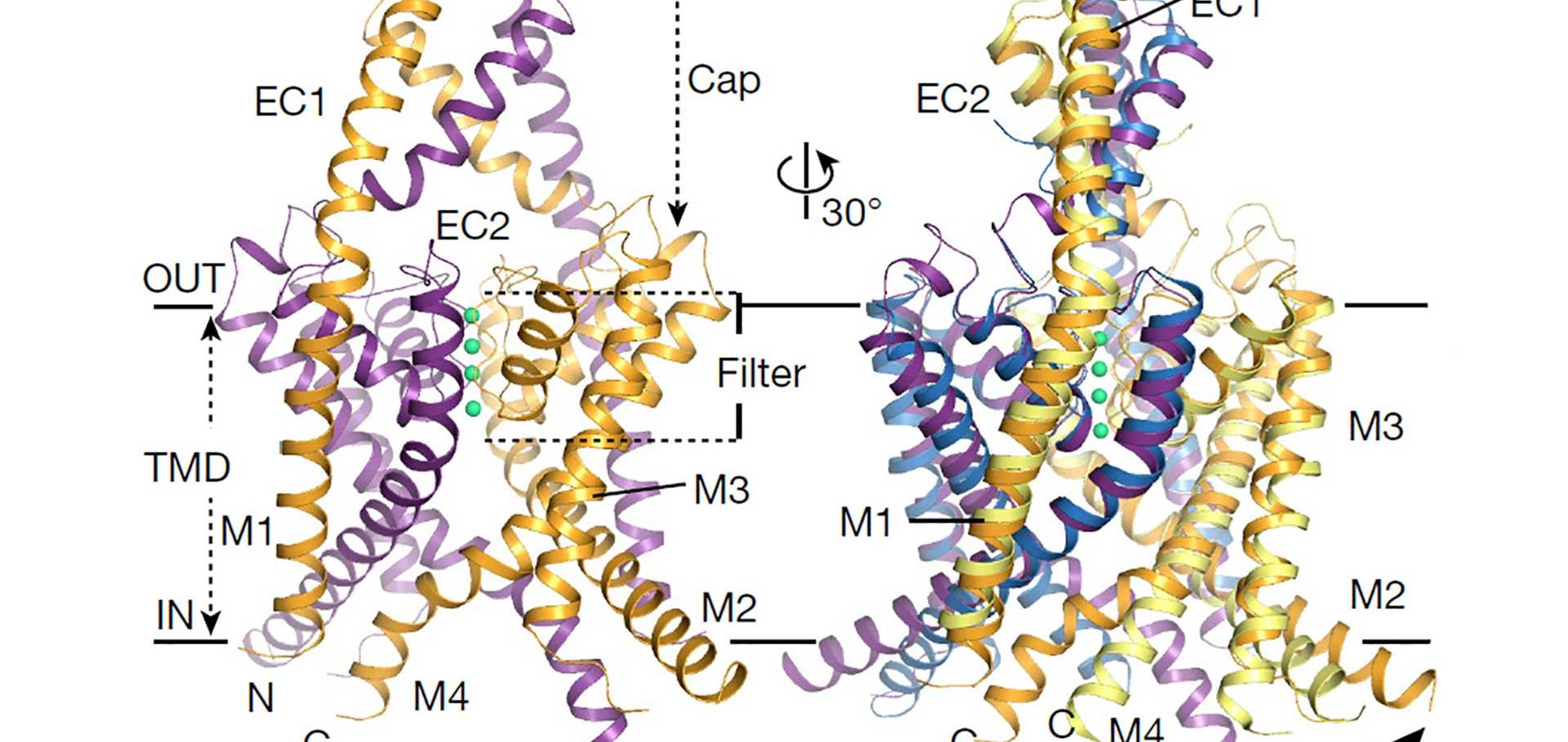
THIK-1 (KCNK13) is a halothane-inhibited and anionic-lipid-activated two-pore domain (K2P) K+ channel implicated in microglial activation and neuroinflammation, and a current target for the treatment of neurodegenerative disorders, for example Alzheimer’s disease and amyothropic lateral sclerosis (ALS). However, compared to other K2P channels, little is known about the structural and functional properties of THIK-1. Here we present a 3.16-Å-resolution cryo-EM structure of human THIK-1 that reveals several distinct features, in particular, a tyrosine in M4 that contributes to a lower ‘Y gate’ that opens upon activation by physiologically relevant G-protein-coupled receptor and lipid signaling pathways. We demonstrate that linoleic acid bound within a modulatory pocket adjacent to the filter influences channel activity, and that halothane inhibition involves a binding site within the inner cavity, both resulting in conformational changes to the Y gate. Finally, the extracellular cap domain contains positively charged residues that line the ion exit pathway and contribute to the distinct biophysical properties of this channel. Overall, our results provide structural insights into THIK-1 function and identify distinct regulatory sites that expand its potential as a drug target for the modulation of microglial function.BPS2025 - Cryo-EM structure of the human THIK-1 K2P K+ channel reveals and lower “Y-gate” regulated by lipids and anesthetics
Biophysical Journal Elsevier 124:3 (2025) 129a