

Three-dimensional Ocean Dynamics and Detectability of Tidally Locked Lava Worlds
Astrophysical Journal 1005:1 (2026)
Abstract:
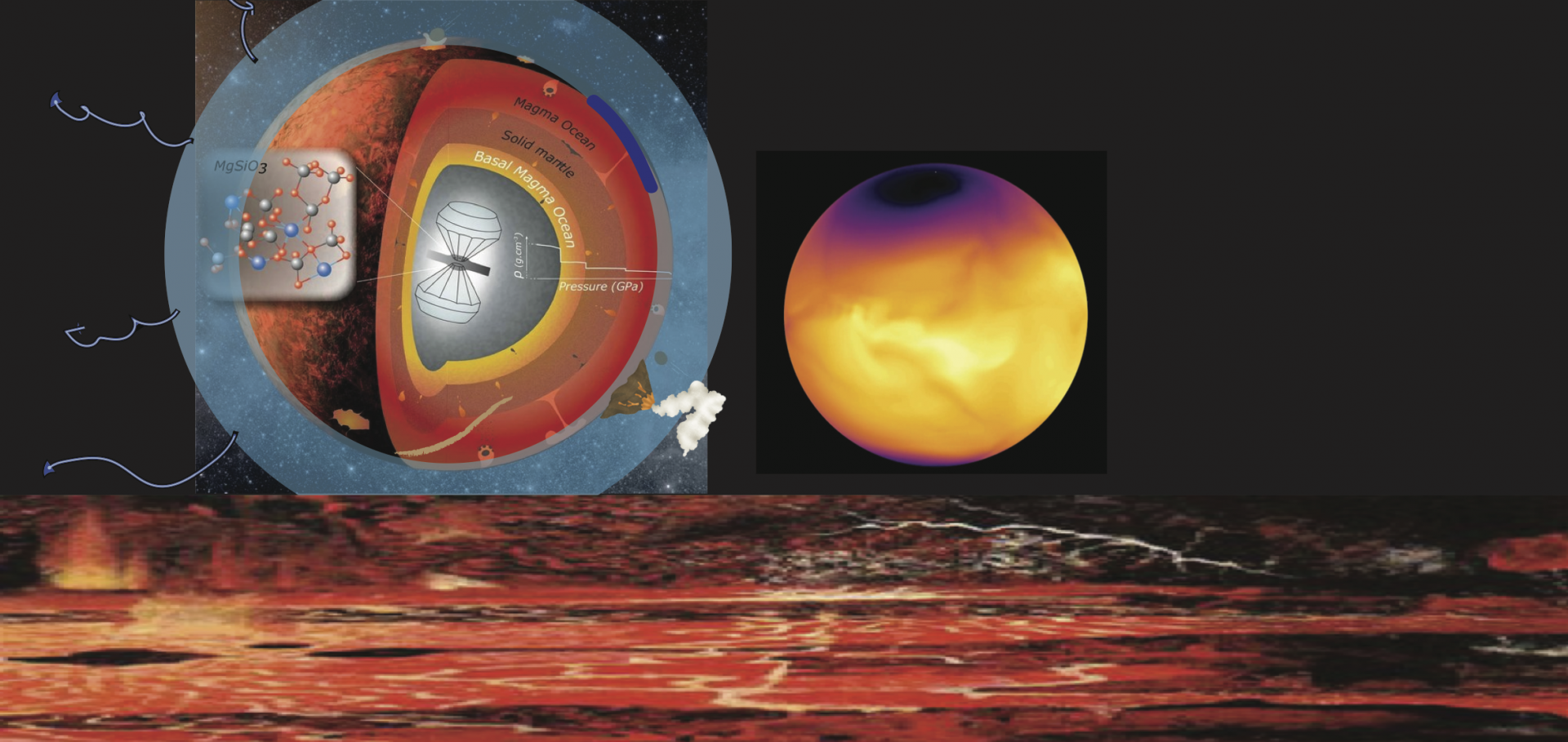
Tidally locked lava planets are hot, rocky worlds on close-in orbits with a permanent molten dayside. With JWST, their surfaces and atmospheres are beginning to be revealed. This work investigates three-dimensional (3D) magma ocean dynamics, derives scaling laws for the resulting ocean heat transport, and predicts its detectability. For the first time, the ocean circulation driven by the intense momentum and mass exchanges with the supersonic atmosphere is considered in addition to that by thermal forcing. The wind forcing turns out to overwhelmingly dominate the other two mechanisms, driving ocean currents reaching ∼100 m s−1 and greatly expanding the latitudinal extent of the Matsuno–Gill response. Despite these extreme flow speeds, scaling analysis and 3D simulations consistently demonstrate that magma ocean circulation alone does not produce an observable hot-spot offset. This inefficiency arises because basin geometry and circulation structure fundamentally constrain zonal heat redistribution, suppressing large-scale longitudinal transport even under vigorous flow.The Days Drag On on WASP-121 b: Interpreting Its NIRISS Spectroscopic Phase Curve with General Circulation Models
Astrophysical Journal 1004:1 (2026)
Abstract:
Ultra-hot Jupiters (UHJs) present extreme atmospheric phenomena not found in the solar system. These planets’ daysides experience strong temperature inversions, molecular species (including HMost rocky sub-Neptunes are molten: mapping the solidification shoreline for gas dwarf exoplanets
Monthly Notices of the Royal Astronomical Society Oxford University Press 549:3 (2026) stag1007
Abstract:
Sub-Neptunes are the most common type of detected exoplanet, yet their observed masses and radii are degenerate with several interior structures. One possibility is that sub-Neptunes have silicate/iron interiors and H-dominated atmospheres ( < 3.8 g mol), i.e., they are ‘gas dwarfs’. If gas dwarfs have molten interiors, interactions between their magma oceans and atmospheres will produce distinct observational signatures. These signatures may break the degeneracy in interior structure, while providing insight into their interior processes, history, and population trends. We expect all such planets are born molten, but under what conditions do they remain molten today? We use the coupled interior-climate evolution model, proteus, to estimate the ‘solidification shoreline’: the instellation flux boundary (as a function of stellar ) that separates molten gas dwarfs from solidified ones. Our results show that 98 per cent of detected sub-Neptunes occupy a region of parameter space consistent with their having permanent magma oceans, if they are gas dwarfs. While mantle and bulk volatile C/H ratio both influence magma ocean cooling, planets with oxidizing mantles and carbon-rich atmospheres are likely to have high mean-molecular weight atmospheres ( > 3.8 g mol) and are thus outside the scope of this study. Therefore, most detected sub-Neptunes, if they are gas dwarfs, have permanent magma oceans. This result motivates further research into the interactions between molten interiors and overlying atmospheres, and campaigns to identify unambiguous signatures of these interactions.JWST Exoplanetary Worlds and Elemental Survey (JEWELS). II. Condensation Temperature Trends and Galactic Chemical Evolution in JWST Planet-hosting Stars
Astrophysical Journal Supplement Series 284:2 (2026)
Abstract:
We present high-precision chemical abundances for 25 FGK-type stars hosting exoplanets observed in JWST Cycle 3 programs and all Guaranteed Time Observations and Director’s Discretionary Time programs from Cycles 1–3, based on high-resolution, high-signal-to-noise ratio optical spectra from ground-based telescopes. Using a strictly differential, line-by-line analysis relative to the Sun, we derive homogeneous stellar parameters and abundances for 19 elements with an atomic number Z ≤ 30. The sample spans a wide range of stellar properties, with [Fe/H] = −0.6 to +0.4 dex and effective temperatures between 4700 and 6600 K, and includes hosts of terrestrial and giant planets as well as multiplanet systems. We refine carbon and sulfur abundances in cool dwarfs using a spectral synthesis, mitigating systematics from line blending. Several chemically interesting systems are identified, including mildly α-enhanced metal-poor stars and multiplanet hosts with elevated [C/O]. Using isochrone ages, we derive empirical Galactic chemical evolution (GCE) relations and examine condensation temperature (TA Hierarchical Modeling Study of Absorbing Aerosol Impacts on Precipitation Characteristics and Extremes
Journal of Advances in Modeling Earth Systems American Geophysical Union (AGU) 18:6 (2026) e2025MS005400