

Direct Imaging Discovery of Giant Exoplanet β Pictoris d: A Decade-long Game of Hide-and-seek
The Astrophysical Journal Letters American Astronomical Society 1006:1 (2026) L10-L10
Abstract:
We report the direct imaging discovery of a third exoplanet in the β Pictoris (β Pic) system. We detect β Pictoris d (β Pic d) in noncoronagraphic observations obtained with the Very Large Telescope (VLT) Enhanced Resolution Imager and Spectrograph (ERIS), as well as multi-epoch archival datasets from the JWST Near Infrared Camera (NIRCam) and VLT/SPHERE. Astrometric measurements over an 11 yr baseline demonstrate that it is consistent with a gravitationally bound source with orbital motion. Joint multi-planet orbit fits of all three planets in the system yield a semimajor axis of 26.0−6.1+2.2 au and inclination 89.0−0.6+0.7 deg for planet d. β Pic d has a larger orbital semimajor axis than the other known planets in the system, but is coplanar with the inner two planets, and its orbit is consistent with sculpting the inner edge of the debris disk. β Pic d has a contrast of ΔL′=12.11±0.15 mag, with colors and luminosity that closely match those of 51 Eri b, another exoplanet in the β Pic moving group. Its VLT/ERIS and JWST/NIRCam colors are distinct from those of free-floating planetary-mass objects of a similar age and temperature. Its red F410M − F444W color indicates strong CO2 absorption in its atmosphere and suggests significant enhancement in metals compared to free-floating objects. From the ATMO hot-start evolutionary models, we estimate an effective temperature of 600−60+45 K and mass of 2.4 ± 0.6 MJup, which also closely matches similar estimates for 51 Eri b. β Pic d is among the lowest-mass exoplanets imaged from the ground. This discovery highlights the deep sensitivity achievable with ground-based imaging in the mid-infrared and the discovery potential of future high-contrast observations with the Extremely Large Telescope.Geophysical and atmospheric implications of fO2-dependent melting on rocky exoplanets
(2026)
Abstract:
Three-dimensional Ocean Dynamics and Detectability of Tidally Locked Lava Worlds
Astrophysical Journal 1005:1 (2026)
Abstract:
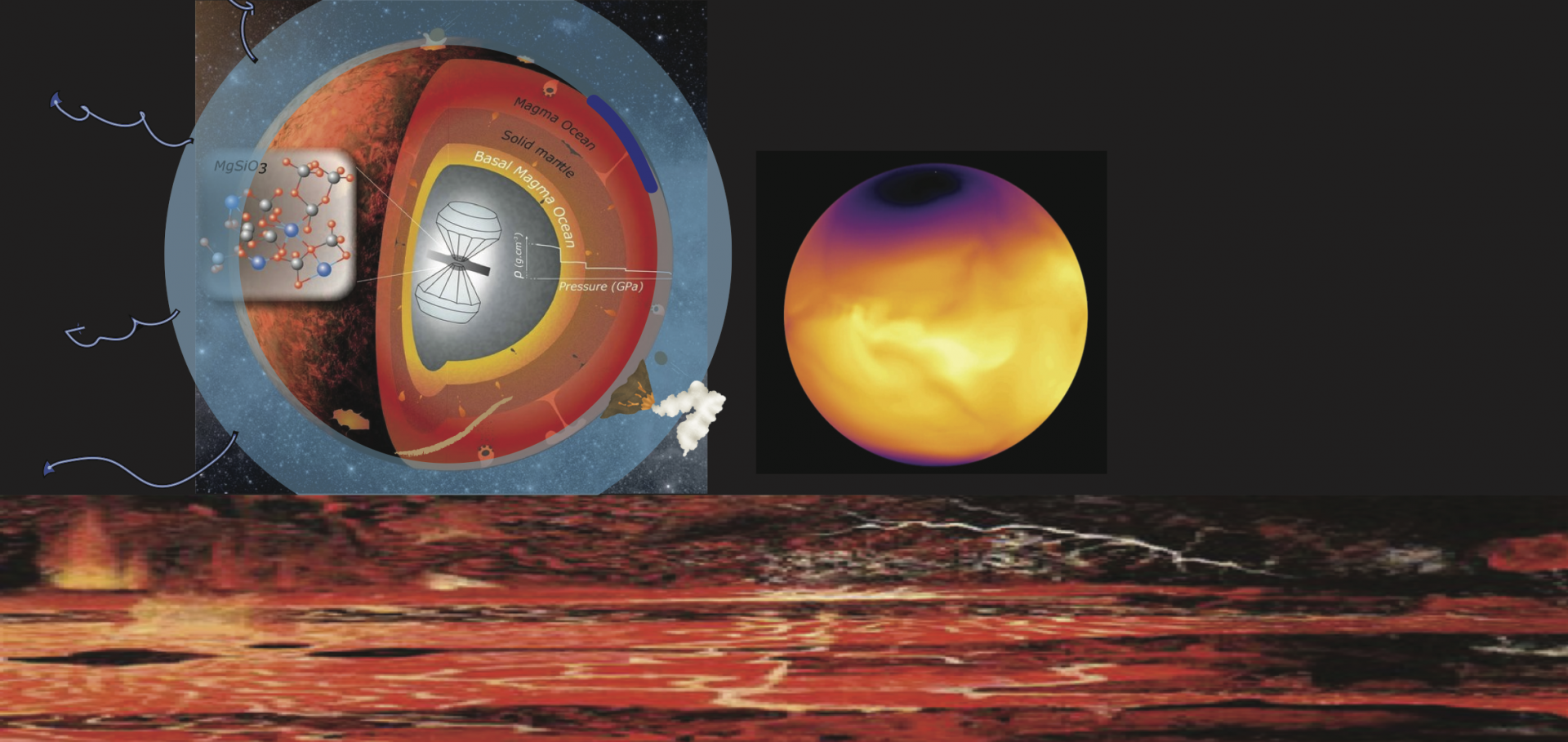
Tidally locked lava planets are hot, rocky worlds on close-in orbits with a permanent molten dayside. With JWST, their surfaces and atmospheres are beginning to be revealed. This work investigates three-dimensional (3D) magma ocean dynamics, derives scaling laws for the resulting ocean heat transport, and predicts its detectability. For the first time, the ocean circulation driven by the intense momentum and mass exchanges with the supersonic atmosphere is considered in addition to that by thermal forcing. The wind forcing turns out to overwhelmingly dominate the other two mechanisms, driving ocean currents reaching ∼100 m s−1 and greatly expanding the latitudinal extent of the Matsuno–Gill response. Despite these extreme flow speeds, scaling analysis and 3D simulations consistently demonstrate that magma ocean circulation alone does not produce an observable hot-spot offset. This inefficiency arises because basin geometry and circulation structure fundamentally constrain zonal heat redistribution, suppressing large-scale longitudinal transport even under vigorous flow.Coupled atmospHere Interior modeL Intercomparison (CHILI). I. Evolutionary Modelling -- Primordial Magma Oceans of Earth and Venus
ArXiv 2606.24757 (2026)
The Days Drag On on WASP-121 b: Interpreting Its NIRISS Spectroscopic Phase Curve with General Circulation Models
Astrophysical Journal 1004:1 (2026)