

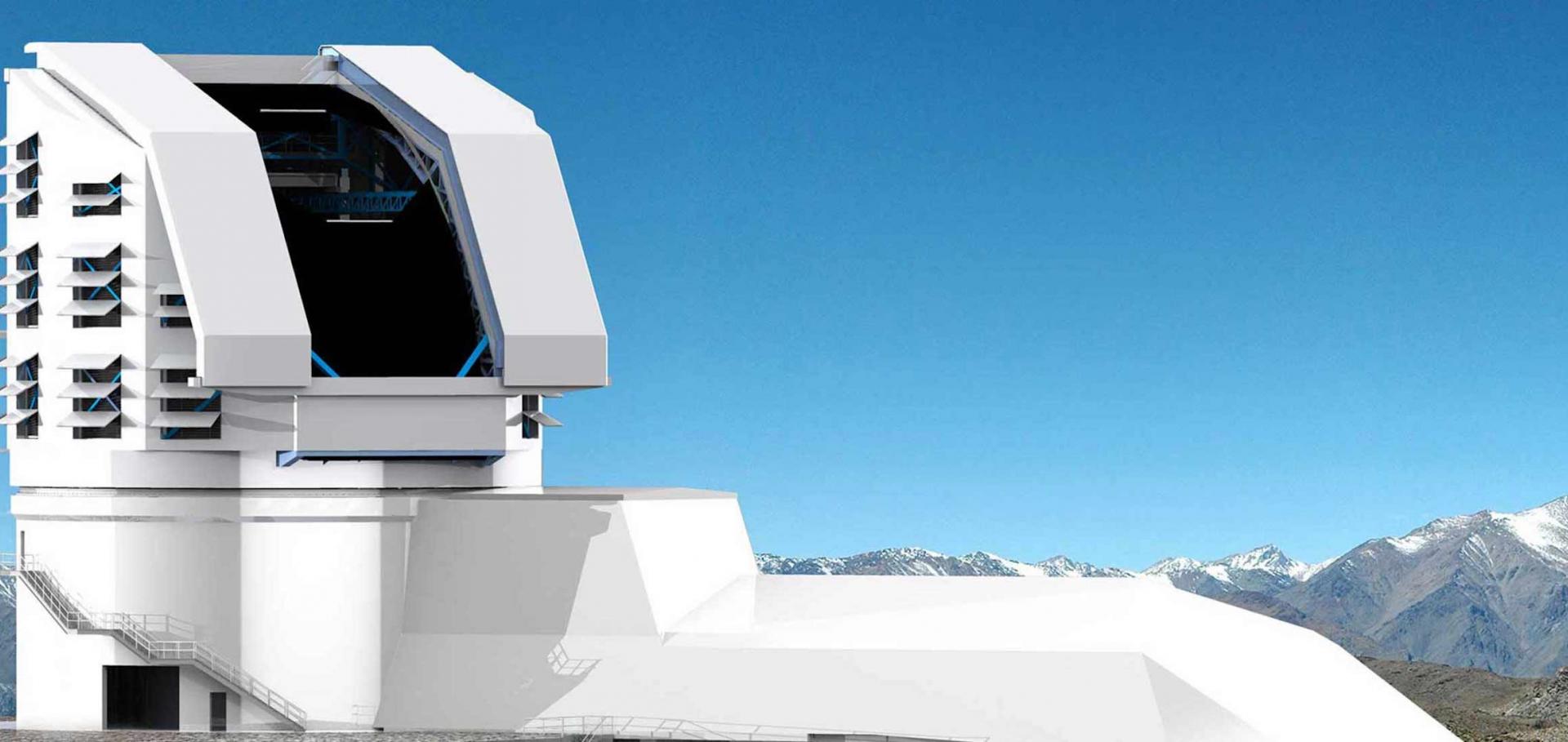
The Simons Observatory: forecasted constraints on primordial gravitational waves with the expanded array of Small Aperture Telescopes
Journal of Cosmology and Astroparticle Physics IOP Publishing 2026:04 (2026) 051
Abstract:
We present updated forecasts for the scientific performance of the degree-scale (0.5 deg FWHM at 93 GHz), deep-field survey to be conducted by the Simons Observatory (SO). By 2027, the SO Small Aperture Telescope (SAT) complement will be doubled from three to six telescopes, including a doubling of the detector count in the 93 GHz and 145 GHz channels to 48,160 detectors. Combined with a planned extension of the survey duration to 2035, this expansion will significantly enhance SO's search for a B-mode signal in the polarisation of the cosmic microwave background, a potential signature of gravitational waves produced in the very early Universe. Assuming a 1/f noise model with knee multipole ℓknee = 50 and a moderately complex model for Galactic foregrounds, we forecast a 1σ (or 68% confidence level) constraint on the tensor-to-scalar ratio r of σr = 1.2 × 10⁻³, assuming no primordial B-modes are present. This forecast assumes that 70% of the B-mode lensing signal can ultimately be removed using high resolution observations from the SO Large Aperture Telescope (LAT) and overlapping large-scale structure surveys. For more optimistic assumptions regarding foregrounds and noise, and assuming the same level of delensing, this forecast constraint improves to σr = 7 × 10⁻⁴. These forecasts represent a major improvement in SO's constraining power, being a factor of around 2.5 times better than what could be achieved with the originally planned campaign, which assumed the existing three SATs would conduct a five-year survey.The Dark Energy Survey supernova program: a reanalysis of cosmology results and evidence for evolving dark energy with an updated Type Ia supernova calibration
Monthly Notices of the Royal Astronomical Society Oxford University Press 548:4 (2026) stag632
Abstract:
We present improved cosmological constraints from a re-analysis of the Dark Energy Survey (DES) 5-year sample of Type Ia supernovae (DES-SN5YR). This re-analysis includes an improved photometric cross-calibration, recent white dwarf observations to cross-calibrate between DES and low-redshift surveys, retraining the salt3 light-curve model and fixing a numerical approximation in the host-galaxy colour law. Our fully recalibrated sample, which we call DES-Dovekie, comprises 1600 likely Type Ia SNe from DES and 200 low-redshift SNe from other surveys. With DES-Dovekie, we obtain in flat Lambda-cold dark matter (CDM) which changes by compared to DES-SN5YR. Combining DES-Dovekie with cosmic microwave background data from Planck, Atacama Cosmology Telescope, and South Pole Telescope and the DESI DR2 measurements in a flat CDM cosmology, we find and . Our results hold a significance of , reduced from for DES-SN5YR, to reject the null hypothesis that the data are compatible with the cosmological constant. This significance is equivalent to a Bayesian model preference odds of approximately 5:1 in favour of the flat CDM model. Using generally accepted thresholds for model preference, our updated data exhibits only a weak preference for evolving dark energy.AT 2024wpp: An Extremely Luminous Fast Ultraviolet Transient Powered by Accretion onto a Black Hole
Monthly Notices of the Royal Astronomical Society Oxford University Press (OUP) (2026) stag678
Abstract:
Abstract We present the discovery of AT 2024wpp (‘Whippet’), a fast and luminous 18cow-like transient. At a redshift of z = 0.0868, revealed by Keck Cosmic Web Imager spectroscopy of its faint star-forming host, it is the fourth-nearest example of its class to date. Rapid identification of the source in the Zwicky Transient Facility data stream permitted ultraviolet-through-optical observations to be obtained prior to peak, allowing the first determination of the peak bolometric luminosity (2 × 1045 erg s−1), maximum photospheric radius (1015 cm), and total radiated energy (1051 erg) of an 18cow-like object. We present results from a comprehensive multiwavelength observing campaign, including a far-UV spectrum from the Cosmic Origins Spectrograph on the Hubble Space Telescope and deep imaging extending >100 days post-explosion from the Very Large Telescope, Hubble Space Telescope, Very Large Array, and Atacama Large Millimetre Array. We interpret the observations under a model in which a rapidly-accreting central engine blows a fast (∼ 0.2 c) wind into the surrounding medium and irradiates it with X-rays. The high Doppler velocities and intense ionization within this wind prevent identifiable spectroscopic features from appearing in the ejecta or in the surrounding circumstellar material. Weak H and He signatures do emerge in the spectra after 35 days in the form of double-peaked narrow lines. Each peak is individually narrow (full width δv ∼ 3000 km s−1) but the two components are separated by Δv ∼ 6600 km s−1, indicating stable structures of denser material, possibly representing streams of tidal ejecta or an ablated companion star.An automated method for planetary nebula detection with SIGNALS: first applications to NGC 4214 and NGC 4449
Monthly Notices of the Royal Astronomical Society Oxford University Press 548:4 (2026) stag661
Abstract:
Utilizing the optical imaging Fourier transform spectrograph SITELLE, the Star-formation, Ionized Gas and Nebular Abundances Legacy Survey (SIGNALS) is designed to study the connection between star-forming regions and their environments. Targeting 31 local star-forming galaxies, its data products also lend themselves to planetary nebula (PN) surveys. We present here a new pipeline to find PNe using automated emission-line diagnostics and morphology tests, that is able to distinguish PNe from contaminants with an accuracy similar to that of past visual methods. We also perform thorough completeness tests using mock PNe inserted into the data cubes with full spectra. We apply these tools to a pilot sample of two dwarf irregular galaxies from the SIGNALS survey, NGC 4214 and NGC 4449, with other galaxies to follow. For these two galaxies, we identify 25 PNe (including six new discoveries) and 23 PNe (including 13 new discoveries), respectively, and calculate PN luminosity function distances of and Mpc, respectively, the latter consistent with previous estimates. We also calculate the bolometric PN specific frequency of our galaxies (), as well as a newly defined V-band PN specific frequency () based solely on the galaxies’ total luminosities in that band.The effects of bar strength and kinematics on galaxy evolution – II. The global and local impacts of slow-strong bars
Monthly Notices of the Royal Astronomical Society Oxford University Press 548:2 (2026) stag561