

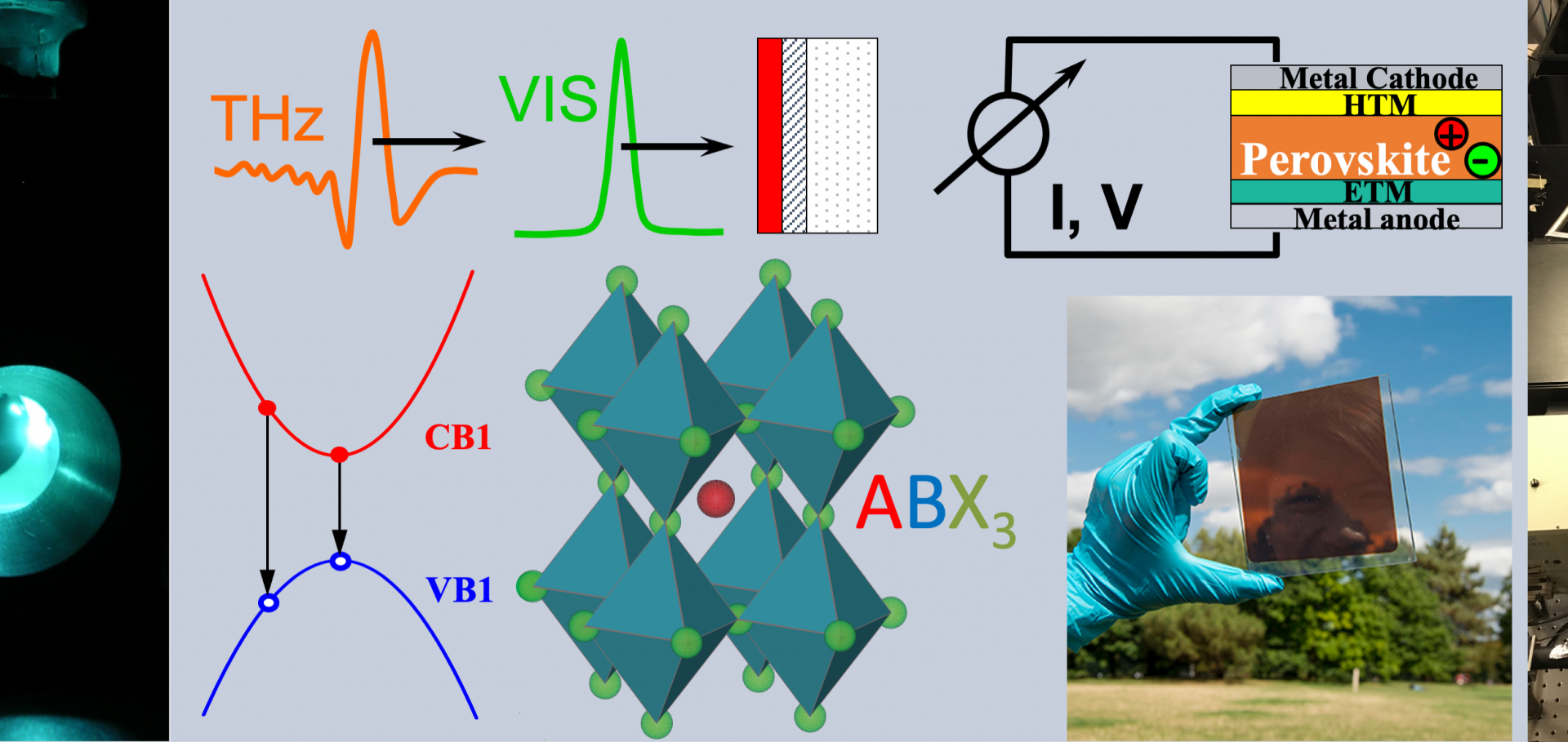
Efficient ambient-air-stable solar cells with 2D-3D heterostructured butylammonium-caesium-formamidinium lead halide perovskites
Nature Energy 2:9 (2017)
Abstract:
© 2017 Macmillan Publishers Limited, part of Springer Nature. All rights reserved. Perovskite solar cells are remarkably efficient; however, they are prone to degradation in water, oxygen and ultraviolet light. Cation engineering in 3D perovskite absorbers has led to reduced degradation. Alternatively, 2D Ruddlesden-Popper layered perovskites exhibit improved stability, but have not delivered efficient solar cells so far. Here, we introduce n-butylammonium cations into a mixed-cation lead mixed-halide FA 0.83 Cs 0.17 Pb(I y Br 1-y ) 3 3D perovskite. We observe the formation of 2D perovskite platelets, interspersed between highly orientated 3D perovskite grains, which suppress non-radiative charge recombination. We investigate the relationship between thin-film composition, crystal alignment and device performance. Solar cells with an optimal butylammonium content exhibit average stabilized power conversion efficiency of 17.5 ± 1.3% with a 1.61-eV-bandgap perovskite and 15.8 ± 0.8% with a 1.72-eV-bandgap perovskite. The stability under simulated sunlight is also enhanced. Cells sustain 80% of their post burn-in' efficiency after 1,000 h in air, and close to 4,000 h when encapsulated.Band-Tail Recombination in Hybrid Lead Iodide Perovskite
ADVANCED FUNCTIONAL MATERIALS 27:29 (2017) ARTN 1700860
Charge-Carrier Dynamics in Hybrid Metal Halide Perovskites for Photovoltaics and Light Emission
Institute of Electrical and Electronics Engineers (IEEE) (2017) 1-1
Investigations of Doping Via Optical Pump Terahertz-Probe Spectroscopy
Institute of Electrical and Electronics Engineers (IEEE) (2017) 1-1
Crystallization Kinetics and Morphology Control of Formamidinium-Cesium Mixed-Cation Lead Mixed-Halide Perovskite via Tunability of the Colloidal Precursor Solution.
Advanced materials (Deerfield Beach, Fla.) 29:29 (2017)