A New Technique to Load 130Te in Liquid Scintillator for Neutrinoless Double Beta Decay Experiments

XXVII INTERNATIONAL CONFERENCE ON NEUTRINO PHYSICS AND ASTROPHYSICS (NEUTRINO2016) 888 (2017) ARTN 012084

Authors:

Steven Biller, Szymon Manecki

Current status and future prospects of the SNO+ experiment

Advances in High Energy Physics Hindawi Publishing Corporation 2016 (2016) 6194250-6194250

Authors:

Steven D Biller, Luca A Cavalli, Jack T Dunger, Nicholas A Jelley, Christopher Jones, Peter G Jones, Jeffrey Lidgard, Krishana Majumdar, Armin Reichold, Laura Segui, Jeffrey C-L Tseng

Abstract:

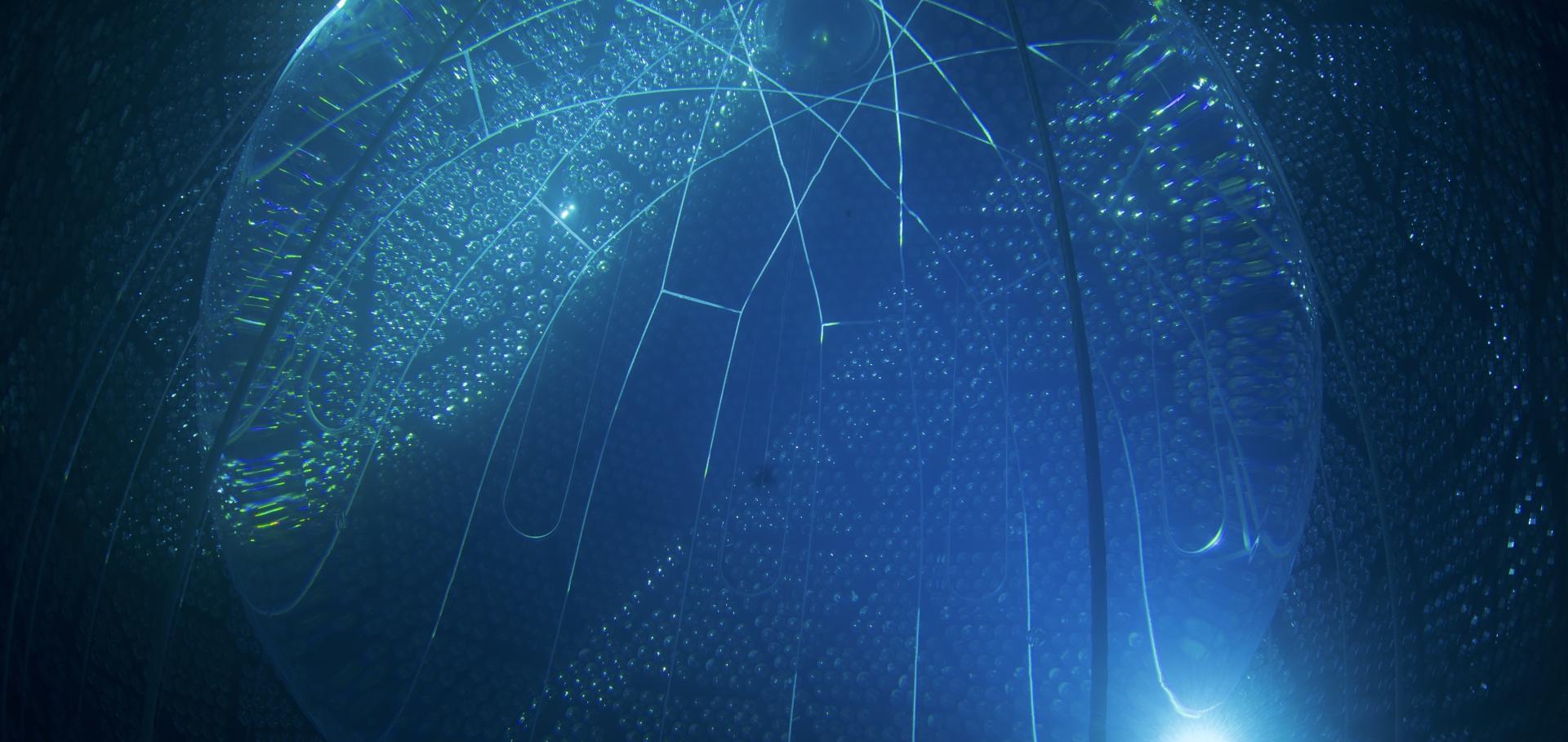
SNO+ is a large liquid scintillator-based experiment located 2km underground at SNOLAB, Sudbury, Canada. It reuses the Sudbury Neutrino Observatory detector, consisting of a 12m diameter acrylic vessel which will be filled with about 780 tonnes of ultra-pure liquid scintillator. Designed as a multipurpose neutrino experiment, the primary goal of SNO+ is a search for the neutrinoless double-beta decay (0$\nu\beta\beta$) of 130Te. In Phase I, the detector will be loaded with 0.3% natural tellurium, corresponding to nearly 800 kg of 130Te, with an expected effective Majorana neutrino mass sensitivity in the region of 55-133 meV, just above the inverted mass hierarchy. Recently, the possibility of deploying up to ten times more natural tellurium has been investigated, which would enable SNO+ to achieve sensitivity deep into the parameter space for the inverted neutrino mass hierarchy in the future. Additionally, SNO+ aims to measure reactor antineutrino oscillations, low-energy solar neutrinos, and geoneutrinos, to be sensitive to supernova neutrinos, and to search for exotic physics. A first phase with the detector filled with water will begin soon, with the scintillator phase expected to start after a few months of water data taking. The 0$\nu\beta\beta$ Phase I is foreseen for 2017.

Data-driven core-collapse supernova multilateration with first neutrino events

Physical Review D American Physical Society (APS) 113:6 (2026) 063005

Authors:

Farrukh Azfar, Jeff Tseng, Marta Colomer Molla, Kate Scholberg, Alec Habig, Segev BenZvi, Melih Kara, James Kneller, Jost Migenda, Dan Milisavljevic, Evan O’Connor

Abstract:

A Galactic core-collapse supernova (CCSN) is likely to be observed in neutrino detectors around the world minutes to hours before the electromagnetic radiation arrives. The SuperNova Early Warning System (SNEWS2.0) network of neutrino and dark matter detectors aims to use the relative arrival times of the neutrinos at the different experiments to point back to the supernova so as to facilitate follow-up observation. One of the simplest methods to estimate the CCSN direction is to use the first neutrino events detected through the inverse β decay (IBD) process, ν ¯ e p e + n . We will consider neutrino detectors sensitive to IBD interactions with low backgrounds. The difference in signal arrival times between a large and a small detector will be biased, however, with the first event at the smaller detector, on average, arriving later than that at the larger detector. This bias can be mitigated by using these first events in a data-driven approach without recourse to simulations or models. The resulting method requires, at minimum, only the times of the first events at most detectors, along with a longer time series of events from one larger detector to act as a reference lightcurve. In this article, we demonstrate this method and its uncertainty estimate using pairs of detectors of different sizes and with different supernova distances. Finally, we use this method to calculate probability skymaps using four detectors currently in operation, Super-Kamiokande, Jiangmen Underground Neutrino Observatory (JUNO), Large Volume Detector (LVD), and SNO + , and show that the calculated probabilities yield appropriate confidence intervals for all supernova directions. The area of the 68% confidence interval varies by distance and direction, but is expected to be a few thousand square degrees. The resulting skymaps should be useful for the multimessenger community as a rapid, initial pointing to follow up on the SNEWS2.0 Galactic CCSN neutrino alert.

Data-driven core collapse supernova multilateration with first neutrino events

Physical Review D: Particles, Fields, Gravitation and Cosmology American Physical Society 113 (2026) 063005

Authors:

farrukh Azfar, Jeff Tseng

Abstract:

A Galactic core-collapse supernova (CCSN) is likely to be observed in neutrino detectors around the world minutes to hours before the electromagnetic radiation arrives. The SNEWS2.0 network of neutrino and dark matter detectors aims to use the relative arrival times of the neutrinos at the different experiments to point back to the supernova so as to facilitate follow-up observation. One of the simplest methods to estimate the CCSN direction is to use the first neutrino events detected through the inverse beta decay (IBD) process, ep → e+n. We will consider neutrino detectors sensitive to IBD interactions with low backgrounds. The difference in signal arrival times between a large and a small detector will be biased, however, with the first event at the smaller detector, on average, arriving later than that at the larger detector. This bias can be mitigated by using these first events in a data-driven approach without recourse to simulations or models. The resulting method requires, at minimum, only the times of the first events at most detectors, along with a longer time series of events from one larger detector to act as a reference lightcurve. In this article, we demonstrate this method and its uncertainty estimate using pairs of detectors of different sizes and with different supernova distances. Finally, we use this method to calculate probability skymaps using four detectors currently in operation (Super-Kamiokande, JUNO, LVD, and SNO+) and show that the calculated probabilities yield appropriate confidence intervals for all supernova directions. The area of the 68\% confidence interval varies by distance and direction, but is expected to be a few thousand square degrees. The resulting skymaps should be useful for the multi-messenger community as a rapid, initial pointing to follow up on the SNEWS2.0 Galactic CCSN neutrino alert.

Cosmogenic neutron production in water at SNO+

Physical Review D American Physical Society (APS) 113:5 (2026) 052014

Authors:

M Abreu, A Allega, MR Anderson, S Andringa, DM Asner, DJ Auty, A Bacon, T Baltazar, F Barão, N Barros, R Bayes, EW Beier, A Bialek, SD Biller, E Caden, EJ Callaghan, M Chen, S Cheng, B Cleveland, D Cookman, J Corning, S DeGraw, R Dehghani, J Deloye, MM Depatie, C Dima, J Dittmer, KH Dixon, MS Esmaeilian, E Falk, N Fatemighomi, R Ford, S Gadamsetty, A Gaur, D Gooding, C Grant, J Grove, S Hall, AL Hallin, D Hallman, MR Hebert, WJ Heintzelman, RL Helmer, C Hewitt, B Hreljac, P Huang, R Hunt-Stokes, AS Inácio, CJ Jillings, S Kaluzienski, T Kaptanoglu, J Kladnik, JR Klein, LL Kormos, B Krar, C Kraus, T Kroupová, C Lake, L Lebanowski, C Lefebvre, B Liggins, V Lozza, M Luo, S Maguire, A Maio, S Manecki, J Maneira, RD Martin, N McCauley, AB McDonald, G Milton, D Morris, M Mubasher, S Naugle, LJ Nolan, HM O’Keeffe, GD Orebi Gann, S Ouyang, J Page, S Pal, K Paleshi, W Parker, LJ Pickard, RC Pitelka, B Quenallata, P Ravi, A Reichold, S Riccetto, J Rose, R Rosero, J Shen, J Simms, P Skensved, M Smiley, MI Stringer, R Tafirout, B Tam, J Tseng, E Vázquez-Jáuregui, CJ Virtue, F Wang, M Ward, JR Wilson, JD Wilson, A Wright, S Yang, Z Ye, M Yeh, S Yu, Y Zhang, K Zuber

Abstract:

Accurate measurement of the cosmogenic muon-induced neutron yield is crucial for constraining a significant background in a wide range of low-energy physics searches. Although previous underground experiments have measured this yield across various cosmogenic muon energies, SNO + is uniquely positioned due to its exposure to one of the highest average cosmogenic muon energies at 364 GeV. Using ultrapure water, we have determined a neutron yield of Y n = ( 3.3 8 0.30 + 0.23 ) × 10 4 cm 2 g 1 μ 1 at SNO + . Comparison with simulations demonstrates clear agreement with the neutron production model, highlighting discrepancies with the widely used 4 model. Furthermore, this measurement reveals a lower cosmogenic neutron yield than that observed by the SNO experiment, which used heavy water under identical muon flux conditions. This result provides new evidence that nuclear structure and target material composition significantly influence neutron production by cosmogenic muons, offering fresh insight with important implications for the design and background modeling of future underground experiments.