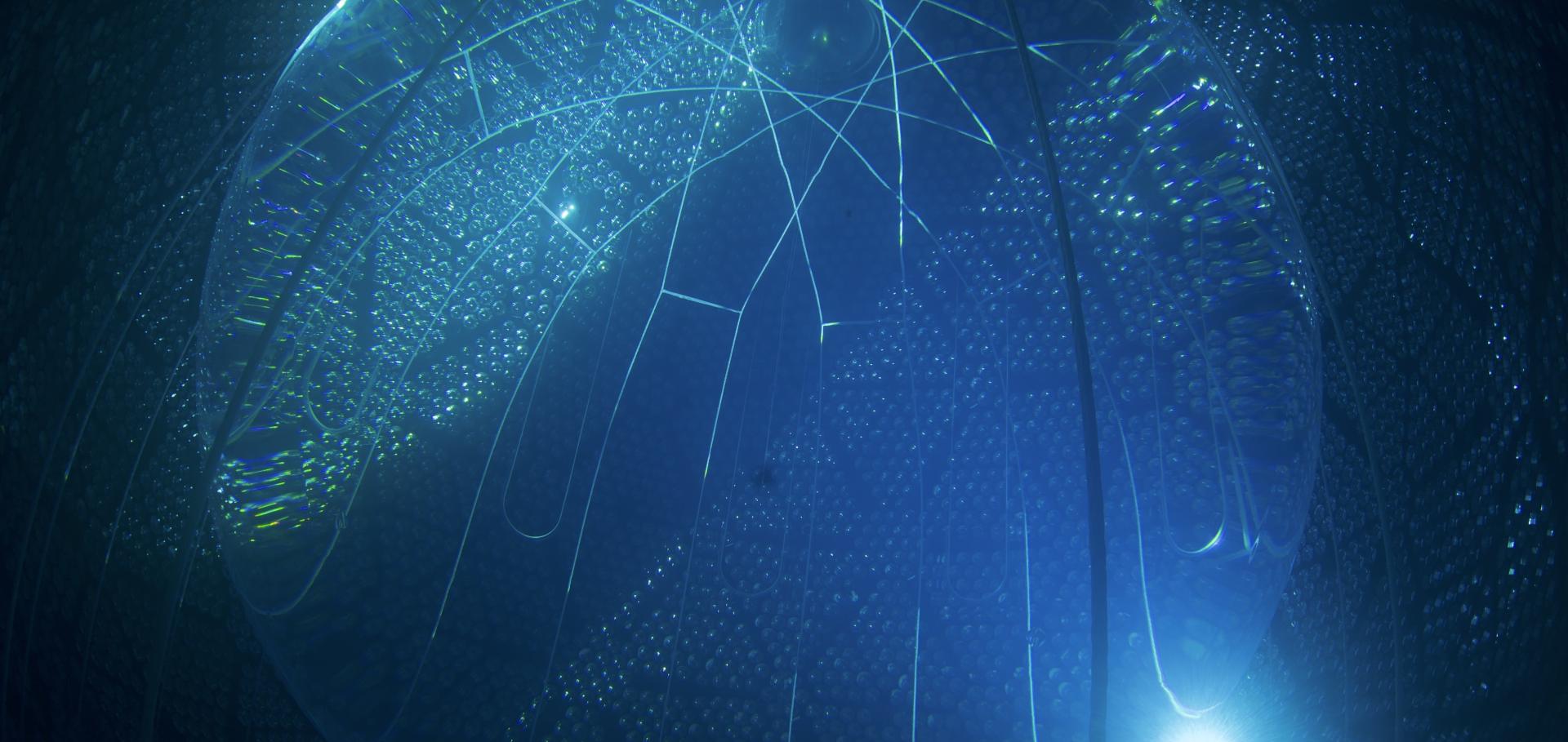
Reactor Antineutrino Oscillations and Geoneutrinos in SNO+

ArXiv 2604.05746 (2026)

Data-driven core-collapse supernova multilateration with first neutrino events

Physical Review D American Physical Society (APS) 113:6 (2026) 063005

Authors:

Farrukh Azfar, Jeff Tseng, Marta Colomer Molla, Kate Scholberg, Alec Habig, Segev BenZvi, Melih Kara, James Kneller, Jost Migenda, Dan Milisavljevic, Evan O’Connor

Abstract:

A Galactic core-collapse supernova (CCSN) is likely to be observed in neutrino detectors around the world minutes to hours before the electromagnetic radiation arrives. The SuperNova Early Warning System (SNEWS2.0) network of neutrino and dark matter detectors aims to use the relative arrival times of the neutrinos at the different experiments to point back to the supernova so as to facilitate follow-up observation. One of the simplest methods to estimate the CCSN direction is to use the first neutrino events detected through the inverse β decay (IBD) process, ν ¯ e p → e + n . We will consider neutrino detectors sensitive to IBD interactions with low backgrounds. The difference in signal arrival times between a large and a small detector will be biased, however, with the first event at the smaller detector, on average, arriving later than that at the larger detector. This bias can be mitigated by using these first events in a data-driven approach without recourse to simulations or models. The resulting method requires, at minimum, only the times of the first events at most detectors, along with a longer time series of events from one larger detector to act as a reference lightcurve. In this article, we demonstrate this method and its uncertainty estimate using pairs of detectors of different sizes and with different supernova distances. Finally, we use this method to calculate probability skymaps using four detectors currently in operation, Super-Kamiokande, Jiangmen Underground Neutrino Observatory (JUNO), Large Volume Detector (LVD), and SNO + , and show that the calculated probabilities yield appropriate confidence intervals for all supernova directions. The area of the 68% confidence interval varies by distance and direction, but is expected to be a few thousand square degrees. The resulting skymaps should be useful for the multimessenger community as a rapid, initial pointing to follow up on the SNEWS2.0 Galactic CCSN neutrino alert.

Data-driven core collapse supernova multilateration with first neutrino events

Physical Review D: Particles, Fields, Gravitation and Cosmology American Physical Society 113 (2026) 063005

Authors:

farrukh Azfar, Jeff Tseng

Abstract:

A Galactic core-collapse supernova (CCSN) is likely to be observed in neutrino detectors around the world minutes to hours before the electromagnetic radiation arrives. The SNEWS2.0 network of neutrino and dark matter detectors aims to use the relative arrival times of the neutrinos at the different experiments to point back to the supernova so as to facilitate follow-up observation. One of the simplest methods to estimate the CCSN direction is to use the first neutrino events detected through the inverse beta decay (IBD) process, v̄ep → e+n. We will consider neutrino detectors sensitive to IBD interactions with low backgrounds. The difference in signal arrival times between a large and a small detector will be biased, however, with the first event at the smaller detector, on average, arriving later than that at the larger detector. This bias can be mitigated by using these first events in a data-driven approach without recourse to simulations or models. The resulting method requires, at minimum, only the times of the first events at most detectors, along with a longer time series of events from one larger detector to act as a reference lightcurve. In this article, we demonstrate this method and its uncertainty estimate using pairs of detectors of different sizes and with different supernova distances. Finally, we use this method to calculate probability skymaps using four detectors currently in operation (Super-Kamiokande, JUNO, LVD, and SNO+) and show that the calculated probabilities yield appropriate confidence intervals for all supernova directions. The area of the 68\% confidence interval varies by distance and direction, but is expected to be a few thousand square degrees. The resulting skymaps should be useful for the multi-messenger community as a rapid, initial pointing to follow up on the SNEWS2.0 Galactic CCSN neutrino alert.

Cosmogenic neutron production in water at SNO+

Physical Review D American Physical Society (APS) 113:5 (2026) 052014

Authors:

M Abreu, A Allega, MR Anderson, S Andringa, DM Asner, DJ Auty, A Bacon, T Baltazar, F Barão, N Barros, R Bayes, EW Beier, A Bialek, SD Biller, E Caden, EJ Callaghan, M Chen, S Cheng, B Cleveland, D Cookman, J Corning, S DeGraw, R Dehghani, J Deloye, MM Depatie, C Dima, J Dittmer, KH Dixon, MS Esmaeilian, E Falk, N Fatemighomi, R Ford, S Gadamsetty, A Gaur, D Gooding, C Grant, J Grove, S Hall, AL Hallin, D Hallman, MR Hebert, WJ Heintzelman, RL Helmer, C Hewitt, B Hreljac, P Huang, R Hunt-Stokes, AS Inácio, CJ Jillings, S Kaluzienski, T Kaptanoglu, J Kladnik, JR Klein, LL Kormos, B Krar, C Kraus, T Kroupová, C Lake, L Lebanowski, C Lefebvre, B Liggins, V Lozza, M Luo, S Maguire, A Maio, S Manecki, J Maneira, RD Martin, N McCauley, AB McDonald, G Milton, D Morris, M Mubasher, S Naugle, LJ Nolan, HM O’Keeffe, GD Orebi Gann, S Ouyang, J Page, S Pal, K Paleshi, W Parker, LJ Pickard, RC Pitelka, B Quenallata, P Ravi, A Reichold, S Riccetto, J Rose, R Rosero, J Shen, J Simms, P Skensved, M Smiley, MI Stringer, R Tafirout, B Tam, J Tseng, E Vázquez-Jáuregui, CJ Virtue, F Wang, M Ward, JR Wilson, JD Wilson, A Wright, S Yang, Z Ye, M Yeh, S Yu, Y Zhang, K Zuber

Abstract:

Accurate measurement of the cosmogenic muon-induced neutron yield is crucial for constraining a significant background in a wide range of low-energy physics searches. Although previous underground experiments have measured this yield across various cosmogenic muon energies, SNO + is uniquely positioned due to its exposure to one of the highest average cosmogenic muon energies at 364 GeV. Using ultrapure water, we have determined a neutron yield of Y n = ( 3.3 8 − 0.30 + 0.23 ) × 10 − 4 cm 2 g − 1 μ − 1 at SNO + . Comparison with simulations demonstrates clear agreement with the neutron production model, highlighting discrepancies with the widely used 4 model. Furthermore, this measurement reveals a lower cosmogenic neutron yield than that observed by the SNO experiment, which used heavy water under identical muon flux conditions. This result provides new evidence that nuclear structure and target material composition significantly influence neutron production by cosmogenic muons, offering fresh insight with important implications for the design and background modeling of future underground experiments.

Sensitivity of the Hyper-Kamiokande experiment to neutrino oscillation parameters using accelerator neutrinos

The European Physical Journal C SpringerOpen 86:2 (2026) 170

Authors:

K Abe, MT Afif, R Ahl Laamara, H Aihara, A Ajmi, R Akutsu, H Alarakia-Charles, I Alekseev, Y Alj Hakim, S Alonso Monsalve, E Amato, F Ameli, L Anthony, A Araya, A Arguello Quiroga, S Arimoto, Y Asaoka, Y Ashida, V Aushev, F Ballester Merelo, M Barbi, G Barr, M Batkiewicz-Kwasniak, A Beauchêne, D Benchekroun

Abstract:

This paper presents the expected sensitivity to the neutrino oscillation parameters of the Hyper-Kamiokande long-baseline program. The Hyper-Kamiokande experiment, currently under construction in Japan, will measure the oscillations of accelerator-produced neutrinos with thousands of selected events per sample: this corresponds to an increase of statistics of a factor 25–100 with respect to recent results from the currently-running long-baseline neutrino oscillation experiment in Japan, T2K. In the most favorable scenario we will achieve the discovery of Charge-Parity (CP) violation in neutrino oscillation at 5σ$$5\sigma $$ C.L. in less than 3 years. With 10 years of data-taking, and assuming a neutrino : antineutrino beam running ratio of 1:3, a CP violation discovery at 5σ$$5\sigma $$ C.L. is possible for more than 60% of the actual values of the CP-violating phase, δCP.$$\delta _{CP}.$$ Moreover, we will measure δCP$$\delta _{CP}$$ with a precision ranging from 20∘,$$^{\circ },$$ in the case of maximal CP violation, to 6∘,$$^{\circ },$$ in the case of CP conservation. We aim to achieve a 0.5% resolution on the Δm322$$\Delta m^2_{32}$$ parameter, and a resolution between 3% and 0.5% on the sin2θ23$$\sin ^2\theta _{23}$$ parameter, depending on its true value. These results are obtained by extending the analysis methods of T2K with dedicated tuning to take into account the Hyper-Kamiokande design: the larger far detector, the more powerful beam, the upgraded near detector ND280, and the planned additional Intermediate Water Cherenkov Detector.