

A Near-surface Temperature Model of Arrokoth
Planetary Science Journal 3:5 (2022)
Abstract:
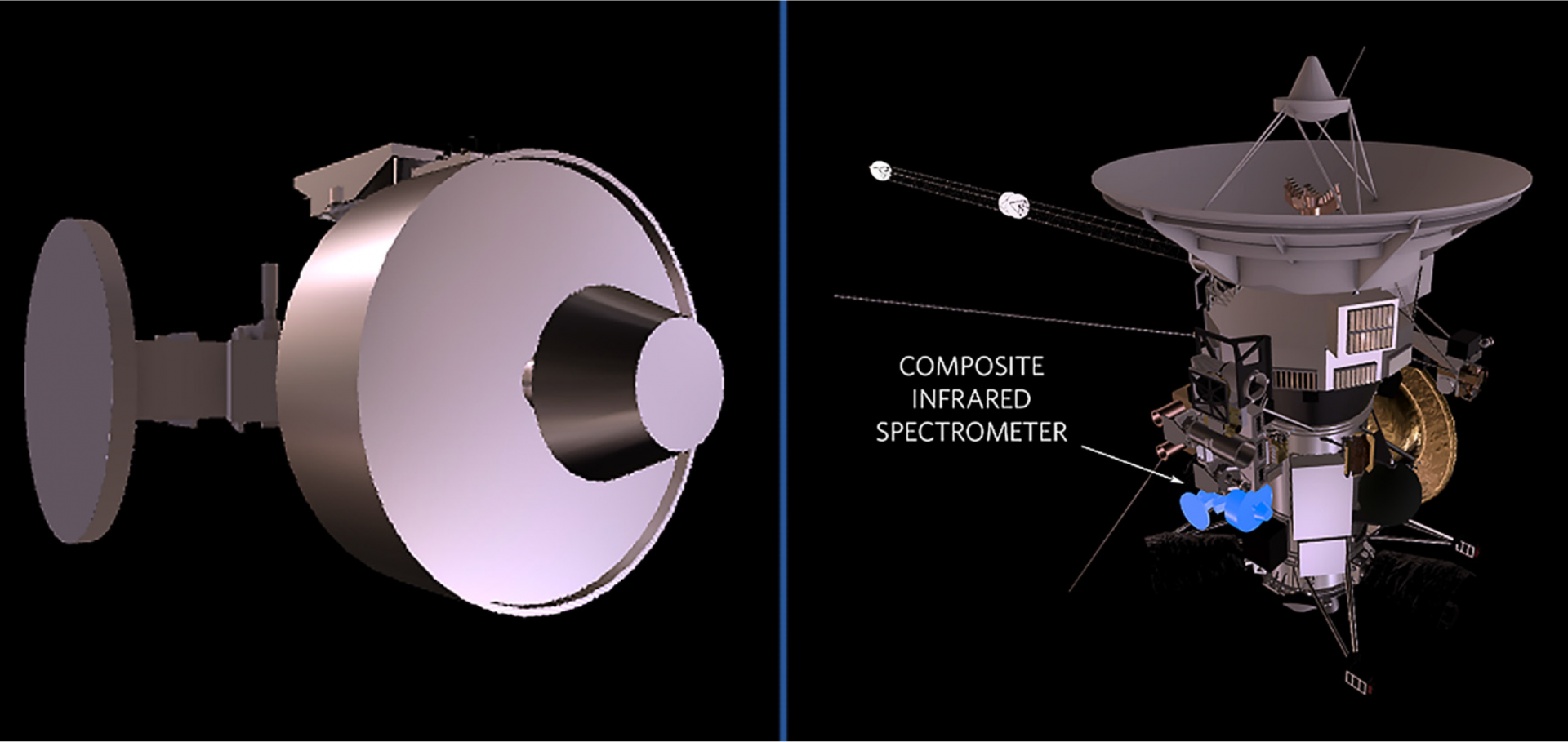
A near-surface thermal model for Arrokoth is developed based on the recently released 105 facet model of the body. This thermal solution takes into account Arrokoth's surface reradiation back onto itself. The solution method exploits Arrokoth's periodic orbital character to develop a thermal response using a time-asymptotic solution method, which involves a Fourier transform solution of the heat equation, an approach recently used by others. We display detailed thermal solutions assuming that Arrokoth's near-surface material's thermal inertia I = 2.5 W/m−2 K−1 s1/2. We predict that at New Horizons' encounter with Arrokoth, its encounter hemisphere surface temperatures were ∼57-59 K in its polar regions, 30-40 K in its equatorial zones, and 11-13 K for its winter hemisphere. Arrokoth's orbitally averaged temperatures are around 30-35 K in its polar regions and closer to 40 K near its equatorial zones. Thermal reradiation from the surrounding surface amounts to less than 5% of the total energy budget, while the total energy ensconced into and exhumed out of Arrokoth's interior via thermal conduction over one orbit is about 0.5% of the total energy budget. As a generalized application of this thermal modeling together with other Kuiper Belt object origins considerations, we favor the interpretation that New Horizons' REX instrument's 29 ± 5 K brightness temperature measurement is consistent with Arrokoth's near-surface material being made of sub-to-few-millimeter-size tholin-coated amorphous H2O ice grains with 1 W/m−2 K−1 s1/2 < I < 10-20 W/m−2 K−1 s1/2 and which are characterized by an X-band emissivity in the range 0.9 and 1.Sub-field of view surface thermal modeling of Cassini CIRS observations of Rhea during south polar winter
Icarus Elsevier 377 (2022) 114910
Extreme exospheric dynamics at Charon: Implications for the red spot
Geophysical Research Letters Wiley 49:8 (2022) e2021GL097580
Abstract:
Charon's exosphere may exhibit extreme seasonal dynamics, with centuries of quiescence punctuated by short lived (∼4 earth years) exospheric surges near the equinoxes, as spring sunrise bi-annually drives frozen methane off the polar night zones. Charon's pole-centric red spot has been proposed to be the product of Ly-α photolysis of frozen methane into refractory hydrocarbon “tholins”, but the role of exospheric dynamics in the red material's formation has not been investigated. We show with exospheric modeling that methane “polar-swap”, in which exospheric CH4 sublimated from the spring polar zone is rapidly re-frozen onto the autumn hemisphere, deposits ∼30 μm polar frosts too thick for Ly-α light to penetrate. Ethane, the primary methane photoproduct under these conditions, may unlike methane remain frozen decades after polar sunrise under solar wind exposure. Solar wind radiolysis of polar ethane frost synthesizes higher-order refractories that may contribute to the coloration of Charon's polar zones.Hypotheses for Triton's plumes: New analyses and future remote sensing tests
Icarus 375 (2022)
Abstract:
At least two active plumes were observed on Neptune's moon Triton during the Voyager 2 flyby in 1989. Models for Triton's plumes have previously been grouped into five hypotheses, two of which are primarily atmospheric phenomena and are generally considered unlikely, and three of which include eruptive processes and are plausible. These hypotheses are compared, including new arguments, such as comparisons based on current understanding of Mars, Enceladus, and Pluto. An eruption model based on a solar-powered, solid-state greenhouse effect was previously considered the leading hypothesis for Triton's plumes, in part due to the proximity of the plumes to the subsolar latitude during the Voyager 2 flyby and the distribution of Triton's fans that are putatively deposits from former plumes. The other two eruption hypotheses are powered by internal heat, not solar insolation. Based on new analyses of the ostensible relation between the latitude of the subsolar point on Triton and the geographic locations of the plumes and fans, we argue that neither the locations of the plumes nor fans are strong evidence in favor of the solar-powered hypothesis. We conclude that all three eruption hypotheses should be considered further. Five tests are presented that could be implemented with remote sensing observations from future spacecraft to confidently distinguish among the eruption hypotheses for Triton's plumes. The five tests are based on the: (1) composition and thickness of Triton's southern hemisphere terrains, (2) composition of fan deposits, (3) distribution of active plumes, (4) distribution of fans, and (5) surface temperature at the locations of plumes and/or fans. The tests are independent, but complementary, and implementable with a single flyby mission such as the Trident mission concept. We note that, in the case of the solar-driven hypothesis, the 2030s and 2040s may be the last chance for approximately a century to observe actively erupting plumes on Triton.Exploring the Clouds of Venus: Science Driven Aerobot Missions to our Sister Planet
Institute of Electrical and Electronics Engineers (IEEE) 00 (2022) 1-20